
Proactive Tax Planning for Business Owners
Last Updated: • Reviewed by Steve Madsen, CPA
Year-round tax planning for business owners, S-Corporations, and real estate investors who want to legally reduce taxes and keep more of what they earn.
“Most business owners overpay because planning happens too late. Tax preparation reports the result — tax planning determines what you pay.” — Steve Madsen, CPA
The IRS outlines how accounting methods, income timing, and deductions impact taxable income across tax years (see IRS Publication 538).
Tax planning isn’t one-size-fits-all.
What is tax planning? Tax planning involves making decisions before year-end to reduce how much you pay in taxes.
Whether you run an S-Corporation, own rental property, or operate a growing business, the right strategy depends on your situation. Start by choosing the path that fits you best.

Led by Steve Madsen, CPA
Steve Madsen has helped business owners with proactive tax planning since 1993, focusing on S-Corporation strategy, real estate tax planning, and year-round advisory guidance.
→ Learn More About Steve Madsen, CPA
Choose the Right Planning Path
Different tax strategies apply depending on your business structure, income sources, and long-term goals. Start with the planning path most relevant to your situation.
🔹 S-Corporation Tax Planning
If your business is structured as an S-Corp—or you are considering it—tax planning decisions around salary, distributions, and payroll directly impact your taxes.
The IRS requires S-Corporation owner-employees to receive reasonable compensation before significant profit distributions are taken. Improper salary structuring can create payroll tax exposure, penalties, and audit risk.
IRS guidance related to reasonable compensation includes Fact Sheet FS-2008-25 and IRS training materials focused on shareholder compensation.
The IRS requires S-Corporation owners to pay themselves “reasonable compensation,” which must reflect the value of services performed (IRS S Corporation guidance).
Start with our S Corporation Tax Planning Guide
🔹 Business Tax Planning
Business tax planning is the process of proactively managing entity structure, deductions, compensation, timing decisions, and cash flow throughout the year to legally reduce taxes before filing deadlines occur.
Unlike tax preparation, which reports past activity, tax planning focuses on decisions that directly change future tax outcomes.
Explore proactive tax planning strategies for business owners
🔹 Real Estate Tax Planning
Real estate tax planning focuses on depreciation strategy, rental classification, ownership structure, and timing decisions that directly impact how rental income and losses are taxed.
Many real estate tax strategies only work when implemented before year-end, making proactive planning substantially more valuable than after-the-fact tax filing.
Real estate tax outcomes are governed by passive activity rules and material participation standards outlined by the IRS (see IRS Publication 925).
If you own rental properties or are investing in real estate:
Start with the numbers before building a strategy.
Use these tools to understand how S-Corp decisions impact your taxes:
Estimate your reasonable salary using the S-Corp Salary Calculator
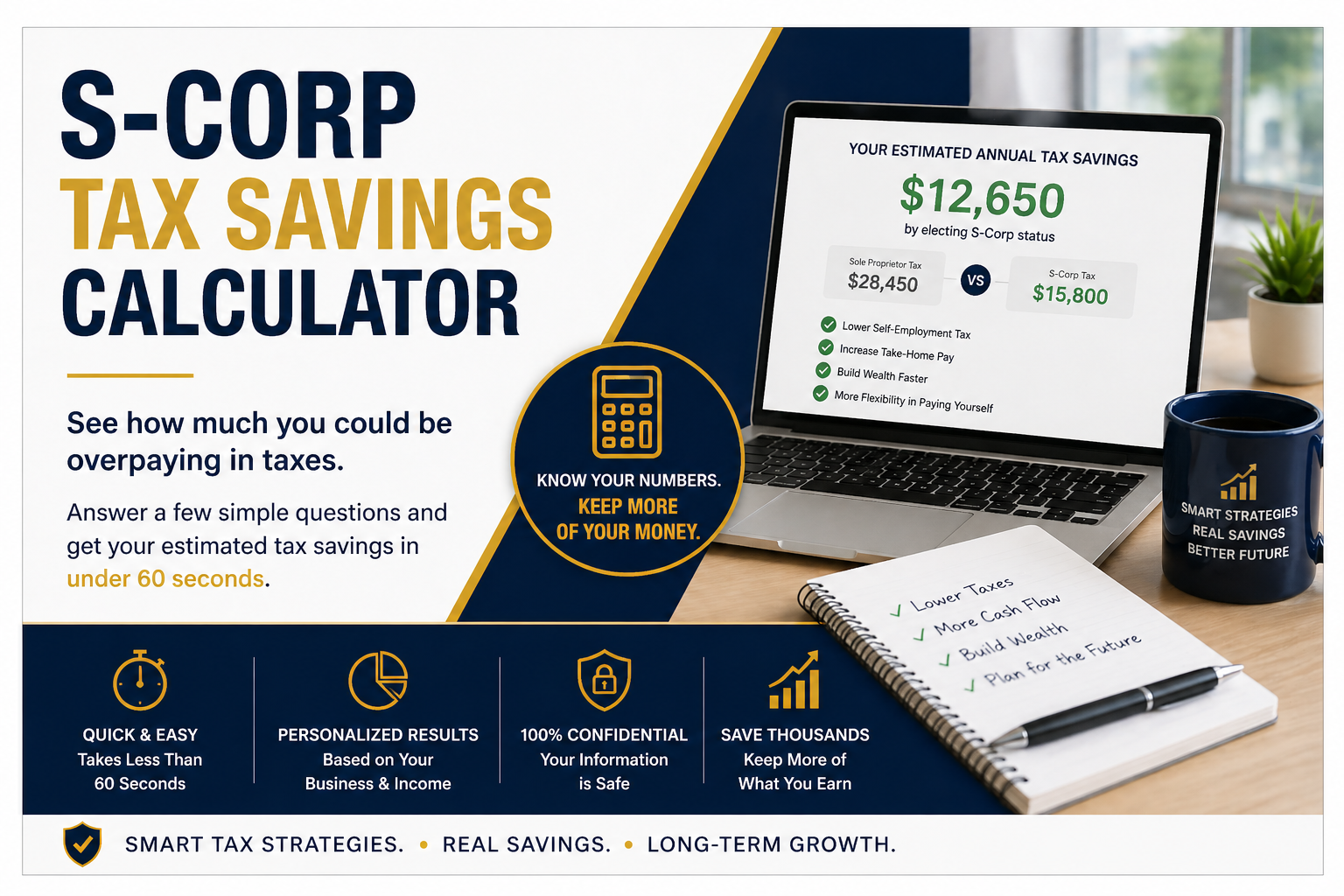
See your total tax savings using the S-Corp Tax Savings Calculator
Best Fit for This Service
This planning-first approach is typically best for:
- Business owners earning $150k+
- S-Corporation owners
- Real estate investors
- Multi-entity business owners
- Clients wanting proactive guidance throughout the year
This is generally not designed for:
- Basic W-2-only tax returns
- Lowest-cost tax preparation
- Filing-only relationships without planning needs
| Situation | Tax Planning Priority |
|---|---|
| W-2 employee with simple return | Usually lower |
| Business owner earning under ~$75k profit | Moderate |
| Business owner earning $150k+ | High |
| S-Corporation owner | High |
| Rental property owner | High |
| Multi-entity business owner | Very High |
| Short-term rental owner | Very High |
| Multi-state income | High |
Why Experience Matters in Tax Planning
Tax planning is not just about identifying deductions — it requires coordinating strategy across entities, payroll, retirement accounts, real estate activities, and year-end timing decisions.
Many clients come to Madsen and Company after realizing their prior CPA focused primarily on tax preparation rather than proactive planning.
Effective tax planning requires ongoing coordination and proactive decision-making before deadlines pass.
Many of the most valuable tax strategies depend on timing, documentation, and implementation long before a return is filed.
Learn more about Steve Madsen, CPA and the planning-first approach used at Madsen and Company.
Where We Work
Based in South Jordan, Utah — Serving Clients Nationwide
Madsen and Company is based in South Jordan, Utah, and works with business owners across the Salt Lake Valley and throughout the United States. Many of our clients are Utah-based small business owners, S-Corporation owners, and real estate investors who rely on proactive tax planning and year-round advisory support.
As a virtual-first CPA firm, we serve clients nationwide using secure technology and structured advisory meetings, allowing us to provide proactive planning regardless of location.
Why Business Owners Choose Madsen and Company
Business owners choose Madsen and Company because our advisory process focuses on proactive decisions that directly impact taxes, cash flow, and long-term business planning — not just year-end filing.
Led by Steve Madsen, licensed since 1993, the firm works primarily with business owners, S-Corporation owners, and real estate investors who need ongoing tax strategy rather than transactional compliance work.
Our approach emphasizes:
- proactive planning before deadlines pass
- practical interpretation of IRS rules
- year-round advisory support
- clear explanations without unnecessary jargon
- coordination between tax strategy and real-world business decisions
Many clients come to us after experiencing reactive CPA relationships where tax planning discussions happen only after the year has already closed.
Our mission is simple:
Smarter tax strategy. Clearer financial direction. Year‑round peace of mind.
What Clients Often Say
Proactive Planning
“We finally had a clear strategy before year-end instead of scrambling during tax season.”
Strategic Guidance
“The biggest difference was having ongoing guidance throughout the year rather than only hearing from our CPA at filing time.”
Business Owner Clarity
“The planning process helped us better understand how entity structure and timing decisions affected our taxes.”
→ See What Clients Say About Working With Madsen and Company
Understanding Tax Planning Costs
Tax planning costs vary depending on business complexity, entity structure, number of states involved, payroll coordination, and the level of ongoing advisory support required.
For many business owners, proactive planning creates substantially more value than reactive tax filing because decisions are reviewed before deadlines pass.
Common areas reviewed during tax planning may include:
- S-Corporation salary structure
- retirement contribution opportunities
- depreciation timing
- estimated tax projections
- rental property classification
- owner compensation strategy
- cash flow and distribution planning
In many cases, business owners pursue tax planning after realizing their current CPA relationship focuses primarily on filing returns instead of evaluating strategy proactively throughout the year.
If you’re evaluating whether tax planning is worth it:
Why Most Business Owners Overpay in Taxes
Most business owners overpay in taxes because tax-saving decisions are made too late.
By the time a tax return is prepared, many of the highest-impact strategies — including entity elections, retirement contributions, depreciation planning, payroll structuring, and estimated tax adjustments — are already locked in.
Tax planning focuses on decisions made before deadlines pass so business owners can legally reduce taxes and improve cash flow proactively instead of reacting after year-end.
Tax preparation tells you what already happened.
Tax planning changes what will happen.
| Tax Preparation | Tax Planning |
|---|---|
| Reports prior-year activity | Changes future tax outcomes |
| Happens after year-end | Happens during the year |
| Focuses on compliance | Focuses on strategy |
| Files required tax forms | Evaluates tax-saving opportunities |
| Primarily historical | Forward-looking |
| Often reactive | Proactive |
Many tax-saving strategies depend on elections, entity structure decisions, retirement contribution timing, depreciation rules, and estimated payment planning that must be implemented before year-end or before IRS deadlines pass.
IRS guidance covering these areas includes:
- S Corporation elections under IRC §1362
- Depreciation rules under IRC §179 and bonus depreciation rules under IRC §168(k)
- Estimated tax requirements under IRS Form 1040-ES
- Retirement contribution deadlines and deduction rules under IRS Publication 560
Business owners who want proactive guidance before year-end decisions are finalized can learn more about working with Steve Madsen, CPA.
Think You May Be Overpaying in Taxes?
Most business owners don’t need more tax forms—they need a tax strategy before year-end decisions are locked in.
CPA Insight from Steve Madsen, CPA
“One of the biggest misconceptions business owners have is believing taxes are primarily determined when the return is filed. In reality, most meaningful tax savings come from decisions made months earlier — including payroll structure, retirement planning, estimated taxes, and entity elections. Once the year closes, many opportunities are already gone.”
What Tax Planning Includes
Tax planning isn’t just one thing — it’s a coordinated strategy that can include:
- Choosing the right entity structure
- S-Corporation strategy & reasonable salary planning
- Real estate depreciation & cost segregation strategy
- Timing of income and expenses
- Retirement and HSA strategies
- Multi-state tax coordination
S Corporation strategy and real estate tax planning are two of the most impactful approaches for reducing taxes when implemented correctly. Explore S-Corp strategy or learn how short-term rental tax strategy works.
The IRS outlines how timing, income structure, and deductions affect overall tax liability (see IRS Topic No. 409 on capital gains and losses).
Additional guidance on depreciation and deduction timing is covered in IRS Publication 946, which explains how businesses recover costs through depreciation (IRS Publication 946).
The Madsen Planning-First Framework™
At Madsen and Company, tax strategy is built using a structured, planning-first approach designed to reduce taxes before year-end — not after.
Our process focuses on four core areas:
- Income Structure — How income is earned and categorized (S-Corporation, W-2, rental, etc.)
- Timing — When income and deductions are recognized
- Strategy Selection — Choosing the right tax strategies based on your situation
- Ongoing Adjustment — Monitoring and refining throughout the year
“Tax planning isn’t a one-time event — it’s a system that must be implemented and maintained to produce results.” — Steve Madsen, CPA
Work With Steve Madsen, CPA
Tax planning is not just about filing returns correctly — it requires ongoing strategy, timing decisions, and coordination throughout the year.
Steve Madsen has worked with business owners since 1993, helping clients implement proactive tax strategies involving:
- S-Corporation planning
- Real estate tax strategy
- Income timing
- Reasonable salary planning
- Cost segregation coordination
- Retirement and entity planning
Many business owners come to us after realizing their prior CPA focused primarily on filing returns instead of proactive planning.
If you want ongoing guidance before year-end decisions are finalized, the next step is to schedule a consultation.
Courts have repeatedly upheld IRS enforcement around reasonable compensation, documentation, and business-owner payroll structuring. Cases such as Watson v. United States and David E. Watson, P.C. v. United States reinforced that compensation decisions must reflect actual services performed and reasonable market compensation.
→ Meet Steve Madsen, CPA
→ Schedule a Tax Planning Consultation
Important: Tax Strategies Must Be Properly Implemented
Many tax strategies fail because implementation happens too late, documentation is incomplete, or the strategy does not properly align with the business structure.
A strategy that works well for one business owner may create problems for another depending on payroll setup, entity structure, real estate activity, or income timing.
Effective tax planning requires both strategy selection and ongoing coordination throughout the year.
Many tax strategies depend on proper documentation, entity compliance, payroll coordination, and timing requirements governed by IRS regulations and Treasury guidance.
Common examples include:
Tax Planning Strategies We Use
- S-Corp salary & distribution optimization
- Cost segregation and accelerated depreciation
- Income shifting & timing strategies
- Entity restructuring when appropriate
- Proactive tax projections
- Estimated tax planning to avoid penalties
The IRS also provides guidance on deductible business expenses and recordkeeping requirements, which directly affect how strategies are implemented (see IRS Publication 535).
Common Tax Planning Mistakes Business Owners Make
Many business owners lose tax-saving opportunities because planning decisions happen too late or strategies are never properly coordinated.
Common issues include:
- waiting until tax season to discuss strategy
- running an S-Corporation without reasonable salary analysis
- missing retirement contribution opportunities
- failing to track material participation for rentals
- poor estimated tax planning
- taking distributions without payroll coordination
- implementing strategies without documentation
In many cases, the issue is not lack of deductions — it is lack of proactive planning before deadlines pass.
How Much Can Tax Planning Actually Save?
The impact of tax planning depends on income, structure, and strategy timing — but for many business owners, the difference can be significant when planning is done proactively.
The value of tax planning is often less about one individual deduction and more about coordinating multiple decisions together throughout the year.
“After working through a structured tax plan, I went from expecting a large tax bill to having a clear strategy that reduced what I owed.”— Client, Google Review
“For many S-Corporation owners, proper planning can reduce taxes by thousands to tens of thousands annually — but only if decisions are made before year-end.” — Steve Madsen, CPA
How Our Tax Planning Process Works
Step 1: Initial Tax Analysis
We review prior tax returns, entity structure, payroll setup, projected income, real estate activity, and current tax strategy to identify planning opportunities and potential problem areas.
Step 2: Strategy Development
After reviewing the numbers, we identify strategies that may improve tax efficiency based on your business structure, income sources, and long-term goals.
Step 3: Implementation & Coordination
Tax strategies only work when implemented properly. This stage may involve payroll adjustments, entity elections, retirement coordination, depreciation planning, or estimated tax updates.
Step 4: Ongoing Monitoring & Adjustments
Tax planning is not static. As income, business activity, or tax laws change throughout the year, strategies may need adjustment to remain effective.
Frequently Asked Questions About Business Tax Planning
Schedule a Consultation to Discuss Your Tax Situation
Most new clients start with a consultation to review their situation and identify planning opportunities before deciding whether to move forward with tax planning or advisory services.