

How Much Does Tax Planning Cost? (2026 Guide for Business Owners)
Tax planning costs vary—but for business owners with consistent income, the right strategy often produces significantly more savings than it costs.
Quick Answer
Tax planning costs vary based on complexity, but for most business owners, structured tax planning typically ranges from $750 to $5,000+ per year.
The real question is not the cost.
It’s whether the strategy produces more tax savings and clarity than it costs.
For business owners using an S-Corporation, tax planning plays a critical role in reducing overall tax liability.
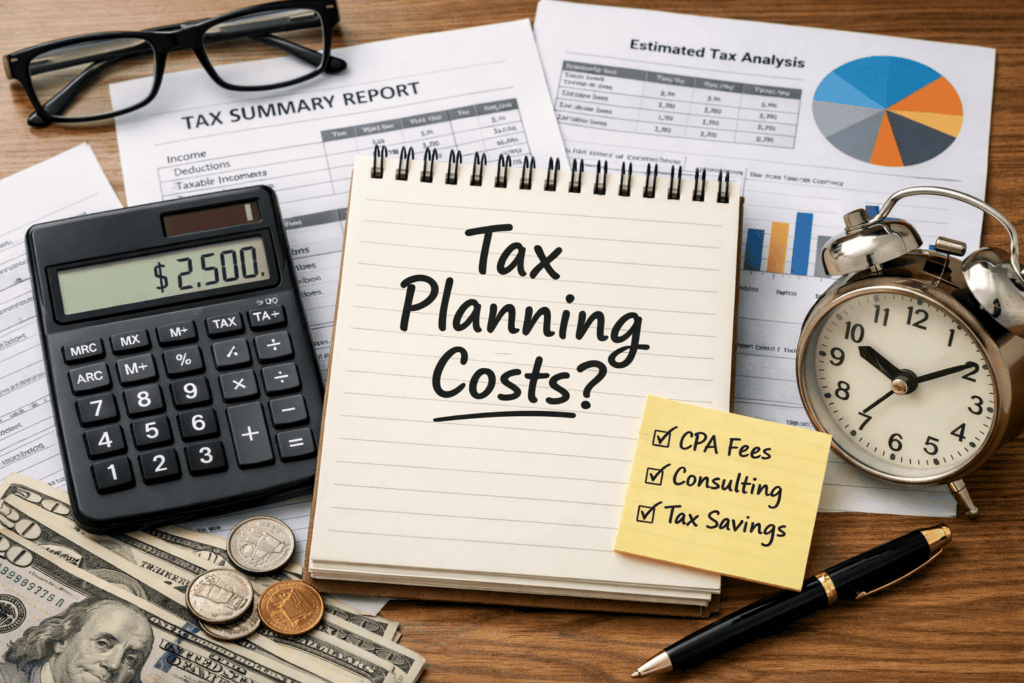
What Most Business Owners Get Wrong About Tax Planning
Many business owners assume tax planning is:
- A one-time meeting
- A quick review before filing
- Something done during tax season
That’s not tax planning.
That’s reaction.
Real tax planning happens before decisions are made, not after the year is over.
What You’re Actually Paying For
Tax planning is not just advice—it’s structured analysis and strategy.
A proper tax planning engagement typically includes:
- Review of prior tax returns
- Analysis of current income and business structure
- Identification of tax-saving opportunities
- Salary and distribution planning (for S-Corps)
- Timing strategies for income and deductions
- Ongoing advisory support
This is where the value is created.
Typical Tax Planning Fee Ranges
Basic Review ($750 – $1,500)
- One-time review
- Limited strategy
- Minimal follow-up
Best for simple situations
Structured Tax Planning ($1,500 – $3,500)
- Full analysis of your tax situation
- Clear strategy recommendations
- Actionable next steps
Most business owners fall into this range
Ongoing Tax Planning & Advisory ($3,500 – $10,000+)
- Year-round strategy
- Ongoing adjustments
- Integration with business decisions
Best for higher-income or growing businesses
Why Cheap Tax Planning Often Fails
Lower-cost tax planning typically:
- Focuses on surface-level advice
- Misses key opportunities
- Lacks follow-through
The result:
You save little—or nothing
Or worse, you implement something incorrectly
What Good Tax Planning Should Produce
Effective tax planning should:
- Reduce your overall tax liability
- Improve cash flow
- Provide clarity before major decisions
- Eliminate surprises at tax time
If it doesn’t do those things, it’s not working.
Example: When Tax Planning Pays for Itself
A business owner earning $180,000 may:
- Elect S-Corporation status
- Adjust salary and distributions
- Implement timing strategies
Result:
$10,000+ in potential tax savings
That’s why the focus should be on return on strategy, not just cost.
When Tax Planning Is Worth It
Tax planning typically makes sense when:
- You have consistent business profit
- Your income is increasing
- You are making structural decisions
- You want to reduce taxes legally
When Tax Planning Is NOT a Fit
Tax planning is likely not a fit if:
- You are looking for the cheapest option
- You only want a tax return filed
- Your income is low or inconsistent
- You are not ready to implement strategy
How We Approach Tax Planning
At Madsen and Company, tax planning begins with a structured review.
This allows us to:
- Identify missed opportunities
- Evaluate your current structure
- Build a clear, actionable strategy
From there, we outline next steps and ongoing support options.
Key Takeaways
- Tax planning is an investment, not a cost
- The value comes from strategy—not just advice
- Most tax savings happen before decisions are finalized
- Cheap planning often leads to missed opportunities
- The right plan should produce measurable results
Many business owners identify meaningful tax savings during their first planning review.
Call to Action
If you’re trying to determine whether tax planning is worth it for your situation, the next step is a structured review.
We’ll help you understand:
- Where you stand today
- What opportunities exist
- Whether planning makes sense for you