
S-Corp Tax Savings Calculator (2026 Guide for Business Owners)
Reviewed by Steve Madsen, CPA
Licensed CPA since 1993 • Tax Planning for S-Corporation Owners Nationwide
Quick Answer
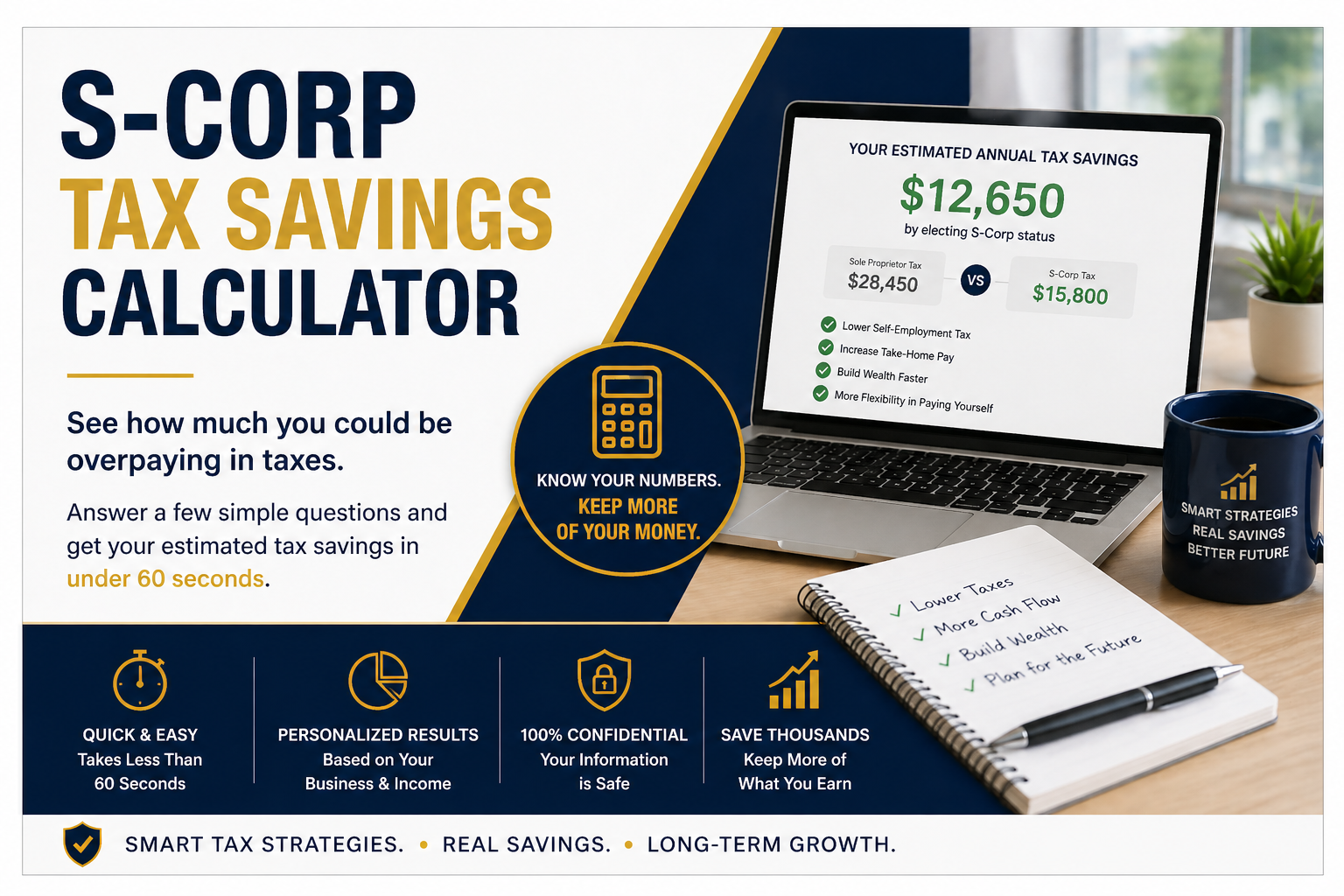
This S-Corp tax savings calculator estimates potential payroll tax savings by comparing business profit, reasonable salary, and the portion of income that may be treated as distributions instead of wages. It is designed to help business owners evaluate whether an S-Corporation structure may be worth reviewing further.
The estimate is not a final tax projection. Actual savings depend on reasonable compensation, payroll setup, retirement planning, bookkeeping accuracy, state taxes, and whether the S-Corp election is implemented correctly.
Most business owners begin seeing meaningful savings once profit exceeds $75,000 to $100,000—but the actual outcome depends on how salary and distributions are structured.
If your income is already in this range, it may be worth reviewing whether your current compensation structure is creating unnecessary payroll tax exposure.

Key Benefits of the S-Corp Tax Savings Calculator
This calculator helps business owners estimate whether an S-Corporation structure may create meaningful payroll tax savings before making an election or changing compensation.
A tax savings estimate may help you:
- Compare potential S-Corp savings against payroll and compliance costs
- Evaluate whether your profit level may justify S-Corp planning
- Understand how salary and distributions affect tax savings
- Identify whether reasonable compensation needs review
- Avoid relying on inflated savings estimates that ignore IRS rules
- Decide whether to schedule a more detailed S-Corp tax planning review
Led by Steve Madsen, CPA
Steve Madsen has advised S-Corporation owners since 1993, helping business owners evaluate reasonable salary, payroll structure, distributions, and proactive tax planning before year-end decisions become fixed.
→ Learn More About Steve Madsen, CPA
Madsen and Company provides proactive tax planning for business owners nationwide, with a focus on S-Corporation strategy, reasonable compensation planning, and year-round tax coordination.
Direct Answer: How Does an S-Corp Reduce Taxes?
An S-Corp may reduce taxes by allowing part of business profit to be treated as distributions instead of self-employment income. Business owners generally still pay payroll taxes on reasonable salary, but distributions may avoid self-employment tax when structured correctly.
The amount saved depends on profit level, salary structure, payroll compliance, retirement planning, and overall tax strategy.
CPA Insight
“The goal is not simply to maximize estimated tax savings — it’s to create a compensation structure that remains both tax-efficient and defensible under IRS rules.”
This calculator is designed primarily for active business owners, LLC owners considering an S-Corp election, and existing S-Corporation owners reviewing compensation strategy. It is especially useful for service-based businesses with consistent profit and owner involvement in daily operations.
S-Corp Tax Savings Calculator
Estimate your potential tax savings from electing S-Corporation status. Drag the sliders and your number updates the moment you move.

30+ years of CPA tax experience. The goal here is not just a payroll tax number. It is determining whether an S-Corp strategy actually makes sense for your specific situation.
A reasonable salary is based on your role, industry, experience, hours worked, and the value of the services you provide, not simply a fixed percentage of profit. This slider is an estimate only; Steve sets the defensible figure for your situation.
See the breakdown +
| Business net profit | $0 |
| Reasonable salary (payroll) | $0 |
| Distributions (no self-employment tax) | $0 |
| Self-employment tax as a sole proprietor | $0 |
| Payroll tax as an S-Corp | $0 |
| Estimated S-Corp costs (payroll + filing) | $0 |
In your S-Corp strategy review, we confirm whether the election actually improves your overall tax position, not just your payroll tax.
This calculator provides a general estimate for educational purposes only and is not tax, legal, or accounting advice. Actual savings depend on your specific facts, state taxes, the Social Security wage base, and a genuinely reasonable salary determination. No specific outcome is guaranteed. Consult Madsen & Company before acting.
How to interpret your results
Your estimated S-Corp tax savings should be interpreted as a planning signal, not a final decision. Higher estimated savings may indicate that an S-Corp review is worthwhile, but the result still needs to be tested against reasonable salary rules, payroll costs, bookkeeping requirements, and administrative complexity.
This calculator provides an estimate—not a final answer.
| Estimated Annual Savings | What It May Indicate | Recommended Next Step |
|---|---|---|
| Above $5,000 | S-Corp planning may provide meaningful tax savings if salary is defensible. | Review reasonable compensation, payroll setup, and election timing. |
| $2,000–$5,000 | Savings may exist, but implementation costs and payroll complexity matter. | Compare projected savings against payroll, tax prep, and advisory costs. |
| Under $2,000 | The benefit may not justify the added complexity yet. | Revisit when profit becomes more consistent or increases. |
The difference between saving money and overpaying taxes comes down to how the strategy is implemented—not just the numbers.
If your estimated savings are above $5,000, delaying action often means continuing to overpay payroll taxes throughout the year.
Example:
A business earning $120,000 may save $8,000 to $15,000 annually depending on how salary and distributions are structured.
If you’re seeing potential savings, the next question is whether an S Corporation actually makes sense for your situation.
When Does an S-Corp Make Sense
Payroll tax savings estimates should always be balanced against IRS reasonable compensation requirements. Compensation levels that appear artificially low can increase audit exposure and payroll scrutiny.
Our S-Corp Reasonable Salary Guide explains the factors commonly used to evaluate reasonable compensation.
What This S-Corp Tax Savings Calculator Actually Estimates
This calculator estimates potential payroll tax savings by comparing self-employment tax exposure to a projected S-Corporation compensation structure.
This calculator should be used alongside IRS reasonable compensation rules. The IRS states that shareholder-employees of S corporations must receive reasonable compensation for services performed before non-wage distributions are taken. That means S-Corp tax savings are not created simply by lowering salary — they depend on using a salary that is both tax-efficient and defensible.
IRS Reference: S Corporation Compensation and Medical Insurance Issues
| Included in the Estimate | Not Fully Included |
|---|---|
| Business profit | State-specific tax treatment |
| Estimated reasonable salary | Payroll provider costs |
| Estimated payroll tax savings | Retirement plan contribution impact |
| Salary vs. distribution structure | Bookkeeping cleanup or compliance issues |
| Basic S-Corp savings estimate | Full household tax projection |
The estimate is based on:
- projected business profit
- estimated reasonable salary
- payroll tax assumptions
- owner compensation structure
Actual tax outcomes depend on:
- reasonable compensation requirements
- retirement contributions
- state taxes
- business deductions
- entity structure
- overall household income
This calculator is designed as a planning tool — not a substitute for CPA advice or formal tax projections.
This Calculator Is Most Useful For
- Business owners earning consistent profits
- LLC owners evaluating an S-Corp election
- Existing S-Corp owners reviewing compensation
- Service-based businesses
- Owners wanting proactive tax planning before year-end
This calculator is generally less useful for:
- early-stage businesses with inconsistent profits
- passive investors
- owners unwilling to run payroll properly
- businesses seeking only basic tax filing
When an S-Corp May Not Be the Right Fit
An S-Corp structure is not always beneficial. Businesses with inconsistent income, very low profit, passive investment activity, or owners unwilling to maintain payroll compliance may not benefit enough to justify the added complexity.
In some situations, remaining a sole proprietorship or LLC taxed as a disregarded entity may produce a simpler and more efficient outcome.
What determines your actual S-Corporation tax savings
Actual S-Corporation tax savings are mainly determined by the difference between total business profit and reasonable W-2 salary. The larger the defensible distribution amount, the greater the potential payroll tax savings — but setting salary too low can create IRS risk.
The IRS has warned that S corporation officers are employees for federal employment tax purposes and should not avoid payroll taxes by improperly classifying compensation as distributions or other non-wage payments.
IRS Reference: IRS Fact Sheet FS-2008-25
Three Factors Determine Actual Savings
- Your total business profit
- Your reasonable salary
- How consistently the structure is maintained
For most business owners, salary is the single biggest factor. A poorly set salary can eliminate savings or create IRS risk.
| Factor | Why It Matters | Risk If Ignored |
|---|---|---|
| Consistent profit | Savings are more reliable when income is predictable. | The S-Corp may create complexity without meaningful benefit. |
| Reasonable salary | Salary controls both tax savings and IRS defensibility. | Low salary may trigger payroll tax scrutiny. |
| Payroll setup | Shareholder-employees generally require proper payroll reporting. | Late or missing payroll can weaken the strategy. |
| Election timing | The S-Corp election must apply to the correct tax year. | Savings may be delayed or require late election relief. |
| Ongoing planning | Salary and distributions should be adjusted as profit changes. | Savings may disappear or create compliance issues. |
CPA Insight — Steve Madsen, CPA
“Most S-Corp tax savings problems are caused by salary mistakes. Business owners often focus only on maximizing savings, but the real objective is creating a compensation structure that remains consistent, supportable, and sustainable as the business grows.”
When the S-Corp Election Timing Matters
An S-Corp tax savings estimate is only useful if the election can be made for the correct tax year. Form 2553 is the IRS form used by qualifying corporations and LLCs to elect S-Corporation tax treatment.
For many calendar-year businesses, the election generally must be filed early in the year for that year’s treatment to apply. If the deadline has already passed, late election relief may still be available in some situations, but the rules should be reviewed carefully before relying on projected savings.
IRS Reference: About Form 2553
What Should You Do Next?
Your estimate is only useful if it leads to the right decision.
Now that you’ve seen your estimated savings, the next step depends on your situation:
• Not sure if an S-Corp is right for you → When Does an S-Corp Make Sense
• Want to optimize your salary → S-Corp Salary Calculator
• Ready to reduce your tax bill → Schedule a Tax Planning Consultation
Each step helps you move forward based on your numbers.
How to Turn These Numbers Into Real Tax Savings
The calculator shows potential savings, but real savings come from implementation. To capture the benefit, the business must establish a defensible salary, run payroll correctly, track distributions properly, and revisit the strategy as profit changes.
The most important factor is salary planning. A salary that is too high may eliminate most of the projected savings. A salary that is too low may create IRS risk. The goal is not the lowest salary possible — it is a compensation structure that supports both tax savings and compliance.
To get this right:
• Set your salary correctly (this is where most savings are lost or created)
• Structure your distributions properly
• Adjust your strategy as your income changes
This is where most business owners either capture the savings—or miss them entirely.
Why S-Corporation Tax Strategies Often Fail
S-Corporation tax strategies usually fail because the election is treated as a one-time filing decision instead of an ongoing payroll and planning structure. The tax savings depend on salary, payroll timing, distributions, bookkeeping accuracy, and year-round coordination.
Some of the most common problems include:
- Salary set too low without documentation
- Payroll started too late
- Retirement contributions not coordinated with wages
- Distributions taken inconsistently
- Owners electing S-Corp status before profits justify the complexity
- Tax savings estimated without considering payroll compliance
In many cases, the issue is not the S-Corporation itself — it is poor implementation and lack of ongoing planning.
Think Your S-Corp Could Be Saving More in Taxes?
Estimated savings only matter if the salary, payroll, distributions, and tax strategy are implemented correctly.
Schedule a tax planning consultation with Steve Madsen, CPA to review whether an S-Corporation structure makes sense and whether your compensation strategy is properly coordinated.
CPA Insight — Steve Madsen, CPA
Most S-Corp tax savings opportunities are missed—not because the strategy is complicated, but because it is not implemented correctly.
The biggest mistakes include:
- Setting salary too high (eliminates savings)
- Setting salary too low (creates IRS risk)
- Treating S-Corp as a one-time decision
Tax savings come from ongoing planning—not just making the election.
We work with business owners across the United States, including California, Texas, Florida, and New York, helping them reduce taxes through proactive S-Corp planning.
Madsen and Company is based in South Jordan, Utah and serves clients nationwide through a virtual-first model.
How the Madsen Planning-First Framework™ Applies to S-Corp Tax Savings
S-Corporation tax savings depend on coordinating salary, payroll, distributions, retirement planning, and tax projections throughout the year — not after the return is prepared.
Our planning-first framework focuses on:
- Reasonable compensation
- Payroll coordination
- Distribution planning
- Timing decisions
- Ongoing adjustments as profits change
This helps business owners evaluate whether S-Corporation status creates meaningful long-term tax benefit instead of simply chasing estimated savings.
Important: Calculator Results Are Estimates
An S-Corporation calculator can estimate potential savings, but it cannot determine whether an S-Corp is appropriate without reviewing payroll requirements, business structure, retirement planning, bookkeeping processes, and overall tax strategy.
Many online calculators overstate tax savings by ignoring:
- reasonable salary requirements
- payroll costs
- administrative complexity
- retirement contribution interaction
- state tax implications
The real value of S-Corporation planning comes from implementation and ongoing coordination — not just projected savings.
Common Misunderstanding About S-Corp Tax Savings
Many business owners assume an S-Corp automatically reduces taxes. In reality, tax savings usually come from properly balancing reasonable salary and owner distributions while maintaining payroll compliance.
An improperly structured S-Corp can reduce or eliminate projected savings and may increase IRS scrutiny if salary is not supportable.
Review Whether Your S-Corp Structure Makes Sense
If your results show potential savings, the next step is making sure your S-Corp is structured correctly.
We help business owners:
• Confirm whether an S-Corp actually makes sense
• Set a defensible reasonable salary
• Identify missed tax-saving opportunities
• Build a proactive strategy for the year ahead
If your numbers show potential savings, the opportunity is not whether to act—it’s whether to implement the strategy correctly.
Schedule a Tax Planning Consultation to turn these estimates into a real plan.