

Missed the S-Corp Deadline? What You Can Still Do (2026 Guide)
Quick Answer
If you missed the S Corporation election deadline, it may not be too late.
Many business owners can still make a late S-Corp election and have it treated as if it were filed on time.
However, the rules are specific, and acting incorrectly can delay or prevent approval. The key is determining whether you qualify and submitting the election correctly.
If you are unsure whether S Corporation status is right for your business, start with LLC vs S Corporation before moving forward.
If you want to understand how all of these pieces fit together, start with our complete S Corporation tax planning guide.
S Corporation tax planning guide
Did Missing the Deadline Cost You Money?
If your business profit is above $75,000, missing an S-Corp election can result in significantly higher self-employment taxes.
In many cases, this results in thousands of dollars in unnecessary self-employment taxes.
Use the S-Corp Tax Savings Calculator to estimate how much this may have cost you in under 60 seconds.
Then use the S-Corp Salary Calculator to see how your income should be structured going forward.
The Key Issue
The S Corporation election deadline is typically:
- March 15 for existing businesses
- Or within 2 months and 15 days after the start of your tax year
Missing this deadline creates a problem:
Your business may be taxed as a sole proprietor or partnership for the entire year
That can significantly increase self-employment tax if the issue is not corrected.
That can result in:
- higher self-employment taxes
- missed tax planning opportunities
- unexpected tax liability
What Most Business Owners Don’t Realize
Missing the deadline does not always mean you lost the opportunity.
The IRS allows late S Corporation elections under specific conditions.
Many business owners still qualify, but they either do not realize it, file incorrectly, or wait too long to act.
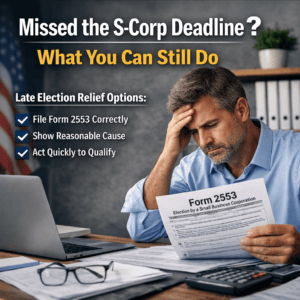
Late S-Corp Election Relief (What You Can Still Do)
In many cases, you may still qualify for late election relief if:
- You intended to be treated as an S Corporation
- You operated as if the election was in place
- You have reasonable cause for missing the deadline
- You file the election correctly with the required explanation
This is commonly done using Form 2553 with late election relief language.
When Late Election Relief Works
You are more likely to qualify if:
- Your business is already operating like an S-Corp
- You have consistent income and payroll intent
- The delay was due to misunderstanding or oversight
- You act promptly once the issue is discovered
When It May NOT Work
Late election relief may be denied if:
- No reasonable cause is provided
- The business did not operate like an S-Corp
- The delay is excessive without explanation
- The filing is incomplete or incorrect
The Most Common Mistake
The biggest mistake is:
Assuming the deadline is final and doing nothing
The second biggest mistake:
Filing a late election incorrectly
This often leads to:
- rejection by the IRS
- delays in approval
- incorrect tax treatment for the year
Not Sure If You Should Fix This Now?
Many business owners either assume it’s too late—or file incorrectly and create a bigger problem.
Schedule a Tax Planning Consultation to determine if you qualify and how to fix this correctly.
Example: What This Can Cost
A business owner earning $120,000:
- Without S-Corp election → full self-employment tax
- With S-Corp election → potential tax savings through distributions
Missing the election without correcting it can cost thousands in unnecessary taxes.
What You Should Do Next
If you missed the S-Corp deadline, start with the step that fits your situation:
• Not sure how much this may have cost you → S-Corp Tax Savings Calculator
• Not sure if you qualify for late election relief → Schedule a Tax Planning Consultation
• Want to understand how S-Corp works before fixing it → S Corporation tax planning guide
Acting quickly improves your chances of approval and reduces potential tax impact.
How This Connects to Your Overall Strategy
Electing S Corporation status is only one part of the decision.
Once approved, the real impact comes from:
- how you pay yourself
- how your salary is structured
- how distributions are handled
See How to Pay Yourself from an S Corporation to understand how salary and distributions affect the value of the election.
CPA Insight
At Madsen and Company, we help business owners correct missed S Corporation elections and structure them properly going forward.
Most clients come to us after either assuming it was too late or filing incorrectly and creating a bigger problem.
Late election relief is often available, but it must be handled correctly to avoid delays, rejection, or the wrong tax treatment for the year.
What This Means for You
If you missed the S-Corp deadline and have not reviewed your options:
there is a high likelihood you still have an opportunity to fix it
But:
- the longer you wait
- the more complex the situation becomes
This is one of the few tax decisions where timing and execution both matter immediately.
If you need help correcting this properly, see our S Corporation Tax Planning services.
Fix Your S-Corp Election Before It Costs You More
If your election was missed or filed incorrectly, there is still a strong chance it can be corrected—but timing and execution matter.
We help business owners:
- Determine if they qualify for late election relief
- File Form 2553 correctly with required documentation
- Identify missed tax-saving opportunities
- Build a proactive tax strategy going forward—before the year is locked in.
Fix this before your next deadline.