

S-Corporation Tax Planning for Business Owners
Many business owners come to us after realizing their prior CPA focused primarily on filing returns rather than proactively managing salary, payroll, distributions, and year-end planning decisions.
Effective S-Corporation planning requires ongoing coordination throughout the year — not last-minute adjustments after payroll and compensation decisions are already finalized.
“Most S-Corporation tax savings don’t come from the election — they come from how compensation is structured throughout the year.” — Steve Madsen, CPA
At Madsen and Company, we help S-Corporation owners make proactive decisions throughout the year — not after the return is already filed — so your strategy works in your favor instead of against you.
Quick Answer
What is an S Corporation? An S Corporation is a tax election that allows business owners to split income between salary and distributions to reduce self-employment taxes.
S-Corporation tax planning reduces taxes by splitting business income between salary and distributions, which lowers self-employment taxes. Most business owners begin seeing meaningful savings once profits reach approximately $75,000 to $100,000, depending on how compensation is structured.

The IRS explains that S-Corporations are generally not subject to self-employment tax on distributions, but shareholder-employees must receive reasonable compensation for services performed (see IRS S Corporation guidance).
Start with our S-Corporation Tax Planning Guide to see how salary, distributions, and tax savings all fit together.
Led by Steve Madsen, CPA
Steve Madsen has helped business owners with S-Corporation tax planning since 1993, focusing on reasonable salary planning, payroll strategy, distributions, and proactive year-round tax planning.
→ Learn More About Steve Madsen, CPA
How much can an S-Corporation save in taxes?
Most S-Corporation owners save between $3,000 and $25,000+ per year by reducing self-employment taxes. Savings typically begin once profits reach approximately $75,000 to $100,000 and increase as income rises, depending on how salary and distributions are structured.
These savings are primarily driven by reducing self-employment tax exposure, which is governed by IRS rules on compensation and payroll taxes (see IRS guidance on employment taxes).
Are You Overpaying in S-Corp Taxes?
S-Corporation owners often overpay taxes when salary and distributions are not coordinated correctly. The tax savings usually come from paying a defensible salary through payroll while taking remaining business profit as distributions when appropriate.
If salary is too high, payroll taxes may be unnecessarily high. If salary is too low, the IRS may challenge the structure and reclassify distributions as wages.
The difference is not how much you make—it’s how your compensation is structured.
Start with your numbers first.
If your salary or structure is off, you could be overpaying taxes right now without realizing it.
Estimate your numbers before making any decisions:
- Use the S-Corp Salary Calculator to see where your salary should fall
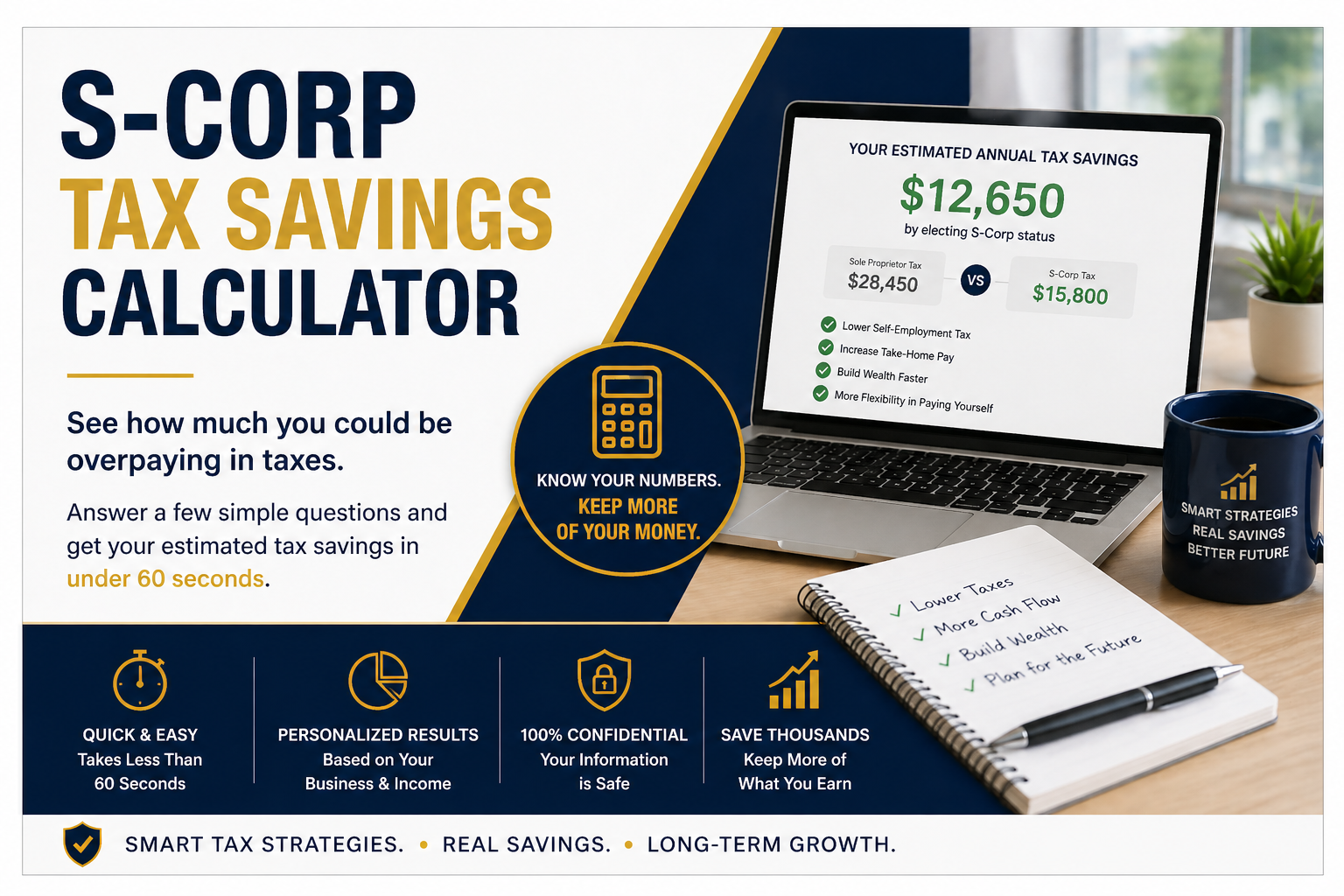
- Then use the S-Corp Tax Savings Calculator to estimate your potential savings
This gives you a clear baseline before applying strategy.
Most S-Corporation owners don’t realize how much they are overpaying until they run the numbers and review their salary structure.
Business owners throughout Salt Lake County, West Jordan, and across the United States work with us to evaluate salary structure, payroll strategy, and ongoing S-Corporation tax planning opportunities.
Work With a CPA Who Understands S Corporations
“S-Corporation strategy is not a one-time election — it’s an ongoing process that requires coordinating salary, distributions, and tax planning throughout the year.” — Steve Madsen, CPA
Without that coordination, many S-Corp owners either overpay payroll taxes or create unnecessary IRS risk.
S-Corporation elections must be filed timely to ensure proper tax treatment. See Rev. Proc. 2016-26 for election procedures and deadlines.
Work with Steve Madsen, CPA to implement and monitor these strategies correctly.
What is a reasonable salary for an S-Corporation owner?
A reasonable salary is the amount you would pay someone else to do your job. It must reflect your role, responsibilities, experience, and industry standards.
IRS Fact Sheet FS‑2008‑25 and IRS Publication 15‑A outline the IRS criteria for evaluating reasonable compensation and payroll compliance.
| Reasonable Salary Factor | Why It Matters | Documentation to Keep |
|---|---|---|
| Owner duties | Compensation should reflect the work actually performed | Role description, weekly responsibilities, time spent |
| Industry compensation | Salary should be compared to similar roles in similar businesses | Salary surveys, job postings, compensation benchmarks |
| Business profitability | Compensation should make sense relative to available company income | Profit and loss reports, payroll records, owner distributions |
| Distribution history | Large distributions with little or no salary can increase IRS risk | Payroll reports, shareholder distribution records |
If salary is too high, you overpay payroll taxes. If too low, you risk IRS penalties.
For S-Corp owners, the goal is to set a defensible salary while maximizing distributions to reduce self-employment taxes.
The IRS requires S-Corporation owners to pay themselves “reasonable compensation,” which must reflect the value of the work performed (IRS S Corporation guidance)
IRS guidance states that S corporations must pay reasonable compensation to shareholder-employees for services provided before making non-wage distributions. The IRS also notes that courts have reclassified distributions and other payments as wages when shareholder-employees performed services but did not receive appropriate wage compensation.
“Most tax savings don’t come from the election itself — they come from structuring salary and distributions correctly throughout the year.” — Steve Madsen, CPA
Determining reasonable compensation is one of the most important and commonly misunderstood areas of S-Corporation tax planning. Business owners looking for practical salary benchmarks, IRS factors, and compensation planning guidance should review our 2026 S-Corp Reasonable Salary Guide.
CPA Insight from Steve Madsen, CPA: “Reasonable compensation isn’t a single percentage — it must be defensible based on duties performed, profitability, and industry norms. Getting this right early drives both compliance and tax efficiency.”
S-Corporation Tax Savings by Profit Level
S-Corporation tax savings depend on profit level and how salary is structured. Most savings come from reducing self-employment taxes. The table below shows typical ranges based on profit:
| Annual Business Profit | Typical S-Corp Planning Impact | Estimated Tax Savings Range | Planning Priority |
|---|---|---|---|
| Under $50,000 | Limited benefit after payroll and compliance costs | $0 – $2,000 | Usually evaluate later |
| $75,000 – $100,000 | Common entry point where S-Corp savings may begin | $3,000 – $8,000 | Review salary and payroll structure |
| $100,000 – $250,000 | Strong planning range for salary and distribution optimization | $8,000 – $25,000+ | Coordinate salary, distributions, estimates, and retirement planning |
| $250,000+ | Advanced planning may be needed | Varies significantly | Review compensation, retirement plans, entity structure, and projections |
This range represents the difference between a properly structured S-Corporation and one that is overpaying taxes.
Business owners begin seeing meaningful S-Corporation tax savings once profits reach approximately $75,000 to $100,000. Below this range, payroll costs often offset the benefit. Above this range, proper salary structuring can significantly reduce self-employment taxes.
The difference between overpaying taxes and optimizing an S-Corporation is almost always how salary is structured.
| Business Situation | S-Corp May Make Sense | Why |
|---|---|---|
| Consistent profits above $75,000 | Usually yes | Payroll tax savings often begin becoming meaningful |
| Owner actively works in the business | Usually yes | Salary/distribution planning becomes available |
| Minimal or inconsistent income | Possibly not yet | Compliance costs may offset savings |
| Passive investment activity only | Often no | S-Corp payroll structure may not provide meaningful benefit |
| Rapidly growing profitability | Often yes | Advanced compensation planning opportunities increase |
Who This Is For
This service is designed for:
- Profitable S-Corporation owners
- Business owners paying themselves through payroll and distributions
- Owners unsure if their salary is reasonable
- Growing businesses with increasing or fluctuating income
- Owners who want proactive tax strategy, not just tax filing
Who This Is Not For
This page is not intended for:
- Passive shareholders
- Real estate-only investors
- One-time tax filing clients
- Owners who only want compliance without ongoing advisory support
Why S-Corporation Tax Planning Matters
| Planning Item | When It Should Be Reviewed | Why It Matters |
|---|---|---|
| Form 2553 S-Corp election | Before or early in the tax year | Late elections can delay or complicate intended tax treatment |
| Reasonable salary | Before payroll is finalized | Salary decisions affect payroll taxes and IRS risk |
| Distributions | Throughout the year | Distributions should be coordinated with salary and cash flow |
| Tax projections | Mid-year and before year-end | Projections help prevent underpayment and missed planning opportunities |
| Retirement contributions | Before year-end or plan deadlines | Contribution options may depend on payroll and plan structure |
S-Corporation tax planning matters because most of the tax result is determined before the return is prepared. Salary, payroll, distributions, estimated taxes, and retirement contributions must be coordinated during the year.
Once payroll has been processed and the year has closed, many compensation decisions cannot be easily corrected.
For most calendar-year businesses, Form 2553 must generally be filed no later than 2 months and 15 days after the beginning of the tax year the S-Corporation election is intended to apply. Late-election relief may be available, but it should not be treated as a substitute for timely planning.
Without proactive planning, most S-Corp owners overpay payroll taxes by setting salary incorrectly or failing to coordinate distributions and tax strategy.
These mistakes are not minor. Once payroll is processed and the year ends, most S-Corporation tax decisions cannot be reversed.
That is why S-Corp tax planning must happen during the year—not at tax filing time.
Without proactive planning, many owners:
- Overpay payroll taxes
- Underpay or miscalculate reasonable compensation
- Miss tax-saving opportunities
- Face unnecessary audit risk
- Discover problems after the year is already closed
Many of these issues start with setting salary incorrectly.
Estimate your S-Corp salary to see where you may be overpaying
Tax savings come from decisions made during the year—not at tax filing time.
In many cases, business owners don’t realize how much they are overpaying until they run the numbers using the S-Corp Tax Savings Calculator.
Before making any changes to your salary or structure:
Use the S-Corp Tax Savings Calculator to estimate your potential tax savings
“Tax savings don’t come from what you earn — they come from how and when you structure that income.” — Steve Madsen, CPA
How the Madsen Planning-First Framework™ Applies to S-Corporations
Effective S-Corporation tax planning requires coordinating compensation, payroll, retirement contributions, distributions, and tax projections throughout the year — not after the return is filed.
Our planning-first framework focuses on:
- Compensation structure
- Payroll coordination
- Timing decisions
- Ongoing adjustments as profits change
This proactive approach helps business owners reduce taxes while maintaining compliance with IRS reasonable compensation requirements.
S-Corporation vs LLC Tax Treatment
An LLC taxed as a sole proprietorship or partnership generally passes business profit through to the owner, where it may be subject to self-employment tax. An S-Corporation changes how owner compensation is structured.
In an S-Corporation, the shareholder-employee is typically paid wages through payroll, and remaining profit may be distributed as shareholder distributions. The planning opportunity comes from setting a reasonable salary while avoiding unnecessary payroll taxes on excess distributions.
This is why S-Corporation tax planning is not just an entity decision. The tax result depends on salary, payroll, profit level, and documentation.
This difference allows S-Corporation owners to reduce payroll taxes by properly splitting income between salary and distributions.
The IRS addresses wage vs distribution treatment in guidance such as IRS S‑Corporation FAQs, highlighting compliance expectations for payroll and distributions.
For many business owners, this is the primary source of S-Corp tax savings.
The IRS defines self-employment tax as Social Security and Medicare taxes that apply to net earnings from self-employment (see IRS Self-Employment Tax guidance).
According to IRS guidance, shareholder distributions from an S-Corporation are generally not subject to self-employment tax treatment in the same way as sole proprietorship or partnership earnings, provided compensation is properly structured and payroll requirements are followed.
Where Most S-Corp Strategies Break Down
Most S-Corp strategies break down when the owner treats the election as the strategy. The election only creates the opportunity. The actual tax result comes from how salary, payroll, distributions, tax projections, and documentation are managed during the year.
The most common breakdowns include salary set too high, salary set too low, distributions taken without payroll coordination, missed estimated tax payments, and no documentation supporting the owner’s compensation.
If these pieces are not coordinated, an S-Corp can either save less than expected or create unnecessary IRS risk.
If you’re unsure where your setup may be off, start here:
- How to Pay Yourself from an S Corporation — understand how salary and distributions actually work
- How S-Corp Payroll Really Works — see how payroll impacts your taxes
- When Does an S-Corp Make Sense — determine if this structure is right for you
These are the decisions that determine whether your S-Corp actually saves you money.
S Corporation tax savings don’t come from the election alone — they come from how the strategy is implemented and adjusted throughout the year.
What Our S-Corporation Tax Planning Includes
We focus on decisions that directly impact your taxes:
- Year-round planning and advisory support
- Reasonable salary analysis
- Payroll and distribution planning
- Coordination of payroll and income taxes
- Tax projections and strategy adjustments
- Retirement and tax-efficient planning strategies
Based in South Jordan, Utah — Serving S-Corporation Owners Nationwide
Madsen and Company works with S-Corporation owners throughout South Jordan, Draper, Sandy, Riverton, Herriman, Salt Lake County, Utah County, and nationwide through a secure virtual-first process designed for proactive year-round planning.
Why Timing Matters
From a CPA’s perspective, S-Corporation tax savings come from compensation and payroll decisions made before the year closes — not from how the return is prepared afterward.
Many business owners assume salary and distributions can simply be adjusted at tax time. In reality, payroll reporting rules often lock those decisions in long before the return is prepared.
What Happens When Planning Happens Too Late
When compensation is not proactively managed during the year, business owners often:
- Overpay payroll taxes
- Underpay or miscalculate reasonable compensation
- Miss tax-saving opportunities
- Create unnecessary IRS risk
- Discover problems after the year has already closed
The real-world consequence is overpaid payroll tax or compliance issues that often cannot be corrected after year-end.
What Ongoing S-Corp Planning Actually Involves
Ongoing S-Corp planning means reviewing salary, distributions, payroll taxes, estimated taxes, retirement contributions, and cash flow before year-end. The goal is to reduce unnecessary payroll taxes while keeping the compensation structure defensible.
This is especially important when profit changes during the year, because the right salary structure may change as income increases or decreases.
Effective S-Corporation planning may include:
- Evaluating reasonable compensation for owner-employees
- Optimizing salary vs. distributions
- Coordinating payroll taxes and income taxes
- Planning retirement contributions through the business
- Managing quarterly estimates and cash flow
- Adjusting strategy as profits increase or fluctuate
Many S-Corporation strategies come down to three key decisions:
- How salary is structured
- How much tax could potentially be saved
- When the S-Corporation election actually makes sense
That’s why we recommend starting with the numbers first — then building strategy around them.
→ Estimate your salary
→ Estimate your potential savings
→ Then apply the strategy correctly
Related Resources
- How to Pay Yourself from an S Corporation
- S-Corp Tax Preparation Service
- Learn more about Steve Madsen, CPA and the planning-first advisory approach used at Madsen and Company
Important: S-Corporation Strategies Must Be Properly Coordinated
S-Corporation planning works best when payroll, distributions, estimated taxes, retirement contributions, and year-end projections are reviewed together. Treating each item separately often leads to missed savings or compliance problems.
For example, a salary decision affects payroll taxes, retirement contribution limits, cash flow, and whether distributions appear reasonable. That is why the strategy should be reviewed before year-end instead of after the return is prepared.
How the Process Works
- Initial Review – Evaluate your current structure, compensation, and tax exposure
- Strategy Development – Identify tax-saving opportunities and compliance risks
- Implementation – Align payroll, distributions, and planning strategies
- Ongoing Planning – Adjust strategy as income, laws, and business goals change
This ensures decisions are made proactively—not after deadlines have passed.
Why Business Owners Work With Us
Business owners typically come to us after realizing their current tax process is reactive instead of strategic.
S-Corporation tax planning requires ongoing coordination between payroll, distributions, tax projections, retirement contributions, and year-end planning decisions.
Our role is to help business owners proactively manage those moving pieces throughout the year — before missed opportunities and compliance problems occur.
Led by Steve Madsen, CPA (licensed since 1993), our firm specializes in helping S-Corporation owners make informed decisions about salary, payroll, and tax strategy.
- 30+ years of CPA experience
- Led by Steve Madsen, CPA
- Planning-first approach
- Virtual-first CPA firm
- Based in South Jordan, Utah, serving business owners nationwide
Our role is to help you make informed decisions—not react after the fact.
Still Have Questions About Your S-Corp Strategy?
Most business owners don’t need more information—they need clarity on how these rules apply to their specific situation.
S-Corporation tax savings usually come down to:
- profit level
- salary structure
- timing decisions
When these are coordinated properly, many business owners reduce unnecessary payroll taxes while maintaining compliance.timized.
S-Corporation tax savings come down to three key factors:
Profit level — Most savings begin once profits reach $75,000 to $100,000
Salary structure — The primary driver of tax savings and compliance
Timing — Decisions must be made during the year, not at tax filing
When these three factors are aligned, most business owners save in reduced payroll taxes.
Reviewed by Steve Madsen, CPA — founder of Madsen and Company with over 30 years of experience advising business owners and real estate investors on proactive tax planning strategies.
Not Sure Where to Start?
Most business owners don’t need more information—they need to know what step to take next.
Start here based on your situation:
• Want to understand how S-Corp strategy works → S-Corporation Tax Planning Guide
• Want to see how much you could be saving → S-Corp Tax Savings Calculator
• Want to estimate the right salary → S-Corp Salary Calculator
Each step gives you clarity before making a decision.
If your S-Corporation salary has not been reviewed recently, there is a strong chance you are overpaying payroll taxes right now.
Ready to See If You’re Overpaying in Taxes?
Start by estimating your salary and potential tax savings before making structural changes.
Then schedule a consultation to determine whether your current setup is optimized.
S-Corporation strategy comes down to a few key decisions:
→ Estimate your salary
→ Estimate your potential savings
→ Then apply the strategy correctly with guidance from Steve Madsen, CPA
Each of these determines whether your S-Corp actually reduces taxes.
Frequently Asked Questions About S-Corporation Tax Planning
These are the most common questions business owners ask before starting S-Corporation tax planning.
Related S-Corporation Resources
Compensation & Payroll
- How to Pay Yourself From an S Corporation
- Reasonable Salary for S-Corp Owners
- S Corp Salary Calculator
Tax Savings & Strategy
- S Corp Tax Savings Calculator
- When Should an LLC Elect S-Corporation Status?
- What Tax Strategies Can S-Corp Owners Use to Reduce Taxes?