
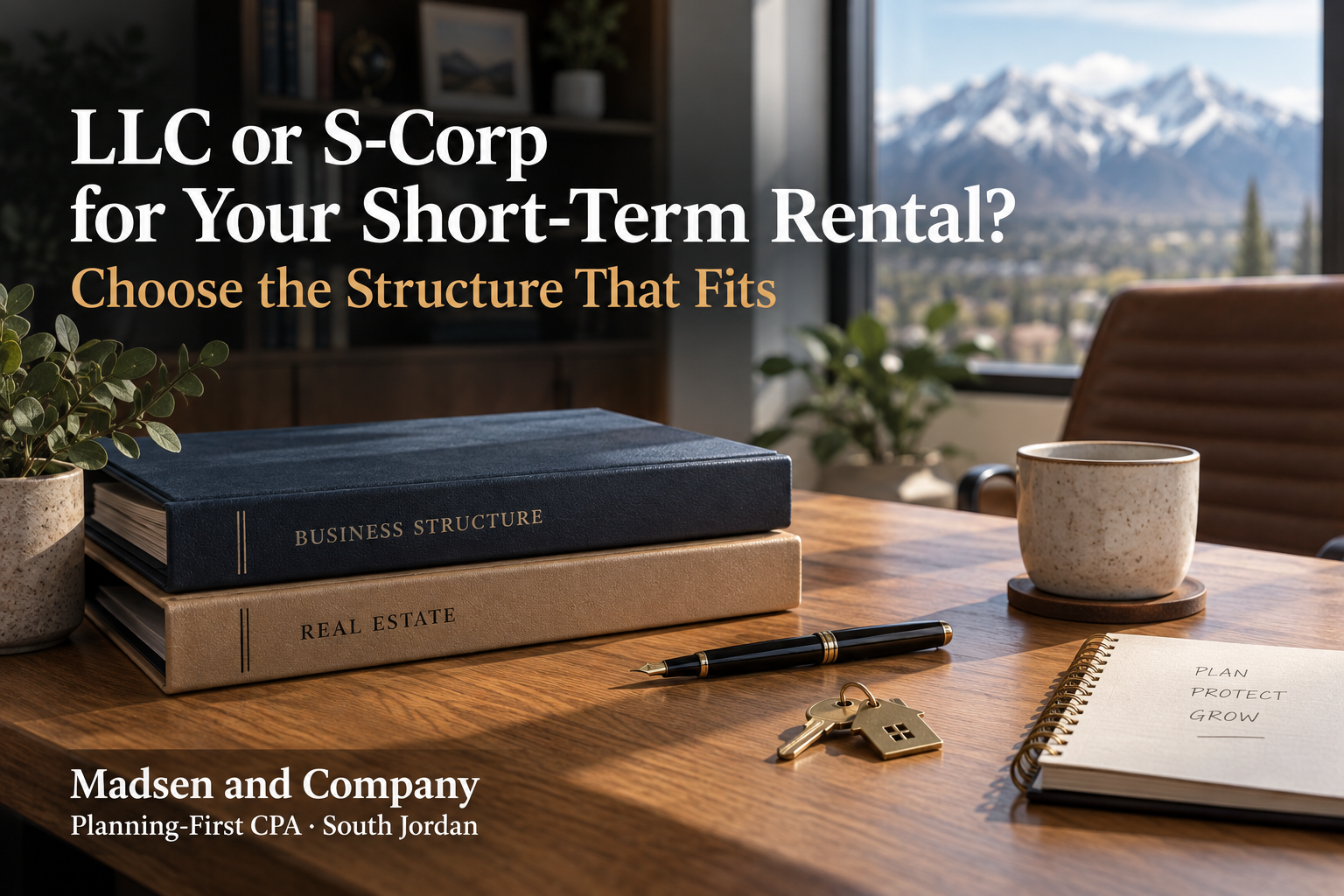
LLC or S-Corp for Your Short-Term Rental? What Airbnb Investors Should Know
Quick Answer
Most short-term rental owners are better served by an LLC than an S-Corp, and many need neither for tax reasons alone.
An LLC is primarily about liability protection and clean ownership; on its own it usually does not change how your rental is taxed. An S-Corp election is designed to reduce self-employment tax on active business profit, and rental income is generally not subject to self-employment tax in the first place. That means the classic S-Corp savings often do not apply to a pure rental, and holding appreciating real estate inside an S-Corp can create problems later.
The real answer depends on the level of services you provide, whether you also run a related business such as management or co-hosting, your liability picture, and your financing. This is a structuring decision, not a default.
Deciding how to hold a rental you are buying?
The cleanest time to get the structure right is before you close, not after.
What an LLC does, and does not do
A limited liability company gives you legal separation between the property and your personal assets, and it makes ownership, financing, and estate planning cleaner. What it generally does not do is change your federal income tax by itself. A single-member LLC is a disregarded entity by default, and a multi-member LLC is taxed as a partnership by default. In both cases the rental income and deductions still flow to your personal return much as they would without the LLC.
In other words, forming an LLC is often a good idea for liability and organization, but it is not a tax strategy on its own. The tax outcome comes from how the rental is used and structured, not from the three letters after its name.
Why an S-Corp usually does not help a rental
The tax benefit people associate with an S-Corp is a reduction in self-employment tax: the owner takes reasonable compensation as wages and the remaining profit passes through without the additional 15.3% self-employment layer. That mechanism only matters when the income was subject to self-employment tax to begin with.
Rental real estate income is generally excluded from self-employment tax under IRC §1402(a)(1). Because there is usually no self-employment tax on rental income, there is usually no self-employment tax for an S-Corp to save. Electing S-Corp status for a straightforward rental often adds cost and complexity (a separate return, payroll, and reasonable-compensation analysis) without a matching benefit.
Unlike an online calculator that only compares payroll-tax savings, the real question for a rental owner is whether the income is even subject to self-employment tax. For most rentals, it is not, which changes the entire analysis.
The appreciation trap
There is a further reason specialists are cautious about putting real estate in an S-Corp: getting appreciated property back out can trigger tax. When an S-Corp distributes real estate that has gone up in value, the gain is generally recognized, and unwinding the structure later can be expensive. Real estate that is expected to appreciate is often held more flexibly in an LLC taxed as a partnership or a disregarded entity, where financing, refinancing, and eventual exit have more room to breathe.
When entity structure actually matters
None of this means structure is irrelevant. It means the decision is fact-specific. An S-Corp or a more involved structure can make sense when:
| Situation | Why structure may matter |
|---|---|
| Substantial services provided (hotel-like) | If you provide significant services beyond ordinary rental (daily cleaning, meals, concierge), the activity can rise to a trade or business (see IRS Publication 527), and income may become subject to self-employment tax, which is where S-Corp analysis re-enters. |
| A separate active business | If you run a management, co-hosting, or design business alongside the rentals, that active business income (not the rental itself) may benefit from S-Corp treatment. |
| Multiple properties and partners | Partnership taxation inside an LLC offers flexible allocations, special basis rules, and cleaner multi-owner planning that an S-Corp cannot match. |
| Liability and lending | An LLC may be required or preferred by your lender and your risk tolerance, independent of any tax effect. |
The through-line is that the entity should follow the facts. The starting question is what the activity actually is (passive rental, active trade or business, or a mix), because that determines whether self-employment tax is even in play. For business owners who also invest in real estate, we often model both the operating business and the rentals together, which is exactly what our S-Corp vs. LLC tax comparison is built to explore.
A word on “reasonable compensation”
If an S-Corp is genuinely appropriate for your active business, reasonable compensation becomes central. The IRS does not define it as a percentage of profit, and treating it as a fixed percentage is a common and risky mistake. It is based on the role you fill, your industry, your experience, the hours you work, and the value of the services you provide. Setting it too low invites reclassification; setting it mechanically ignores the standard entirely. This is one of the areas where a considered analysis matters most.
Madsen and Company | Real Estate and S-Corp Tax Planning CPA Serving Utah and Nationwide. Steve R. Madsen, CPA has practiced for more than 30 years, advising real estate investors and business owners across the country from a virtual-first practice in South Jordan, Utah. If you are still deciding whether you even need professional guidance, start with Do I Need a CPA for My Short-Term Rental?
Own a business and a rental, and not sure how they should be structured together?
That combination is where structure earns its keep.
Frequently asked questions
Should I put my Airbnb in an LLC?
Often, for liability protection and clean ownership, an LLC is reasonable. Just understand that an LLC by itself usually does not change your federal income tax on a rental. A single-member LLC is disregarded and a multi-member LLC is taxed as a partnership by default, so the income still flows to your personal return. Treat the LLC as a liability and organization decision, and handle the tax outcome separately.
Does an S-Corp save taxes on rental income?
Usually not. The S-Corp benefit is a reduction in self-employment tax, and rental income is generally excluded from self-employment tax under IRC Section 1402. With no self-employment tax to reduce, there is typically nothing for the S-Corp election to save, and it adds payroll and filing complexity. S-Corp analysis mainly re-enters when you provide substantial hotel-like services or run a separate active business.
Why is it risky to hold real estate in an S-Corp?
Because taking appreciated property back out of an S-Corp generally triggers taxable gain, which limits your flexibility to refinance, restructure, or exit. Real estate expected to appreciate is often better held in an LLC taxed as a partnership or as a disregarded entity, where those moves have more room. This is a common reason specialists steer rental owners away from S-Corps.
When does an S-Corp make sense for a real estate investor?
Typically when there is active business income involved, such as a property management, co-hosting, or design company operating alongside the rentals, or when a short-term rental provides substantial services and rises to a trade or business. In those cases the active income, not the rental itself, is what an S-Corp analysis addresses. It is a fact-specific decision, not a default.
How is reasonable compensation determined for an S-Corp?
Reasonable compensation is based on the role, industry, experience, hours worked, and value of the services provided, not on a fixed percentage of profit. The IRS does not define it as a percentage, and using one as a rule is a common mistake. Getting it right requires a considered analysis of what the work would cost to replace.
This content is for general educational and informational purposes only and does not constitute tax, legal, or accounting advice, nor does it create a client relationship. Tax outcomes depend on each taxpayer’s specific facts and applicable law, and individual results will vary. No specific result is guaranteed. Steve R. Madsen, CPA, Madsen and Company, is licensed in Utah. Consult a qualified professional regarding your situation.