
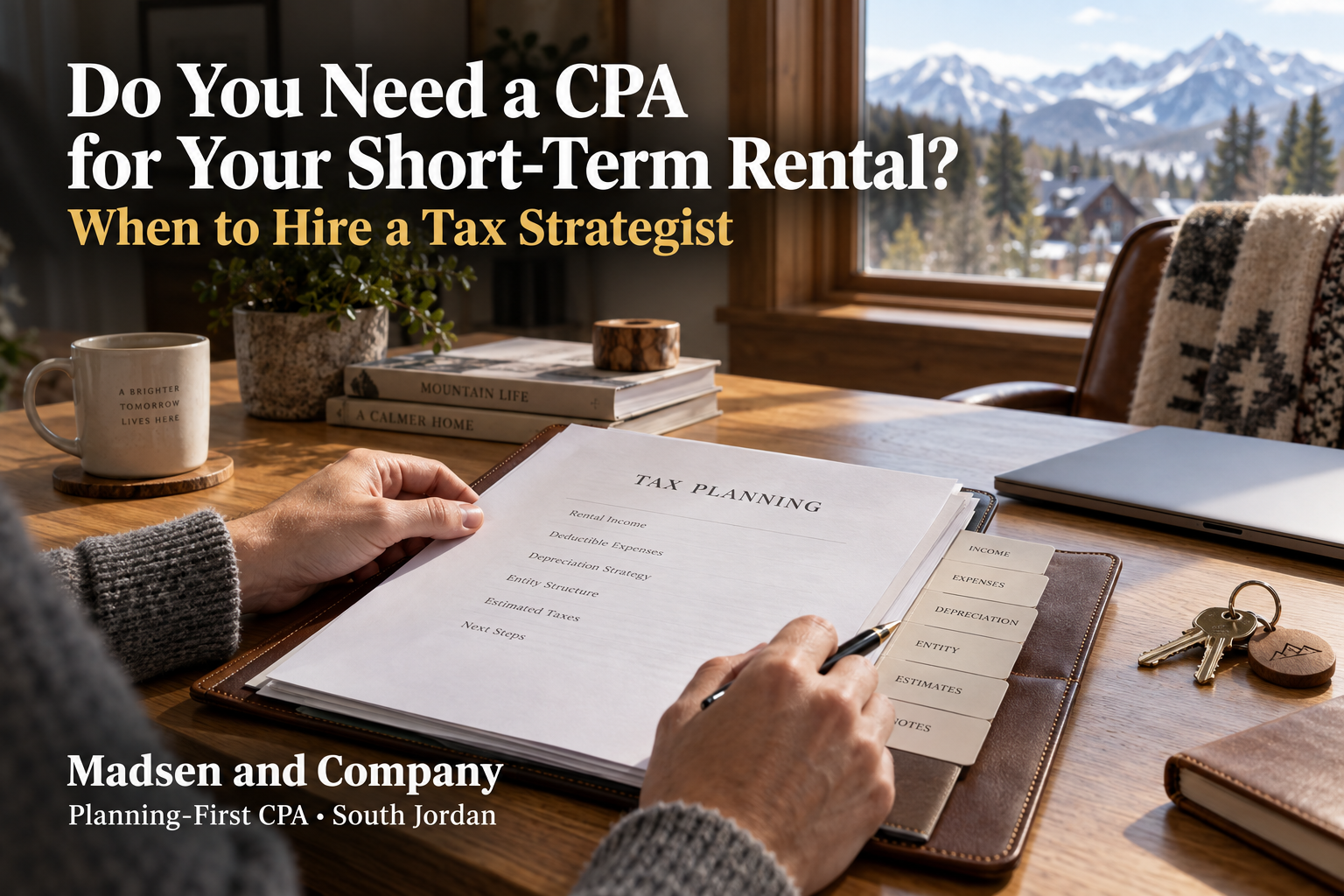
Do I Need a CPA for My Short-Term Rental? When to Hire a Tax Strategist
Quick Answer
Not every short-term rental owner needs a CPA, but once your rental is producing real income or losses, most benefit from a tax strategist rather than a once-a-year preparer.
The dividing line is simple: a preparer records what already happened, while a strategist helps you make the decisions that change the outcome before the year closes. Short-term rentals sit right where that difference matters most, because the tools that make them tax-efficient (material participation, cost segregation, the seven-day rule, entity structure) all have to be planned in advance, not discovered on the return.
If your rental is a single property producing modest income and you are comfortable with tax software, you may not need one yet. If you have a high W-2 income, more than one property, or you are weighing whether losses can offset other income, the planning usually pays for itself.
Not sure which category you fall into?
A short consultation is the fastest way to find out whether your situation calls for planning or just filing.
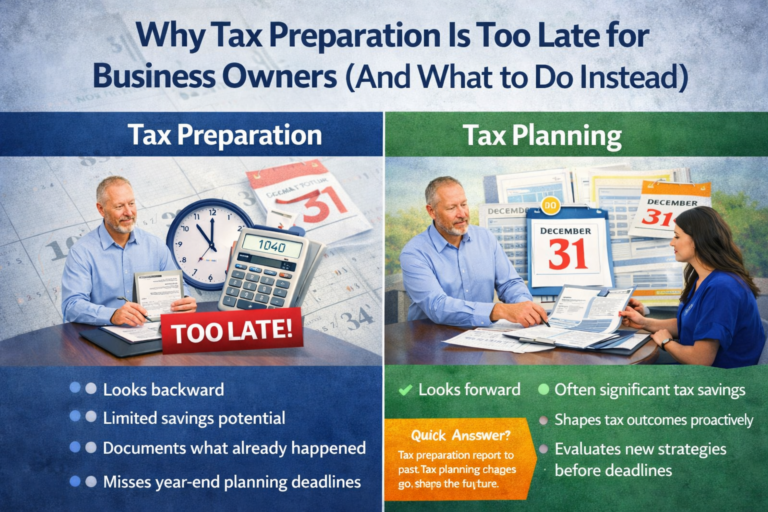
Tax preparer vs. tax strategist: they are not the same job
Most people use “CPA,” “accountant,” and “tax preparer” interchangeably, but the roles are different, and the difference is exactly what decides whether a short-term rental is run efficiently.
| Tax preparer | Tax strategist (planning-first CPA) | |
|---|---|---|
| When you meet | After the year ends, at filing | Before and during the year, while decisions are still open |
| Main question | What did you earn and spend? | How should this be structured so it is efficient? |
| STR issues handled | Reports the rental on Schedule E or C as-is | Reviews material participation, depreciation, entity choice, and exit timing |
| Typical outcome | An accurate return | An accurate return, plus decisions made at the right time |
A short-term rental can be perfectly reported and still leave real planning on the table, because by the time a return is prepared, most of the levers have already been pulled. That is why we describe our work as planning-first: the value is in the timing, not just the filing.
The short-term rental issues that get missed
Short-term rentals are one of the most nuanced areas of individual tax, and they are also one of the most oversimplified online. These are the questions where general software and general preparers most often fall short.
1. Whether your losses can actually offset other income
This is the single biggest one. Most rental losses are passive and cannot offset wages. Short-term rentals can be different: when the average period of customer use is seven days or less, the activity is generally not treated as a rental activity for purposes of the passive-activity rules under Section 469 (Treas. Reg. §1.469-1T(e)(3)(ii)(A)). It stays rental real estate for depreciation, and most short-term rentals are still reported on Schedule E; the seven-day point is only about the passive-loss rules and is a separate question from where the income is reported. If you provide substantial services mainly for your guests’ convenience (the hotel-like services described in IRS Publication 527), the activity can instead belong on Schedule C.
Even then, you still have to materially participate for a loss to be nonpassive, and other limits can apply, including basis, the at-risk rules, the vacation-home rules, and the excess business loss limitation. The seven-day rule and material participation are distinct requirements, and clearing one does not clear the other. Whether it works comes down entirely to your documented facts. We cover this in depth in Can Short-Term Rental Losses Offset W-2 Income?
2. Depreciation and cost segregation timing
A property is depreciated over many years by default, but a cost segregation study can reclassify part of it into shorter-lived components and move a meaningful portion of that deduction into the early years. Those eligible components (not the land or the building structure itself) can qualify for 100% bonus depreciation, which has been restored with no scheduled phaseout for eligible property acquired and placed in service after January 19, 2025. The catch is timing: it interacts with recapture when you sell, and it works best when it is planned in the year the property is placed in service. See Is a Cost Segregation Study Worth It for Your STR?
3. Whether you need an entity at all
Many owners assume an LLC or S-Corp will save tax on a rental. For most pure rental income, that assumption does not hold, because rental income is generally not subject to self-employment tax in the first place. The right structure depends on liability, financing, the level of services you provide, and whether you run a related business. We walk through this in LLC or S-Corp for Your Short-Term Rental?
4. Documentation that holds up
Material participation is provable by any reasonable means under the Form 8582 instructions; a daily log is not strictly required by statute. In practice, a contemporaneous record of your hours is the strongest position, and it is far easier to build during the year than to reconstruct after the fact. A strategist sets that up front; a preparer inherits whatever you kept.
Signs it is time to hire a tax strategist
You are likely past the do-it-yourself stage if several of these are true:
You have a high W-2 income and at least one short-term rental. You own more than one property, or plan to. You are considering a cost segregation study. You have heard about the “short-term rental strategy” and want to know if it applies to you. You are buying, selling, or refinancing this year. Your rental is generating a loss you are not sure you can use, or income you are not sure how to shelter.
None of these require a CPA in an absolute sense, but each one is a decision with a right and a wrong time to make it. That is what a planning relationship is for.
What working with a specialist actually looks like
A real estate-focused CPA does more than file a return in April. The work is spread across the year: a review of your properties and income before year-end, a look at whether material participation is achievable and documented, a feasibility check before any cost segregation study, entity and financing input when you buy, and coordination of the sale or exchange when you sell. The return itself becomes the last step, not the whole engagement.
Because the work is virtual-first, none of this depends on being local. Madsen and Company serves real estate investors across the country from South Jordan, Utah, and short-term rental strategy is a core part of the practice rather than an afterthought.
Madsen and Company | Real Estate and Short-Term Rental Tax Planning CPA Serving Utah and Nationwide. Steve R. Madsen, CPA has practiced for more than 30 years, working with real estate investors and high-income professionals nationwide through a virtual-first practice based in South Jordan, Utah. For an overview of the approach, see Real Estate Tax Planning.
Ready to find out what planning would change for your rental?
Bring your properties and your rough numbers, and we will tell you honestly whether it is worth it.
Frequently asked questions
Do I need a CPA if I only have one Airbnb?
Not necessarily. A single property with modest income and straightforward expenses can often be handled with quality tax software. The value of a CPA rises quickly once you have a high W-2 income, more than one property, or you want to know whether your losses can offset other income, because those are planning decisions rather than data-entry.
What is the difference between a CPA and a tax preparer for a rental?
A preparer records what already happened and files an accurate return. A planning-focused CPA helps you make decisions during the year that change the result, such as whether you materially participate, whether a cost segregation study fits, and how to structure a purchase or sale. For short-term rentals, most of the tax outcome is decided before the return is ever prepared.
Can a CPA help my short-term rental losses offset my W-2 income?
Possibly, if the facts support it. When the average guest stay is seven days or less and you materially participate, the loss may be nonpassive and able to offset active income, subject to basis, at-risk, vacation-home, and excess business loss limitations. A CPA’s role is to confirm whether your situation qualifies and to make sure the participation is documented before year-end.
Is hiring a CPA worth it for a short-term rental?
It depends on your situation. For an owner in a higher tax bracket with real estate losses or a property purchase in play, planning often pays for itself many times over. For a small, simple rental, it may not yet. The honest answer comes from a short feasibility conversation, which is exactly what an initial consultation is for.
Does a short-term rental CPA need to be local to me?
No. Short-term rental and real estate tax rules are federal, and a virtual-first practice can serve investors in any state. State conformity and local nuances are still reviewed, but the relationship does not require being in the same city.
This content is for general educational and informational purposes only and does not constitute tax, legal, or accounting advice, nor does it create a client relationship. Tax outcomes depend on each taxpayer’s specific facts and applicable law, and individual results will vary. No specific result is guaranteed. Steve R. Madsen, CPA, Madsen and Company, is licensed in Utah. Consult a qualified professional regarding your situation.