
S-Corp Tax Planning: Why Waiting Until April Costs You
Quick answer: S-Corp tax planning or savings depend on timing, not just entity choice. Waiting until April usually eliminates the payroll strategies that make S-Corp taxation effective.
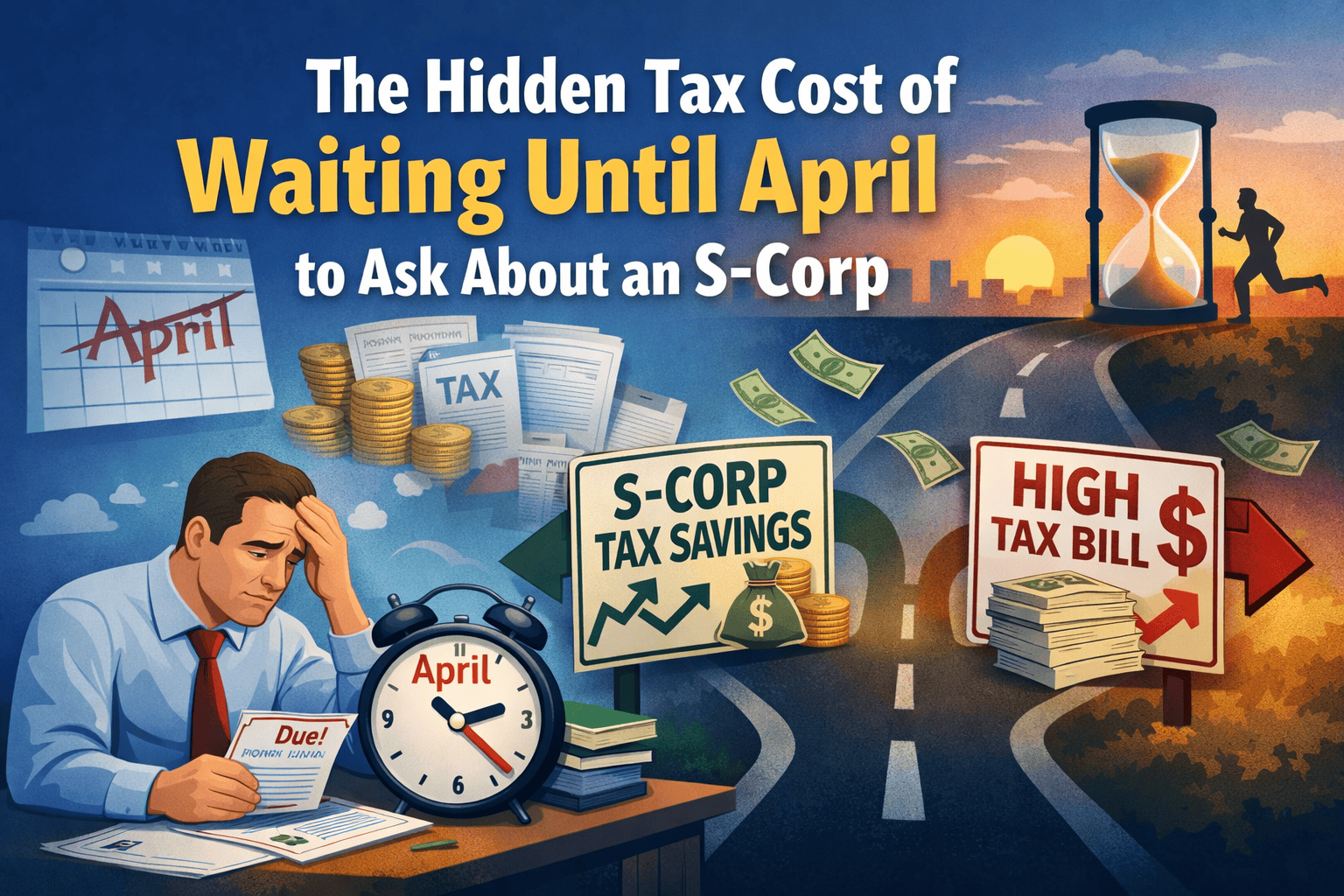
Waiting until April to ask whether you should be taxed as an S-Corporation often costs business owners thousands in avoidable self-employment taxes. By the time tax season arrives, most of the planning opportunities tied to S-Corp status have already expired. Proactive timing — not last-minute filing — determines whether an S-Corp actually saves you money.
For many service-based businesses, including Utah professional firms, S-Corp timing directly affects payroll compliance and tax outcomes.
Why does waiting until April eliminate most S-Corp tax savings?
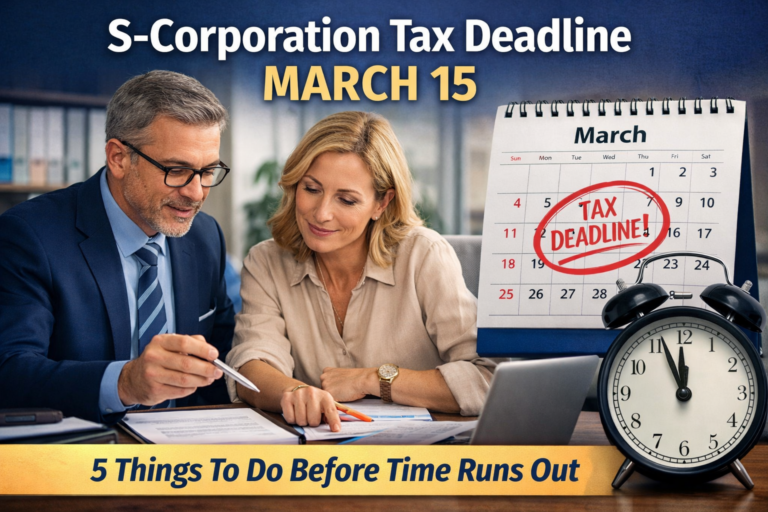
Waiting until April eliminates most S-Corp tax savings because S-Corp elections must generally be made by March 15 to apply for that tax year.
Once the year has closed, income and payroll decisions are already set. As a result:
- The business owner is stuck paying full self-employment tax on all profits.
- No reasonable salary was established or paid through payroll.
- Payroll tax strategies cannot be applied retroactively.
- Retirement contributions tied to wages may be limited.
Therefore, waiting until April turns S-Corp planning into a missed opportunity rather than a tax strategy.
Already past the deadline? We can still help you file accurately and plan ahead for next year.
What tax benefits are lost when an S-Corp is chosen too late?
The main tax benefit lost is the ability to split income between salary and distributions.
When timing is missed:
- All business profit is taxed as self-employment income.
- Social Security and Medicare taxes apply to the full amount.
- Health insurance and fringe benefits may be structured incorrectly.
- Quarterly estimates may already be wrong.
In contrast, proper timing allows:
- A reasonable salary to be taxed through payroll.
- Remaining profit to avoid self-employment tax.
- Payroll withholding to support retirement contributions.
Thus, timing determines whether an S-Corp produces real savings or simply adds paperwork.
Who actually benefits from S-Corp taxation?
Not every business benefits from S-Corp taxation, but many profitable service businesses do.
S-Corp taxation usually helps when:
- Net profit is consistently above $40,000–$50,000.
- The owner materially participates in operations.
- Income is stable and predictable.
- Payroll can be run consistently.
However, S-Corp status is usually a poor fit when:
- Profits fluctuate wildly.
- The business is still in startup mode.
- Owners cannot support payroll compliance.
Therefore, S-Corp status works best as part of a larger tax strategy rather than a reaction to tax season.
Why should S-Corp planning happen before the year starts?
S-Corp planning must happen before the year starts because payroll structure drives tax savings.
When planning happens early:
- Salary can be set correctly from January.
- Payroll taxes can be optimized across the year.
- Estimated payments align with actual tax strategy.
- Retirement contributions can be maximized.
When planning happens late:
- Salary cannot be fixed retroactively.
- Distributions are already misclassified.
- Compliance risk increases.
- Savings are permanently lost.
As a result, S-Corp strategy works best as a proactive decision — not an emergency response.
How does this affect small business owners specifically?
Small business owners are most affected because they control both income and compensation.
This means:
- Their timing decisions directly affect tax liability.
- Their structure determines payroll exposure.
- Their planning window closes once the year ends.
Without early guidance:
- Owners often overpay self-employment tax.
- Business cash flow suffers unnecessarily.
- Long-term planning becomes reactive instead of strategic.
Consequently, S-Corp decisions should be evaluated during the year — not after it.
Bottom Line
Waiting until April to ask about S-Corp taxation usually eliminates the tax benefits it is meant to provide.
S-Corp status is most effective when salary, payroll, and profit distributions are structured in advance.
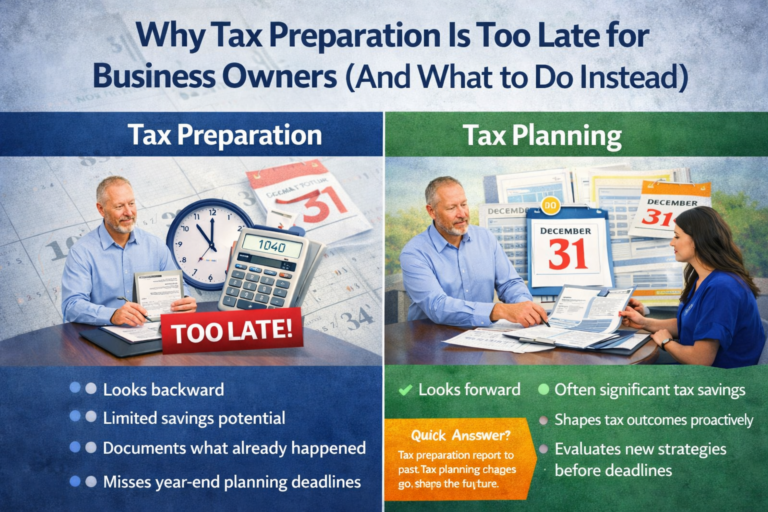
Proactive tax planning — not tax preparation — determines whether an S-Corp reduces tax or simply increases complexity.
View Our Business Tax Preparation Services
How Madsen and Company Can Help
Madsen and Company helps business owners evaluate S-Corp taxation before deadlines pass — not after the savings are gone.
We help Utah-based and nationwide service businesses plan S-Corp taxation before deadlines pass — not after savings are gone.
Our tax planning process includes:
- Analyzing whether S-Corp taxation actually lowers your total tax
- Structuring reasonable salary and payroll correctly
- Coordinating income timing and retirement contributions
- Integrating tax planning with tax preparation for full compliance
If you want your tax return to reflect strategy instead of surprises, proactive planning is the first step.
Frequently Asked Questions
Can I still elect S-Corp status after March 15?
Yes, but it usually applies to the following tax year unless special relief applies. Late elections often eliminate current-year tax savings.
Does forming an LLC automatically make me an S-Corp?
No. An LLC must file a separate election with the IRS to be taxed as an S-Corporation
How much tax can an S-Corp save?
Savings depend on profit level and salary structure. Many owners save several thousand dollars per year when structured correctly.
Is an S-Corp right for every business?
No. Low-profit or startup businesses often gain little benefit and may increase compliance costs.
Should I ask about S-Corp status during tax season?
Tax season is often too late. S-Corp strategy should be reviewed before or during the tax year to be effective.
Schedule a Tax Planning Consultation
Find out whether S-Corp tax planning could lower your self-employment tax before another year of savings is lost.