

Short-Term Rental Tax Planning Case Study: How an Investor Leveraged STR Rules to Maximize Tax Benefits
Overview
Short-term rentals (STRs) can create unique tax opportunities for investors, including deductions for depreciation, expenses, and the potential to offset high ordinary income if material participation rules are met.
This case study demonstrates how a real estate investor used short-term rental tax planning strategies to maximize deductions, comply with IRS rules, and improve after-tax cash flow.
Case Study Snapshot
| Industry | Real Estate Investing |
| Property Type | Short-Term Rental (STR) Property |
| Strategy | STR Tax Planning / Material Participation Analysis |
| Primary Goal | Maximize Deductions and Offset Income |
| Outcome | Increased Tax Deductions and Improved After-Tax Cash Flow |
| Client Profile | High-income investor with a newly acquired short-term rental property. |
This case study is based on a combination of real client situations. Names and identifying details have been changed to protect confidentiality. Individual results vary.
Client Situation
A real estate investor purchased a short-term rental property with the goal of generating additional income while taking advantage of available tax benefits.
Initially, the investor was unsure:
- How to structure the rental for maximum deductions.
- How material participation rules impacted eligibility for STR tax benefits.
- How depreciation and expense allocation would affect taxable income.
The Challenge
Without strategic tax planning:
- The investor risked missing key deductions.
- Taxable income could remain high, reducing cash flow.
- Compliance with the IRS’s STR rules (including 100-hour material participation requirement) could be unclear.
- Opportunity to offset ordinary income through STR deductions might be lost.
Our Analysis
We reviewed:
- Rental property usage and availability for rent.
- Hours contributed by the investor to meet material participation rules.
- Depreciation opportunities, including cost segregation where applicable.
- Operating expenses allocation for STR versus personal use.
- State and federal tax implications for STR income.
The Strategy
We recommended:
- Tracking all hours spent managing the property to satisfy material participation.
- Allocating expenses and depreciation properly between STR and personal use.
- Applying cost segregation for any eligible capital improvements.
- Leveraging bonus depreciation to maximize first-year deductions.
- Documenting all STR activity to ensure audit readiness.
The goal was to legally maximize deductions and reduce tax liability while maintaining IRS compliance.
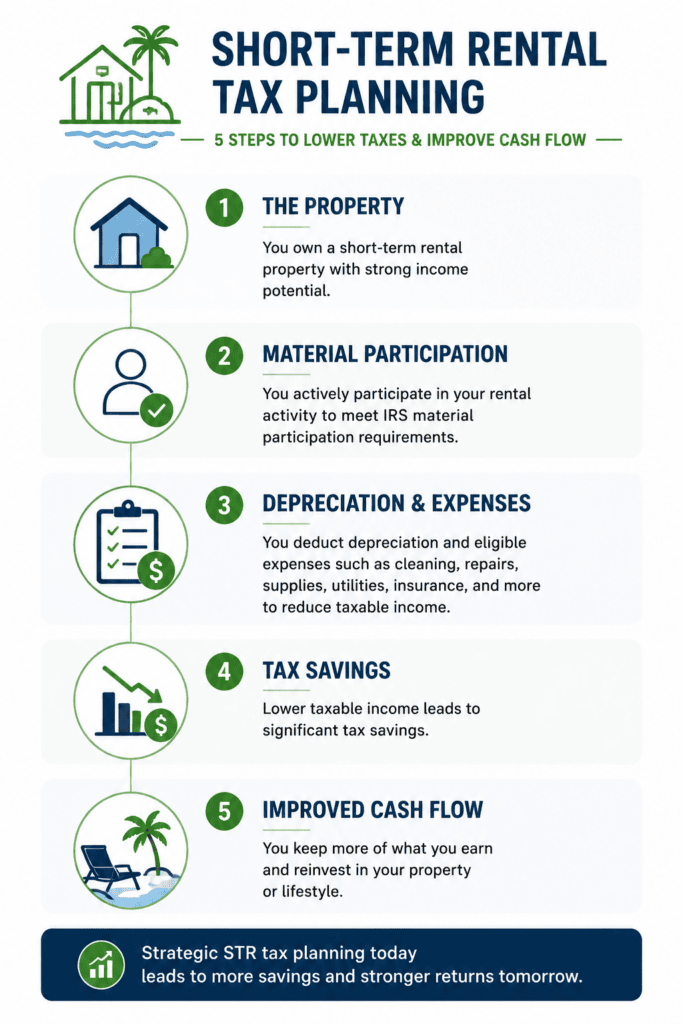
The Results
After implementing the STR tax planning strategy:
- The investor qualified for all applicable deductions.
- Depreciation and other deductions significantly reduced taxable income.
- Short-term rental income effectively offset other high-income sources.
- Cash flow improved, giving the investor more flexibility to reinvest.
The investor gained confidence in the ongoing management and tax planning for short-term rental properties.
Key Lessons for STR Investors
- Accurate hour tracking and documentation are essential for material participation.
- Proper allocation of expenses between personal and STR use prevents IRS issues.
- Cost segregation and bonus depreciation can significantly increase first-year deductions.
- Proactive planning early in the rental cycle maximizes benefits.
Could STR Tax Planning Benefit Your Property?
Short-term rental owners often miss opportunities to reduce taxes because:
- Material participation rules are not tracked.
- Expenses and depreciation are misallocated.
- Bonus depreciation and cost segregation are overlooked.
A proactive tax analysis can identify strategies tailored to your STR investment.
The potential benefits depend on your income level, participation hours, property usage, and overall tax situation.