

How Much Should You Pay Yourself as an S Corp Owner? (2026 Guide)
Quick Answer
S Corporation owners must pay themselves a reasonable salary based on the work they perform.
For many business owners, that salary often falls between 40% and 60% of net business profit — but the correct amount depends on your role, industry, and responsibilities.
Setting salary too low can create IRS risk. Setting it too high can reduce your tax savings.
If you want to understand how all of these pieces fit together, start with our complete S Corporation tax planning guide.
S Corporation tax planning guide
Why Salary Matters for S Corporation Owners
S Corporation tax savings come from how income is split:
- Salary (W-2 income) → subject to payroll taxes
- Distributions → generally not subject to self-employment tax
Your salary determines:
- how much you pay in payroll taxes
- how much income can be distributed
- how much you actually save
This is one of the most important tax decisions S Corp owners make.
General Salary Guidelines
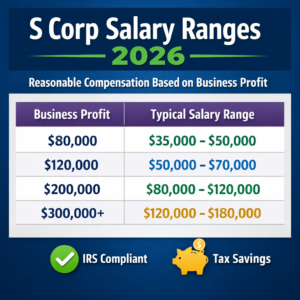
While there is no fixed percentage required by the IRS, common ranges include:
| Business Profit | Typical Salary Range |
|---|---|
| $80,000 | $35,000 – $50,000 |
| $120,000 | $50,000 – $70,000 |
| $200,000 | $80,000 – $120,000 |
| $300,000+ | $120,000 – $180,000 |
These are general guidelines — not rules.
Actual salary should reflect the work you perform and the value of those services.
What the IRS Looks At
The IRS requires S Corporation owners to pay themselves reasonable compensation.
Factors include:
- Your role in the business
- Time spent working
- Industry compensation standards
- Experience and skill level
- Business size and profitability
This is one of the most commonly reviewed areas in S Corporation audits.
Example: How Salary Affects Taxes
Scenario: $150,000 Business Profit
Low Salary (Too Aggressive)
- Salary: $40,000
- Distributions: $110,000
Higher audit risk
Reasonable Salary
- Salary: $75,000
- Distributions: $75,000
Balanced tax savings and compliance
High Salary (Too Conservative)
- Salary: $120,000
- Distributions: $30,000
Reduced tax savings
The Most Common Mistake
The biggest mistake S Corporation owners make is:
Setting salary based on what they want to pay in taxes — instead of what is reasonable.
This often leads to:
- audit risk
- reclassification of income
- penalties and back taxes
How Salary Connects to Tax Savings
Your salary directly impacts your total tax savings.
If salary is too low:
- risk increases
If salary is too high:
- savings disappear
See how much an S Corporation could save based on your income.
When Salary Needs to Be Reviewed
Salary should be reviewed when:
- Business income changes significantly
- Your role in the business changes
- You hire employees or reduce involvement
- The business grows or becomes more complex
Many business owners set salary once and never revisit it — which often leads to missed opportunities or unnecessary risk.
How This Fits Into S Corporation Planning
Salary is only one part of the bigger picture.
S Corporation planning also includes:
- evaluating whether S Corp status makes sense
- structuring distributions correctly
- timing income and deductions
- managing payroll and compliance
Review when S Corporation status makes sense for your business.
What This Means for You
If you own an S Corporation and are unsure whether your salary is set correctly, this is one of the most important areas to review.
Most business owners either:
- set salary too low and increase risk, or
- set salary too high and lose savings
Both mistakes cost money.
At Madsen and Company, we help S Corporation owners structure salary, distributions, and tax strategy proactively — before decisions are locked in.
CPA Insight
From a real-world perspective, most S Corporation owners either underpay salary and create risk — or overpay and lose tax savings.
Reviewed by Steve Madsen, CPA — founder of Madsen and Company with over 30 years of experience advising business owners and real estate investors on proactive tax planning strategies.
Review Your S Corporation Salary Before Year-End
The best time to review your salary is before year-end — not during tax preparation.
A proper review can help:
- ensure compliance with IRS rules
- optimize tax savings
- align salary with your business reality
This is not something most business owners calculate accurately on their own.
Schedule a consultation to review your S Corporation salary and overall tax strategy.
For a full breakdown of how S-Corp strategies work together, review our S Corporation tax planning guide.
Frequently Asked Questions
What is a reasonable salary for an S Corp owner?
A reasonable salary is what you would pay someone else to perform the same work under similar circumstances.
Can I pay myself a low salary to save taxes?
No. The IRS requires reasonable compensation. Setting salary too low can lead to penalties and reclassification.
What percentage should S Corp salary be?
Many fall between 40%–60% of profit, but the correct amount depends on your role and industry.
How often should I review my salary?
At least annually, or whenever income or responsibilities change.
Does salary affect S Corp tax savings?
Yes. Salary determines how much income is subject to payroll taxes and how much can be distributed.