

How Much Tax Should a Business Owner Be Paying? (Real Benchmarks by Income)
Quick Answer
How much tax should a business owner pay? Most business owners pay between 20% and 35% in total taxes, depending on income level, entity structure, and planning strategy.
If your effective tax rate is higher than expected for your income level, it is often a sign that tax planning is missing — not that tax laws are the problem.
The Real Question Business Owners Should Be Asking
Most business owners don’t actually ask:
“How much tax should I pay?”
They ask:
“Why does my tax bill feel so high?”
The problem is — without a benchmark — you have no way to know if:
- Your tax bill is normal
- You’re overpaying
- Or you’re missing planning opportunities
This is where most business owners lose money.
WHAT IS A “NORMAL” TAX RATE FOR BUSINESS OWNERS?
Your total tax rate includes:
- Federal income tax
- State income tax
- Self-employment tax (or payroll taxes for S-Corps)
This is called your effective tax rate.
Your total tax rate includes:
- Federal income tax
- State income tax
- Self-employment tax (or payroll taxes for S-Corps)
This is called your effective tax rate.
If you’re wondering how much tax should a business owner pay at your income level, the benchmarks below will give you a clear starting point.
Typical Tax Ranges by Income Level
$75,000 – $100,000 Profit
- Typical tax rate: 20% – 25%
- Usually still taxed as sole proprietor or LLC
- Limited planning in place
👉 Planning opportunity: evaluating S-Corp election
$100,000 – $200,000 Profit
- Typical tax rate: 25% – 30%
- S-Corp often begins to make sense
- Payroll strategy becomes important
👉 Planning opportunity:
- S-Corp optimization
- Retirement contributions
- Expense timing
$200,000 – $400,000+ Profit
- Typical tax rate: 28% – 35%
- Full planning strategies should be in place
👉 Planning opportunity:
- Advanced S-Corp strategies
- Retirement + entity structure
- Income shifting and timing
These are real S Corporation savings
CPA INSIGHT
Most business owners assume high taxes mean:
“I must be making good money.”
In reality, high taxes often mean:
“No one is managing your tax strategy.”
SIGNS YOU MAY BE OVERPAYING TAXES
If any of these apply, there is a strong chance you are paying more than necessary:
- You owe a large balance every April
- You are not operating as an S-Corporation (over ~$100K profit)
- You are not taking advantage of retirement strategies
- Your CPA only talks to you during tax season
- You don’t know your effective tax rate
REAL EXAMPLE
Scenario A (No Planning)
- Profit: $180,000
- Entity: LLC (no S-Corp election)
- Total tax: ~$55,000
Scenario B (With Planning)
- Profit: $180,000
- Entity: S-Corp
- Optimized salary + distributions
👉 Estimated tax: ~$40,000–$45,000
Difference:
👉 $10,000–$15,000 per year
That’s not a tax loophole.
That’s basic tax planning.
WHY MOST BUSINESS OWNERS OVERPAY
The issue is not tax law.
The issue is timing.
Most business owners:
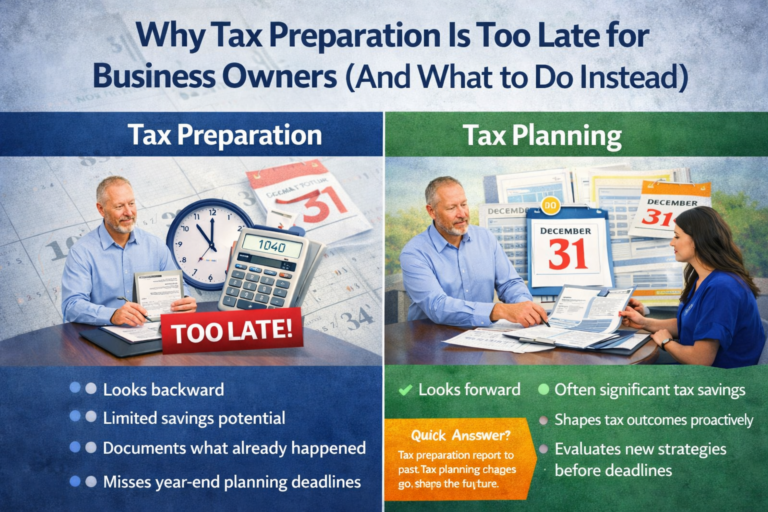
- Think about taxes in March
- File in April
- Move on
By that point, nothing meaningful can be changed.
WHAT TO DO IF YOUR TAXES ARE TOO HIGH
If your tax rate feels too high, the solution is not guessing deductions.
It’s building a system.
A real tax strategy includes:
- Quarterly planning (not annual reaction)
- Entity structure optimization
- Payroll strategy (for S-Corps)
- Retirement planning
- Income timing decisions
WHAT A TAX RETURN SHOULD REALLY BE
Your tax return should not be:
❌ A surprise
❌ A calculation
It should be:
✔ A result of decisions you made earlier in the year
KEY TAKEAWAYS
Most business owners pay between 20% and 35% in total taxes
- If you’re outside normal ranges, something is likely missing
- S-Corp strategy often becomes valuable around $100K+ profit
- The biggest issue is lack of planning — not tax rates
Want to Know If You’re Overpaying Taxes?
If you’re not sure whether your tax bill is normal — or too high — the next step is to review your numbers and identify opportunities before the year is over.
Most business owners don’t realize how much control they actually have over their taxes until they see the numbers clearly.
👉 Schedule a consultation to review your tax situation and identify potential savings opportunities.
Steve Madsen, CPA is a tax planning specialist and the founder of Madsen and Company, a virtual-first CPA firm based in South Jordan, Utah.
With over 30 years of experience, Steve helps business owners and real estate investors reduce taxes through proactive, year-round planning — not just tax preparation.