
2026 Year-End Tax Planning Checklist for S-Corporation Owners
Quick Answer
Before December 31, an S-Corporation owner should confirm that reasonable compensation has been paid through payroll, fund the right retirement contributions, review accountable plan reimbursements, cover estimated taxes and withholding, confirm health insurance reporting, and gather clean records.
The reason year-end matters is practical. Most of the moves that lower an S-Corporation owner’s tax have to happen while the calendar year is still open, because they run through payroll or a retirement plan. Year-end is also a useful time to review accountable plan reimbursements, although their timing depends on the accountable plan rules.
Waiting until you file in the spring usually means those windows have already shut. A short review in November or early December is where the real planning happens, and it is very different from the return your preparer assembles months later.
Key takeaways
- Reasonable compensation has to run through payroll before the year ends, and it is based on the role you perform, not a share of profit.
- Employee elective deferrals need to be elected by year-end, before the wages are paid, and deposited by the applicable plan deadline; the employer contribution can usually wait until the business filing deadline.
- An accountable plan lets the company reimburse legitimate owner expenses with no tax to you, as long as each expense is substantiated and any excess is returned. Putting the plan in writing is the best practice.
- Withholding from a year-end paycheck is generally treated as paid evenly throughout the year, which may reduce an earlier underpayment. Check the required installments before relying on it.
Want a second set of eyes before the year closes?
We can talk through your situation and whether a paid tax analysis makes sense before December 31.
What should S-Corp owners review before December 31?
An S-Corporation owner should review six areas before year-end: reasonable compensation and payroll, retirement plan contributions, accountable plan reimbursements, estimated taxes and withholding, health insurance reporting, and year-end records. Many have a deadline tied to the calendar year, so the review works best in November or early December rather than at filing time.
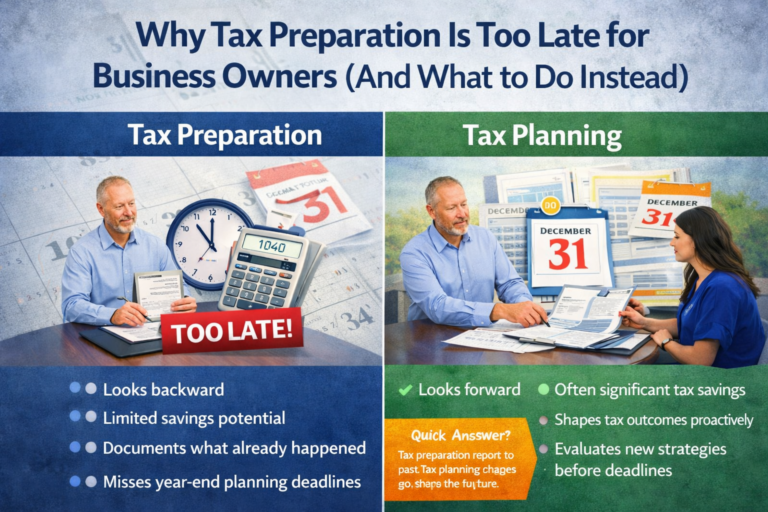
In more than 30 years of planning returns for S-Corporation owners, the pattern holds. The owners who keep the most decide these items while the year is still open, not when the return is prepared in the spring. Unlike a filing-season checkup, which mostly reports what already happened, year-end planning can still change the result.
This is a year-end action list, not a general overview. It is meant to sit alongside the broader tax strategies S-Corp owners use, with a single job: tell you what to confirm while there is still time to act. The table below maps each decision to its usual deadline and what to check.
| Year-end decision | Usual deadline | What to confirm |
|---|---|---|
| Reasonable compensation | Final payroll of the year | Wages match your role and hours, not a share of profit |
| Retirement contributions | Elect deferrals by year-end, before the wages are paid; deposit by the applicable plan deadline; employer piece by the filing deadline | The plan exists and your W-2 wages support the amount |
| Accountable plan reimbursements | Within a reasonable period under the plan | Expenses are substantiated and reimbursed under the plan |
| Estimated taxes and withholding | January estimate; withholding by December 31 | You meet a safe harbor for the year |
| More-than-2% shareholder health insurance | Before W-2s are issued | Company-paid or reimbursed premiums are reported in Box 1 for the shareholder; confirm whether the shareholder may claim the personal deduction. |
| Year-end records | No set deadline; a practical year-end step | Payroll reports and W-2 detail, retirement plan paperwork, accountable plan expense reports, mileage logs and home office records, your shareholder basis schedule, and any required corporate minutes are organized |
Is your reasonable compensation on track for the year?
Reasonable compensation is the W-2 salary an S-Corporation must pay an owner who works in the business before it makes non-wage distributions to that owner, and it has to run through payroll before the year ends. It is based on your role, experience, hours, and the value of your services, never a fixed percentage of profit.
The IRS frames this on the facts of what you do, not on a formula. Its guidance on S Corporation compensation and medical insurance issues points to role, duties, time, and comparable pay. If you are under-compensated for the year, an adjusting or bonus payroll run before December 31 can correct it. Setting the salary too low can lead the IRS to recharacterize distributions as wages, and it quietly limits how much you can put into a retirement plan.
For the method behind the number, see how to calculate owner compensation and our reasonable compensation framework. Estimated potential savings from the salary and distribution mix depend on reasonable compensation, payroll taxes, state taxes, and your specific facts, so the goal is a defensible number rather than the lowest one.
Which retirement contributions should you lock in before year-end?
An S-Corporation owner can contribute to a plan such as a Solo 401(k), which is available when the business has no employees other than you and your spouse, in two ways: an employee elective deferral and an employer contribution. The amount you can save depends on the salary you run.
For 2026 the elective deferral limit is $24,500 per person, not per plan, and the employer contribution can be up to 25% of compensation as defined by the plan, with the two combined capped at $72,000 (higher with catch-up contributions if you are 50 or older). Those figures come from the IRS tables for 401(k) and profit-sharing plan contribution limits, and the 25% employer deduction limit sits in Internal Revenue Code Section 404. For 2026, if you are eligible for catch-up contributions and your 2025 wages from the plan sponsor exceeded $150,000, catch-up contributions generally must be Roth contributions. The higher catch-up limit for participants who turn 60 through 63 in 2026 is $11,250. Both figures come from IRS Notice 2025-67, and the IRS summarizes the rule on its catch-up contributions page. The timing split matters at year-end. The employee elective deferral generally has to be elected by year-end, before the wages are paid, because it comes out of W-2 wages. The employer contribution can usually be funded later, up to the business tax filing deadline including extensions. To make employee deferrals from 2026 wages, the 401(k) generally needs to be in place before those deferrals come out of your pay. A plan that takes only employer contributions can, in some cases, be adopted as late as the business filing deadline, including extensions, under Internal Revenue Code Section 401(b)(2).
One point catches many owners by surprise: distributions you take instead of salary are not compensation for the plan, so they do not raise the limit. A low salary shrinks the employer contribution along with it.
Which expenses should run through an accountable plan?
An accountable plan lets your S-Corporation reimburse you for legitimate business costs you paid personally, such as a qualifying home office, mileage, cell phone, and internet, with no tax to you and a deduction for the company. The expenses must have a business connection and be substantiated within a reasonable time.
The rules live in Treasury Regulation Section 1.62-2 and are summarized in IRS Publication 15 and IRS Publication 463. A plan needs a business connection, substantiation within a reasonable time, and the return of any excess advance. Without a plan, money the company pays you for these costs can become taxable wages instead of a clean reimbursement. Before year-end, submit your expense reports and make sure the corporation substantiates and reimburses eligible expenses within a reasonable period under its accountable plan. The deduction year can depend on the corporation’s accounting method.
Are your estimated taxes and withholding covered for 2026?
Because an S-Corporation’s profit flows to your personal return, you generally cover the tax through quarterly estimated payments, W-2 withholding, or both. A common safe harbor is to pay at least 90% of this year’s tax or 100% of last year’s tax, and 110% if your prior-year adjusted gross income was over $150,000 ($75,000 if married filing separately).
The safe harbor math is in Internal Revenue Code Section 6654, with the practical payment rules on the IRS estimated taxes page. Here is the year-end lever most owners miss. Withholding is generally treated as paid evenly throughout the year, so increasing withholding on a year-end paycheck may reduce an earlier underpayment. The result depends on your payment history and tax situation, so check the required installments before relying on this approach. For the penalty side, see our guide to avoiding IRS underpayment penalties in 2026.
What records should you close the year out with?
Close the year with your payroll reports and W-2 detail, retirement plan paperwork, accountable plan expense reports, mileage logs and home office records, your shareholder basis schedule, and any required corporate minutes. Clean records turn the filing-season return into a confirmation of what you already planned rather than a scramble.
If you also invest in real estate, the same year-end discipline applies on that side of your return. If you own a short-term rental you want to depreciate this year, confirm it is placed in service, meaning ready and available to rent, by December 31, and review whether 100% bonus depreciation fits your situation. Under Internal Revenue Code Section 168(k), 100% bonus depreciation generally applies to eligible shorter-lived property acquired and placed in service after January 19, 2025; the building itself generally does not qualify. Whether those deductions actually reduce your current tax is a separate question, governed by the basis, at-risk, passive activity, and other loss limits we cover in whether a short-term rental loss can offset your wages.
Madsen and Company | S-Corp Tax Planning CPA Serving Utah and Nationwide. Steve R. Madsen, CPA has practiced for more than 30 years, working with S-Corporation owners, real estate investors, and high-income professionals nationwide through a virtual-first practice based in South Jordan, Utah. For an overview of the approach, see S-Corp Tax Planning and Real Estate Tax Planning.
Ready to map your year-end moves?
Bring your payroll, your profit, and your rough numbers. We can discuss what to confirm before December 31 and whether a paid tax analysis makes sense for your situation.
Frequently asked questions
What should S-Corp owners do before December 31 to lower their 2026 taxes?
Before December 31, review your reasonable compensation and payroll, fund the retirement contributions you want for the year, review accountable plan reimbursements, confirm your estimated taxes or withholding meet a safe harbor, check health insurance reporting, and gather your records. Many of these moves have to happen while the tax year is still open.
How late in the year can an S-Corp owner adjust reasonable compensation?
Reasonable compensation must be paid as W-2 wages through payroll, so the practical deadline is your final payroll run of the year. If you are under-compensated, an adjusting or bonus payroll before December 31 can correct it. Set the amount on your role and hours, not a share of profit.
How do S-Corp owners cover estimated taxes they underpaid during the year?
You can make a fourth-quarter estimated payment, generally due in mid-January, or increase withholding on a year-end paycheck. Withholding is generally treated as paid evenly throughout the year, so it may reduce an earlier underpayment, depending on your payment history and tax situation. Aim to meet a safe harbor for the year.
What is an accountable plan and why set one up before year-end?
An accountable plan is a reimbursement arrangement, ideally in writing, that lets your S-Corporation reimburse you for business costs you paid personally, such as mileage, a qualifying home office, phone, and internet, tax free to you and deductible for the company. The expenses must be substantiated within a reasonable period, so year-end is a useful time to review the records.
When must an S-Corporation decide on a retirement plan contribution?
The employee elective deferral generally has to be elected by year-end, before the wages are paid, since it comes out of W-2 wages, and the 401(k) generally needs to be in place before then. The employer contribution can usually be funded later, up to the business tax filing deadline including extensions.
Do distributions count when planning year-end tax moves for an S-Corp?
Distributions move cash to the owner but are not wages, so they do not count as compensation for payroll, retirement plan limits, or reasonable compensation. Year-end planning that depends on wages, such as retirement contributions or Social Security, is driven by your W-2 salary, not by the distributions you take.
Do more-than-2% S-Corporation shareholders need health insurance on their W-2 before year-end?
Yes. An owner who holds more than 2% of the S-Corporation generally must have company-paid or reimbursed health insurance premiums included in W-2 wages to claim the self-employed health insurance deduction, and other conditions apply. Tell your payroll provider before year-end W-2s are prepared, because fixing it afterward means corrected forms.
What records should an S-Corp owner gather before closing out the year?
Gather payroll reports and W-2 detail, retirement plan paperwork, accountable plan expense reports, mileage logs and home office records, your shareholder basis schedule, and any required corporate minutes. These records support the positions on your return and make filing season a review of decisions you already made rather than a last-minute search.
Does paying the owner a year-end bonus change payroll taxes?
A year-end bonus paid as W-2 wages is subject to payroll taxes like regular salary, and it adds to the wages that count toward your reasonable compensation for the year. It can also create room for a larger employer retirement contribution. Run it through payroll before December 31 so it counts in the current tax year.
This content is for general educational and informational purposes only and does not constitute tax, legal, or accounting advice, nor does it create a client relationship. Tax outcomes depend on each taxpayer’s specific facts and applicable law, and individual results will vary. No specific result is guaranteed. Steve R. Madsen, CPA, Madsen and Company, is licensed in Utah. Consult a qualified professional regarding your situation.
Primary sources cited in this article:
- IRS, S Corporation Compensation and Medical Insurance Issues (reasonable compensation; more-than-2% shareholder health insurance on the W-2).
- Instructions for Form 7206, Self-Employed Health Insurance Deduction (premiums paid or reimbursed by the S-Corporation for a more-than-2% shareholder).
- IRS, 401(k) and Profit-Sharing Plan Contribution Limits (2026 elective deferral and overall limits).
- IRS Notice 2025-67 (2026 limits, the $11,250 higher catch-up, and the $150,000 Roth catch-up wage threshold).
- IRS, Retirement Topics: Catch-Up Contributions (Roth catch-up rule).
- Internal Revenue Code Section 404 (employer retirement contribution deduction limit).
- Internal Revenue Code Section 401 (plan adoption timing for employer contributions).
- IRS, One-Participant 401(k) Plans (Solo 401(k) eligibility and the per-person deferral limit).
- Treasury Regulation Section 1.62-2 (accountable plan requirements).
- IRS Publication 15, Employer’s Tax Guide (reimbursements and payroll).
- IRS Publication 463 (accountable plan rules and the reasonable period of time).
- IRS Publication 538, Accounting Periods and Methods (when expenses are deducted under each accounting method).
- Internal Revenue Code Section 280A (home office rules).
- Internal Revenue Code Section 6654 (estimated tax and safe harbors; withholding treated as paid evenly).
- IRS, Estimated Taxes (payment and due-date rules).
- Internal Revenue Code Section 168 (bonus depreciation).
- IRS Notice 2026-11 (100% bonus depreciation for property acquired and placed in service after January 19, 2025).