

Reasonable Salary for an S Corporation Owners (2026 Guide)
Quick Answer
Most S Corporation owners are doing their salary wrong — either too low (creating IRS risk) or too high (overpaying thousands in taxes).
A reasonable salary is based on what you would pay someone else to do your role — not what minimizes taxes.
If your S-Corp profit is over $100,000 and your salary has not been reviewed in the last 12 months, there is a high likelihood it needs to be adjusted.
If you are still deciding whether an S Corporation makes sense, understanding the differences between an LLC and S Corporation is the first step.
If you want to understand how all of these pieces fit together, start with our complete S Corporation tax planning guide.
S Corporation tax planning guide
What Is a Reasonable Salary for an S Corporation Owner?
A reasonable salary is the amount the IRS expects you to pay yourself as an employee of your own business.
The key principle is simple:
If you had to hire someone to do your role, what would you pay them?
This applies before taking distributions.
Why Reasonable Salary Matters
S Corporation owners split income into:
- W-2 salary (subject to payroll taxes)
- Distributions (not subject to self-employment tax)
That creates a tax advantage — but only if the salary is reasonable.
If Your Salary Is Too Low:
- Increased risk of IRS audit
- IRS can reclassify distributions as wages
- Back taxes, penalties, and interest
If Your Salary Is Too High:
- You overpay Social Security and Medicare taxes
- You lose the benefit of the S Corporation structure
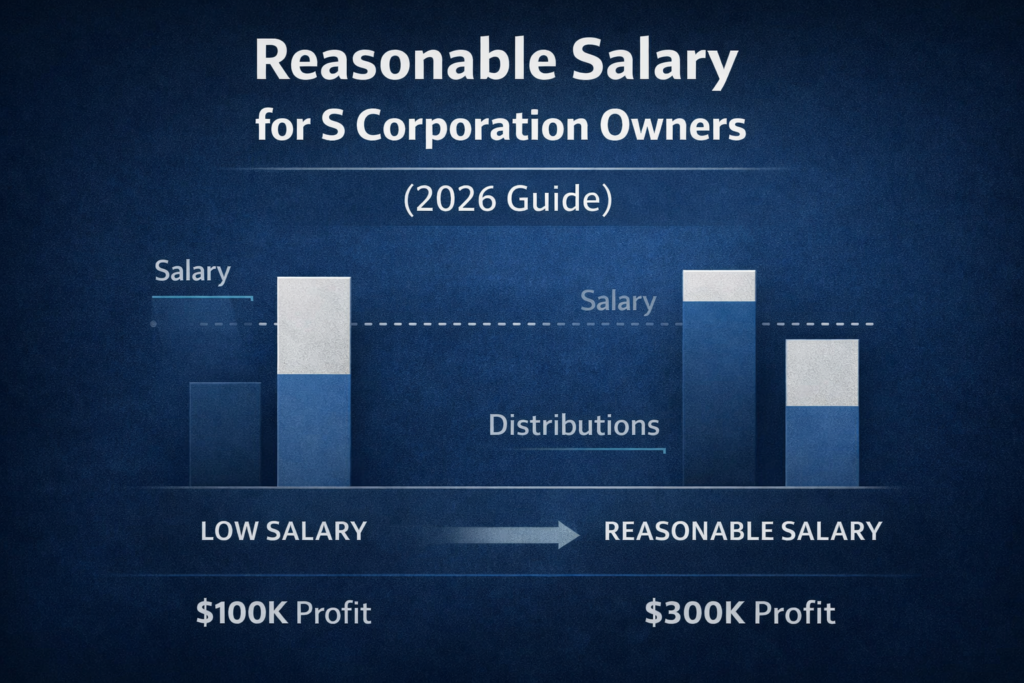
Example: How Salary Impacts Taxes
- Business profit: $300,000
Scenario 1 — Low Salary
- Salary: $60,000
- Distributions: $240,000
- 🚨 Likely too low → higher audit risk
Scenario 2 — More Reasonable Salary
- Salary: $150,000
- Distributions: $150,000
- ✅ More defensible position
This is not about guessing — it is about supporting your position if questioned.
The goal is not to minimize salary — it is to balance tax efficiency with defensibility.
The difference between a properly set salary and an incorrect one can easily be thousands of dollars per year.
What Is a Reasonable Salary Range?
While there is no fixed formula, here are common ranges based on profit:
- $100K profit: $40K–$70K salary
- $200K profit: $80K–$130K salary
- $300K+ profit: $120K–$180K+ salary
These ranges assume the owner is actively working in the business full-time. Passive owners or businesses with employees performing most of the work may justify different compensation levels.
These are general ranges — your actual salary depends on your role, industry, and responsibilities.
The key is being able to support your number if questioned.
This is one of the most common areas the IRS reviews when examining S Corporation returns — especially when salary appears low relative to profits.
How the IRS Evaluates Reasonable Salary
The IRS does not provide a strict formula, but they look at whether your compensation is defensible based on facts.
Common factors include:
- Duties performed and time spent in the business
- Comparable salaries in your industry
- Business size and profitability
- Your experience and expertise
- Payments to non-owner employees
The focus is not perfection — it is whether your salary would hold up under scrutiny.
Why This Should Be Reviewed Before Year-End
Reasonable salary is not something you fix when filing your tax return.
By that point:
- Payroll has already been processed
- Opportunities to reduce taxes are limited
- Fixing mistakes may require amended payroll filings or additional tax costs
The best time to review your salary is:
- Before your next payroll adjustment
- Before year-end
- Before filing your return
How to Support Your Salary (What Actually Matters)
To defend your salary, you should be able to support it with:
- Market compensation data (industry benchmarks)
- A clear description of your role and responsibilities
- Time spent working in the business
- Business profitability
The goal is not precision — it is having a position that is reasonable and defensible if questioned.
Without this support, salary decisions often look arbitrary — which is exactly what the IRS focuses on in an audit.
CPA Insight
Most S Corporation owners I review are not intentionally aggressive — but they are often significantly off.
In many cases:
- Salary is set too low based on outdated advice
- Or too high because no one revisited it as profits grew
Both mistakes cost money — just in different ways.
When You Should Review Your Salary
You should revisit your salary if:
- Your profit has increased significantly
- You changed roles in the business
- You elected S Corporation status recently
- You have not reviewed it in the last 12 months
- You are taking large distributions relative to salary
This is not something to set once and forget.
Common Mistakes S Corp Owners Make
- Picking a salary based on what “feels right”
- Copying what another business owner does
- Setting salary purely to minimize taxes
- Not adjusting salary as profits grow
Relying on advice that worked when the business was smaller
How This Fits Into Tax Planning
Reasonable salary is not a standalone decision.
It directly impacts:
- Payroll taxes
- Retirement contributions
- Health insurance reporting
- Overall tax strategy
This is why it should be reviewed as part of a broader tax planning strategy — not just during tax preparation.
This is why it should be reviewed as part of a broader tax planning strategy — not just during tax preparation. At Madsen and Company, this is a core part of how we help business owners make better decisions before year-end.
What This Means for You
If your salary has not been intentionally set and reviewed, it is likely based on:
- Guessing
- Outdated advice
- Or what “feels right”
That is where most S Corporation owners go wrong.
The longer this goes unreviewed, the more likely it is costing you.
And most business owners do not realize there is an issue until after the year is already closed.
This is not something most business owners get right on their own.
Reviewed by Steve Madsen, CPA — founder of Madsen and Company with over 30 years of experience advising business owners and real estate investors on proactive tax planning strategies.
Review Your S Corporation Salary Before It Costs You
If your S Corporation profit is over $100,000 and your salary has not been reviewed recently, it is likely not optimized.
That means you are either:
- Taking unnecessary IRS risk, or
- Paying more in taxes than you need to
This is one of the most important decisions in your tax strategy — and one of the most commonly done incorrectly.
Schedule a consultation to review your salary and identify opportunities before your next payroll or year-end.
For a full breakdown of how S-Corp strategies work together, review our S Corporation tax planning guide.
Frequently Asked Questions
What happens if my S Corp salary is too low?
The IRS may reclassify distributions as wages, resulting in back payroll taxes, penalties, and interest.
Can I take all income as distributions?
No. S Corporation owners must pay themselves a reasonable salary before taking distributions.
Is there a formula for reasonable salary?
No fixed formula exists. The IRS evaluates compensation based on facts and circumstances, including your role, industry, and business profitability.
How often should I review my salary?
At least once per year, or anytime your income or role changes significantly.
Does reasonable salary affect tax savings?
Yes. Salary determines how much income is subject to payroll taxes versus distributions, which directly impacts overall tax liability.
What is a reasonable salary for an S Corp owner making $200,000?
There is no fixed number, but many S Corp owners earning around $200,000 may have a reasonable salary in the range of $80,000 to $130,000 depending on their role, industry, and level of involvement in the business.