

When Should You Elect S Corporation Status? (2026 Guide)
Quick Answer
Most business owners should evaluate S Corporation status once net income reaches $75,000 to $100,000 (in most cases) — but the real decision is whether you are currently overpaying self-employment taxes.
If your income is approaching six figures and you have not reviewed this, there is a high likelihood you are paying more tax than necessary.
If you are still deciding between structures, understanding the differences between an LLC and S Corporation is the first step.
If you want to understand how all of these pieces fit together, start with our complete S Corporation tax planning guide.
S Corporation tax planning guide
The Key Question
Electing S Corporation status is not about forming a new business — it is about choosing how your income is taxed.
The real question is:
Will the tax savings exceed the added costs and requirements?
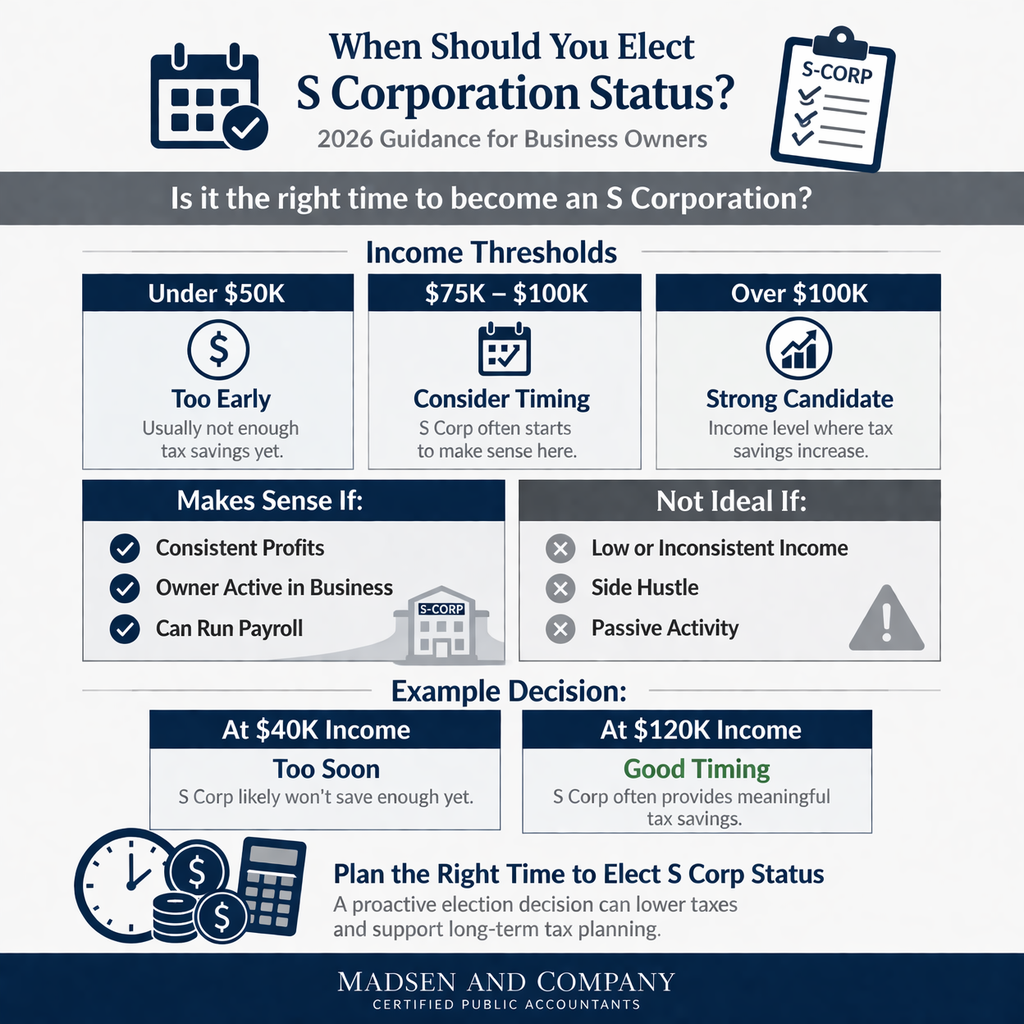
Income Thresholds (When It Starts to Make Sense)
Under $50,000 of Net Income
- Usually too early
- Limited or no tax savings
- Payroll and compliance costs often outweigh benefits
In most cases, staying as a sole proprietor or LLC is more efficient.
$75,000 to $100,000 of Net Income
- Consideration range
- Potential savings begin to appear
- Requires careful analysis
This is where many business owners start evaluating whether an S Corporation makes sense.
Over $100,000 of Net Income
- Strong candidate
- Meaningful tax savings possible
- Structure becomes more important
At this level, many business owners benefit from an S Corporation when set up correctly.
What It Costs to Wait
Many business owners delay evaluating S Corporation status because they are unsure if the timing is right.
The problem:
- Waiting too long can result in thousands of dollars in unnecessary self-employment taxes
- Electing too early can create complexity without savings
For example:
- At $120,000 of net income, failing to evaluate S Corporation status can result in $10,000+ in avoidable taxes annually depending on structure
This is where most business owners either start saving money — or continue overpaying.
Why Income Level Matters
S Corporation tax savings come from reducing self-employment taxes.
As income increases:
- Salary remains relatively stable
- Distributions increase
- Tax savings grow
This is why timing matters — electing too early provides little benefit, while waiting too long can cost you.
When an S Corporation Makes Sense
An S Corporation is typically a good fit when:
- You have consistent and predictable profits
- You are actively working in the business
- The business can support payroll
- You are looking to reduce self-employment taxes
- The expected savings exceed administrative costs
When an S Corporation Does NOT Make Sense
It may not be the right move if:
- Income is low or inconsistent
- The business is a side hustle
- The activity is mostly passive
- Payroll costs eliminate tax savings
- You are not ready to handle additional compliance
Quick Decision Snapshot
You are likely ready to consider an S Corporation if:
- Your net income is consistently above $75,000
- You are actively working in the business
- You can support payroll
- You want to reduce self-employment taxes
You are likely NOT ready if:
- Income is inconsistent
- The business is still early-stage
- You are not prepared to run payroll
Example: When Timing Matters
A business owner earning $40,000:
- Limited savings
- Additional costs may exceed benefit
A business owner earning $120,000:
- Potential for meaningful tax savings
- S Corporation may be beneficial
The difference is not the entity — it is the timing.
The Most Common Mistake
The biggest mistake is:
Electing S Corporation status without a clear plan
This often leads to:
- minimal or no tax savings
- unnecessary complexity
- incorrect payroll setup
- increased IRS risk
The election alone does not create savings — the structure behind it does.
How Salary Impacts the Decision
S Corporation owners must pay themselves a reasonable salary.
That salary determines:
- how much income is subject to payroll taxes
- how much becomes distributions
- how much you actually save
This is one of the most important parts of the decision.
If you are unsure how salary should be set:
Review how to set a reasonable salary for S Corporation owners.
How Much Could You Actually Save?
Most business owners do not realize how much is at stake until they run the numbers.
Use the S Corporation Tax Savings Calculator to estimate your potential savings in under 60 seconds.
Many business owners are surprised to find:
- They are already in the optimal range
- They delayed too long
- Or they would not benefit yet
This is the fastest way to determine whether the timing makes sense.
See how much an S Corporation could save based on your income.
What This Means for You
If your business income is approaching or exceeding $100,000 and you have not evaluated S Corporation status, this is worth reviewing.
The decision is not just about taxes — it affects:
- how you pay yourself
- how your business is structured
- how much you keep after taxes
Most business owners either:
- waiting too long and overpaying self-employment taxes
- making the election without a clear plan and seeing little benefit
Both mistakes cost money.
This decision should be part of a broader S Corporation tax planning strategy.
At Madsen and Company, we help business owners evaluate S Corporation decisions proactively — before year-end — so the strategy actually reduces taxes, not just adds complexity.
CPA Insight
At Madsen and Company, we help business owners evaluate S Corporation decisions proactively — before year-end — so the strategy actually reduces taxes, not just adds complexity.
Most clients come to us after either:
- waiting too long and overpaying self-employment taxes, or
- making the election without a clear plan and seeing little benefit
A structured review ensures the decision is made at the right time — and implemented correctly.
Most business owners do not realize the impact of this decision until it is too late to change it for the current tax year.
Determine If an S Corporation Is Right for You
Most business owners either:
- elect too early and see little benefit, or
- wait too long and overpay taxes
A structured review will help you determine:
- if the timing is right
- how much you could save
- how your salary should be set
Schedule a consultation to evaluate your situation before your next tax year — not after it’s too late to change the outcome.
For a full breakdown of how S-Corp strategies work together, review our S Corporation tax planning guide.
Frequently Asked Questions
When should I switch to an S Corp?
Many business owners consider switching when net income reaches $75,000 to $100,000, but it depends on the full situation.
Is it too early to elect S Corp at $50,000?
In many cases, yes. The tax savings may not outweigh the additional costs and requirements.
Can I elect S Corp later?
Yes. Many business owners wait until income is high enough to justify the change.
Does an S Corp always save money?
No. Savings depend on income level, salary, and structure.
What happens if I elect S Corp too early?
You may add complexity without meaningful tax savings.
What is the biggest mistake with S Corps?
Electing S Corporation status without a salary strategy or tax plan.