

CPA vs Tax Preparer: What’s the Difference and Which Do You Need?
Quick Answer
A CPA and a tax preparer are not the same.
A tax preparer typically focuses on filing tax returns accurately.
A CPA provides tax planning, strategy, and advisory services in addition to tax preparation.
Most business owners need more than just tax preparation — they need guidance before decisions are made.
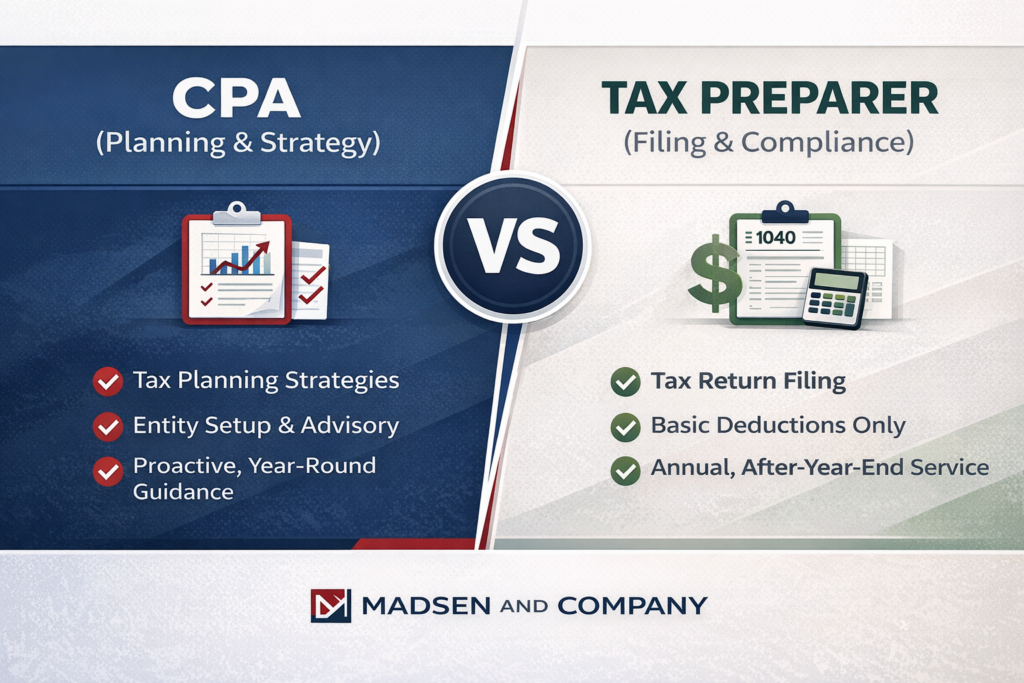
CPA vs Tax Preparer (Side-by-Side)
| CPA | Tax Preparer |
|---|---|
| Licensed professional | No uniform licensing requirement |
| Provides tax planning and strategy | Primarily prepares and files tax returns |
| Advises on business decisions | Focuses on compliance and forms |
| Works with clients year-round | Typically seasonal (tax time) |
| Helps reduce taxes proactively | Reports taxes after the fact |
What Does a Tax Preparer Do?
A tax preparer focuses on:
- Gathering financial information
- Completing and filing tax returns
- Ensuring compliance with tax laws
- Reporting income, deductions, and credits
Tax preparers play an important role in filing accurate returns, but their work is generally limited to what has already happened during the year.
What Does a CPA Do?
A Certified Public Accountant (CPA) provides:
- Tax planning throughout the year
- Business and entity structure advice
- S corporation strategy and reasonable compensation planning
- Real estate tax strategy
- Guidance on major financial decisions before they happen
According to Steve Madsen, most business owners overpay taxes because planning happens too late.
The Most Common Misunderstanding
Many business owners assume that all tax professionals provide the same level of service.
In reality, there is a significant difference between someone who prepares tax returns and someone who provides ongoing tax strategy.
This is often the difference between tax preparation and tax planning.
By the time a return is filed, the opportunity to reduce taxes for that year is often gone.
When a Tax Preparer May Be Enough
A tax preparer may be sufficient if:
- You have a simple W-2 income situation
- You have minimal deductions or planning needs
- You do not own a business or rental property
- Your financial situation does not change year to year
When You Need a CPA
You likely need a CPA if you are:
- A business owner
- An S corporation owner
- A real estate investor
- A short-term rental owner
- A high-income professional
- Making decisions that affect taxes during the year
As Steve Madsen explains, waiting until tax season to ask tax questions is one of the most expensive mistakes business owners make.
Why the Difference Matters
The difference between a CPA and a tax preparer directly impacts your tax outcome.
Tax preparation ensures your return is filed correctly.
Tax planning ensures you are not overpaying in the first place.
To understand this difference in more detail, see our guide on tax planning vs tax preparation.
Once the year is over, most tax-saving strategies are no longer available.
How Madsen and Company Approaches It Differently
At Madsen and Company, the focus is on proactive tax planning.
Tax preparation is still completed — but it reflects decisions that were made during the year, not after the fact.
This planning-first approach helps clients:
- Reduce taxes legally
- Avoid surprises at tax time
- Improve cash flow
- Make better long-term financial decisions
CPA vs Tax Preparer: Which Is Right for You?
If your situation is simple, a tax preparer may be enough.
If your income, business, or investments require decisions throughout the year, working with a CPA provides a significant advantage.
Schedule a Consultation
If you want to understand how proactive tax planning can reduce your tax bill and improve your financial decisions, the next step is to review your situation.
Schedule a consultation to discuss your business, income, and opportunities for tax strategy.