• Skip to main content
  • Skip to primary sidebar

  • Home
  • About
  • Contact

Why Tax Preparation Is Too Late for Business Owners (And What to Do Instead)

January 9, 2026 by Steve Madsen

why tax preparation is too late for business owners

Most business owners assume their CPA helps them reduce taxes when the tax return is prepared. In reality, by the time tax preparation begins, most of the important tax decisions for the year have already been made. Once the calendar year closes, many of the strategies that could have reduced taxes are no longer available.

Quick Answer

Tax preparation is usually too late to meaningfully reduce taxes because most tax-saving decisions must be made before the end of the year. By the time a CPA prepares the return, they are primarily reporting what already happened. Tax planning is where strategies are evaluated and implemented before deadlines pass.

CPA Insight:

Tax returns document decisions that already happened. They do not create new tax-saving opportunities once the year is over.

This distinction is why proactive planning is central to our business tax planning and advisory services, where decisions are evaluated before deadlines pass — not after returns are already being prepared.

This is where many business owners unknowingly overpay taxes year after year.

Much of the confusion comes from not understanding the difference between tax preparation and tax planning.

For a full explanation of how tax preparation and tax planning differ, see our guide on business tax preparation vs tax planning.

For a deeper explanation, see our guide on business tax preparation vs tax planning.


What Tax Preparation Actually Is

Tax preparation is compliance work.

Its purpose is to accurately report what already happened and file the required forms with the IRS and state agencies.

Tax preparation generally includes:

  • Preparing and filing tax returns
  • Reporting income and deductions based on past activity
  • Applying elections that are still available at filing time
  • Ensuring accuracy and compliance

Tax preparation is essential—but it is historical. It looks backward.

CPA Insight:
Tax preparation ensures compliance. Tax planning determines outcomes. Confusing the two is one of the most common reasons business owners overpay taxes.

By the time your CPA is preparing your return, they are limited to reporting decisions that were already made, whether intentional or not.


What Tax Preparation Is Not

This is where expectations often break down.

Tax preparation does not:

  • Change how much salary you paid yourself
  • Restructure your entity after the year ends
  • Retroactively time income or expenses
  • Redesign depreciation strategies
  • Fix missed retirement or health planning opportunities

Once the calendar year closes, most high-impact tax strategies are no longer available.


What Tax Planning Actually Does

Tax planning is strategic and proactive.

It happens before and during the year—not after it ends.

Tax planning focuses on shaping your tax outcome intentionally, rather than reporting it after the fact.

Tax planning may include:

  • Entity structure optimization
  • S-corporation salary vs. distribution analysis
  • Timing of income and expenses
  • Depreciation and asset strategy
  • Retirement contribution planning
  • Health insurance and reimbursement strategy
  • Multi-year tax projections

Good tax planning doesn’t rely on loopholes. It relies on timing, structure, and informed decision-making.


Tax Preparation vs. Tax Planning (Side-by-Side)

Tax PreparationTax Planning
Looks backwardLooks forward
Reports resultsShapes results
Compliance-focusedStrategy-focused
Happens once a yearHappens year-round
Limited savings potentialOften five-figure savings
ReactiveProactive

This difference explains why tax planning fees often feel higher — but frequently produce substantially lower lifetime taxes.

Who Tax Planning Is Best For

Tax planning is not necessary for everyone. It delivers the most value when income and decisions are complex.

Tax planning is typically ideal for:

  • S-Corporation owners
  • Real estate investors
  • Contractors and service businesses
  • Households earning $150,000+
  • Anyone with fluctuating income or multiple entities

If your tax situation involves decisions—not just reporting—planning usually pays for itself many times over.


Who Probably Does Not Need Tax Planning

We believe clarity builds trust.

Tax planning may not be a good fit if:

  • Your income is strictly W-2
  • You do not own a business or rental property
  • Your tax situation rarely changes year to year
  • You are mainly focused on filing accurately at the lowest cost

In those cases, high-quality tax preparation alone may be sufficient.


Why Timing Matters More Than Most People Realize

CPA Insight:
Many tax-saving strategies must be implemented before December 31. Once the year ends, the tax return simply records the outcome of those decisions.

Why planning must happen before year end becomes obvious when you understand how many high-impact tax strategies must be decided before December 31.

Many high-impact strategies must be decided before December 31, including:

  • S-corp salary decisions
  • Bonus depreciation elections
  • Retirement contributions
  • Accountable plan reimbursements
  • Income acceleration or deferral

Once the year ends, the tax return simply documents what already happened.

That’s why trying to “fix it on the tax return” is often impossible.


The Bottom Line

The reason why tax preparation is too late is simple: tax returns report decisions, they don’t create them.

Tax preparation tells you what you owe.
Tax planning helps determine what you should owe.

CPA Insight:
The most expensive time to ask for tax advice is after the return is being prepared. By then, strategy has already been replaced by reporting.

If you only speak with your CPA once a year, you are likely making tax decisions unintentionally—and paying more than necessary as a result.

Tax planning isn’t about aggressive tactics.
It’s about making informed decisions before it’s too late.


Want to Know If Tax Planning Makes Sense for You?

If you own a business, real estate, or have rising income, proactive tax planning may be one of the highest-ROI decisions you can make.

The right tax strategy begins before the return is prepared — while decisions can still be changed.

Frequently Asked Questions

What is the main difference between tax preparation and tax planning?

Tax preparation focuses on accurately filing tax returns based on what already happened during the year. Tax planning focuses on making proactive decisions before and during the year to legally reduce taxes. In short, tax preparation reports results, while tax planning shapes them.

Is tax planning worth the cost for small business owners?

For many small business owners, yes. Tax planning often identifies savings opportunities related to entity structure, payroll strategy, depreciation, retirement contributions, and timing of income and expenses. When income exceeds a certain level or involves a business or rental activity, the tax savings from planning frequently exceed the cost of the service.

Can my CPA still help me reduce taxes if it’s already tax season?

Once the year has ended, most major tax-saving opportunities are no longer available. During tax season, a CPA can ensure accurate reporting and apply any remaining elections, but they generally cannot change key decisions such as salary levels, entity structure, or timing of income. That’s why proactive planning before year-end is critical.

When should business owners start tax planning?

Business owners should begin tax planning well before the end of the year, often during the third or fourth quarter. Planning earlier allows time to adjust salary levels, retirement contributions, asset purchases, and other strategies that can reduce taxes before the year closes.

Filed Under: Business Tax, Individual Tax, Small Business, Tax Planning Tagged With: CPA advisory services, proactive tax planning, S corporation tax planning, tax planning vs tax preparation, year end tax planning

Tax Diversification Can Be a Smart Strategy

January 5, 2026 by admin

We are all familiar with some of the more common threats to our retirement savings. Inflation is a significant threat because it can make today’s dollar worth less in the future. An illness or injury that forces one to spend a large percentage of retirement savings on health care is another. Bad investment decisions and periods of sustained underperformance in the investment markets can also erode retirement savings. However, fewer people are familiar with an important but often overlooked threat to retirement savings — taxes.

Having to pay taxes can reduce the size of your retirement nest egg over time. However, there are strategies that can help minimize the impact of taxes on retirement savings. One of the most effective is tax diversification. It essentially involves spreading your retirement assets among accounts that are treated differently for tax purposes to achieve greater control over your taxes.

Taxable Accounts

When you invest in mutual funds,* stocks, bonds, and money market securities in a taxable account, any net realized capital gains, interest earnings, and dividends are taxable each year. The advantage of a taxable account, however, is that you don’t have to take annual required minimum distributions (RMDs) upon reaching age 73 (or other RMD age), so you can choose to withdraw your money when it suits your needs.

Roth Accounts

When you invest using after-tax dollars in a Roth IRA or a Roth 401(k) plan, investment earnings accumulate tax deferred, and withdrawals from the account will be tax free after you’ve had the account for at least five tax years and have reached age 59½. Investing in a Roth account could give you access to your retirement savings without the potential for being shifted into a higher tax bracket. And if you don’t need to withdraw money, you can simply leave it invested in your account — the RMD rules don’t apply to a Roth IRA or, starting in 2024, to a Roth 401(k) account during the owner’s lifetime.

Traditional Retirement Accounts

You won’t owe any taxes on the money you contribute to a traditional 401(k) or similar workplace retirement savings plan — or on tax-deductible contributions to a traditional IRA — until you make withdrawals. Investment earnings in these accounts are also tax deferred until withdrawal. Tax deferral lets your account grow faster than it would if taxes were paid on the income as it was earned. When you are retired and start taking withdrawals from your account, you may be in a lower tax bracket.

The Benefits of Tax Diversification

Diversifying across different types of accounts can give you greater control over when and how much you take from your retirement accounts. By spreading taxable distributions over a longer period, you may end up paying less tax and retain more of your savings.

The challenge is to determine the most strategic way to allocate your retirement assets among the different accounts. A tax professional can provide more insights on how tax diversification may work for you.

*You should consider the fund’s investment objectives, charges, expenses, and risks carefully before you invest. The fund’s prospectus, which can be obtained from your financial representative, contains this and other information about the fund. Read the prospectus carefully before you invest or send money. Shares, when redeemed, may be worth more or less than their original cost.

Filed Under: Individual Tax

S-Corporation Tax Planning Strategies: 7 Costly Mistakes Owners Make

January 4, 2026 by Steve Madsen

Written by Steve Madsen, CPA — licensed since 1993.

S-Corporation tax planning strategies illustrated with business owners reviewing payroll, distributions, and tax planning mistakes
S-Corporation tax planning strategies help business owners avoid costly payroll, distribution, and retirement planning mistakes before year-end.

S-Corporation tax planning strategies are one of the most powerful tools business owners have to reduce payroll and income taxes. If you own an S-Corporation, proactive planning isn’t optional — it determines how much of what you earn you actually keep.

Yet many profitable S-Corporation owners unknowingly overpay thousands in taxes each year because planning happens after the year ends.

CPA Insight:
S-Corporation tax savings are created by how payroll, distributions, and benefits are structured during the year — not by how the return is filed afterward.

Below are seven overlooked S-Corporation tax planning strategies, why they matter, and what proactive business owners should do instead.

For Utah-based S-Corporation owners, payroll, distributions, and retirement planning often affect both federal and state tax exposure, making early coordination especially important.


What Are S-Corporation Tax Planning Strategies?

S-Corporation tax planning strategies involve proactively structuring payroll, distributions, deductions, and timing decisions throughout the year to legally reduce income and payroll taxes for business owners.

Unlike tax preparation, which reports what already happened, tax planning focuses on decisions made before year-end — when they still matter.

CPA Insight:

Most S-Corporation tax mistakes don’t happen because owners do the wrong thing — they happen because decisions are made too late to fix.


1. Reasonable Salary Is Not a Guess — It’s a Strategy

One of the most common S-Corporation mistakes is setting payroll without documentation or logic.

Why it matters

Your salary determines:

  • Social Security and Medicare taxes
  • IRS audit exposure
  • Whether distributions remain tax-advantaged

What to do instead

A reasonable salary should be based on:

  • Role performed
  • Time spent in the business
  • Comparable market wages
  • Business profitability

CPA Insight:
A reasonable salary is not about minimizing payroll taxes — it’s about defensible documentation that aligns compensation with the work performed.

These S-Corporation tax planning strategies are part of a broader proactive tax planning approach that focuses on decisions made before year-end.

👉 Fix: Document your salary annually and adjust it as profits change — especially after growth years.


2. Distributions Without Planning Can Backfire

Yes, S-Corporation distributions avoid payroll tax — but only after reasonable salary rules are met.

Common mistake

Owners take distributions without reviewing:

  • Year-to-date profits
  • Payroll timing
  • Estimated tax obligations

Smarter approach

Distributions should be coordinated with:

  • Payroll planning
  • Quarterly estimated taxes
  • Cash-flow forecasts

CPA Insight:
Distributions work best when they are planned alongside payroll and estimated taxes, not taken randomly throughout the year.

👉 Fix: Treat distributions as part of a tax plan, not just cash withdrawals.


3. Retirement Contributions Are Often Timed Wrong

Many S-Corporation owners miss out on tens of thousands in deductions simply due to poor timing.

Common issues

  • Solo 401(k) employee vs. employer contributions misunderstood
  • W-2 wages set too low to support employer contributions
  • Contributions made from the wrong account

Many owners misunderstand Solo 401(k) contribution limits, which depend on W-2 wages and employer contribution rules.

These S-Corporation tax planning strategies only work when payroll, timing, and retirement decisions are coordinated before year-end.

CPA Insight:
Most missed retirement deductions in S-Corporations are caused by payroll decisions made too late, not by contribution limits.

👉 Fix: Coordinate payroll, W-2 wages, and retirement planning before December 31 — not after.

This is why S-Corporation retirement planning only works when payroll, timing, and contributions are coordinated before year-end.


4. Health Insurance Is Frequently Deducted Incorrectly

S-Corporation health insurance rules are very specific.

Common problems

  • Premiums paid personally instead of through payroll
  • Incorrect W-2 reporting
  • Missed above-the-line deductions

👉 Fix: Ensure premiums are properly reimbursed or paid by the S-Corporation and reported correctly on your W-2.


5. Home Office Deductions Are Often Handled the Wrong Way

Many owners either:

  • Skip the deduction entirely, or
  • Take it incorrectly as a Schedule C deduction

Better method

For S-Corporations, accountable plan reimbursement is often superior:

  • IRS-compliant
  • Cleaner documentation
  • No payroll tax impact

👉 Fix: Use a formal accountable plan with documented calculations.


6. Vehicle Deductions Are Frequently Overstated or Underdocumented

Vehicles are a high-audit-risk area when done incorrectly.

Common issues

  • No mileage logs
  • Business use overstated
  • Wrong depreciation method

👉 Fix: Decide annually between:

  • Mileage reimbursement, or
  • Actual expense reimbursement
    —and document business usage consistently.

7. No One Is Looking Ahead to Next Year’s Taxes

The biggest issue?
Most S-Corporation owners only look backward.

CPA Insight:
S-Corporation tax problems rarely come from complexity — they come from waiting until the year is over to make decisions.

True tax planning means:

  • Reviewing current-year projections
  • Adjusting payroll and estimates mid-year
  • Planning deductions intentionally

👉 Fix: Meet with your CPA before year-end to run projections and adjust strategy.

When these decisions are reviewed proactively instead of reactively, S-Corporation tax planning shifts from compliance to control.


Who S-Corporation Tax Planning Is Most Valuable For

Proactive planning delivers the greatest benefit for:

  • Owners earning $150,000+ annually
  • Businesses with consistent or growing profits
  • Service-based businesses and consultants
  • Owners paying themselves W-2 wages
  • Multi-entity or real-estate-adjacent businesses

For many Utah-based S-Corporation owners, these planning decisions directly affect both state and federal tax outcomes, making proactive review especially valuable.


Why S-Corporation Tax Planning Strategies Matter

S-Corporations don’t fail tax-wise because of complexity — they fail because decisions are made too late.

At Madsen and Company, we specialize in:

  • Proactive S-Corporation tax planning services
  • Small business advisory
  • Year-round strategy — not just tax prep

S-Corporation Tax Planning FAQs

Do S-Corporation owners really need tax planning?

Yes. Many S-Corporation tax benefits depend on decisions made during the year, not at filing time.

Can tax planning still help if my S-Corporation is already profitable?

Often yes. Payroll optimization, retirement planning, and timing strategies can significantly reduce taxes even for established businesses.

When should S-Corporation owners start tax planning?

Ideally early in the year, with check-ins before mid-year and year-end to adjust strategy.


Want to Know What You’re Missing?

If you own an S-Corporation and want clarity on:

  • Reasonable salary
  • Distributions
  • Retirement planning
  • Reducing unnecessary payroll and income taxes

👉 Schedule a proactive tax planning review and find out where opportunities may exist before the year ends.


About Madsen and Company

Madsen and Company helps small business owners turn complex tax rules into clear, proactive strategies — so taxes stop being a surprise and start becoming a plan.

Filed Under: Business Tax, Small Business, Tax Planning Tagged With: proactive tax planning, reasonable salary, S corporation tax planning, small business CPA

How Fraud and Scams Affect Small Businesses—and How to Move Forward

December 1, 2025 by admin

Fraud and scams are more than just occasional risks for small businesses—they’re a growing threat that can damage finances, reputation, and even long-term viability. From fake invoices and phishing emails to employee theft and cyberattacks, the impact can be devastating.

Small businesses often lack the resources and safeguards that larger organizations use to detect and prevent fraud. That makes them attractive targets for scammers—and particularly vulnerable to lasting harm.

In this article, we’ll explore how fraud and scams affect small businesses, common warning signs, and what steps owners can take to recover and protect their future.

The Real Cost of Fraud for Small Businesses
Fraud can take many forms, but the consequences often look the same:

  • Financial loss: Fraud can wipe out bank accounts, damage cash flow, and derail budgets.
  • Reputational damage: Customers may lose trust if data is compromised or if fraud becomes public.
  • Legal and compliance risks: Businesses may be liable for data breaches or face lawsuits from affected parties.
  • Operational disruption: Time, energy, and resources are diverted from growth to crisis management.
  • Emotional toll: Owners and staff may experience stress, mistrust, and anxiety after being targeted.

According to the Association of Certified Fraud Examiners (ACFE), small businesses lose an average of 5% of their annual revenue to fraud, and nearly half of them don’t recover fully.

Common Types of Fraud and Scams Targeting Small Businesses

  • Email and phishing scams: Fraudsters impersonate vendors, customers, or executives to trick employees into sending money or sharing sensitive information.
  • Fake invoices: Scammers send legitimate-looking bills for products or services that were never ordered.
  • Payroll fraud: Employees falsify hours, inflate expense reports, or issue payments to fake vendors.
  • Credit card or payment fraud: Cybercriminals use stolen card details to make fraudulent purchases or steal payment data.
  • Business identity theft: Scammers use a company’s information to open fake credit lines or apply for loans.
  • Vendor scams: Fraudsters pose as suppliers, especially during procurement, and redirect payments to their own accounts.


How to Spot the Warning Signs

  • Sudden unexplained financial shortfalls
  • Duplicate or unusual payments to the same vendor
  • Missing inventory or supplies
  • Vendors or customers claiming unpaid balances despite records
  • Employees reluctant to take vacations or overly protective of their roles (a red flag for internal fraud)
  • Unexpected emails or calls requesting sensitive information or urgent wire transfers

What to Do If You’ve Been Targeted

1. Act quickly: Time is critical. Notify your bank, credit card companies, and law enforcement as soon as you suspect fraud.

2. Document everything: Keep a detailed record of all communications, transactions, and losses related to the incident.

3. Inform stakeholders: If customer or vendor data was compromised, notify them promptly and transparently.

4. Report the fraud:

  • To your bank or payment processor
  • To the FBI’s Internet Crime Complaint Center (IC3)
  • To your local police department
  • To the Federal Trade Commission (FTC)

5. Review your insurance: Check if your business insurance includes fraud or cybercrime coverage—and file a claim if applicable.

6. Get professional help: Consult a lawyer or forensic accountant to assess the damage and support recovery efforts.

How to Move Forward and Prevent Future Fraud

1. Strengthen internal controls

  • Separate duties (e.g., the person who cuts checks shouldn’t reconcile the bank account)
  • Require dual approval for large payments
  • Conduct regular audits, even in small teams

2. Train employees
Teach staff how to recognize phishing emails, invoice scams, and fraudulent behavior. Make fraud awareness part of onboarding and ongoing training.

3. Use secure technology

  • Use reputable accounting and payroll software
  • Enable two-factor authentication
  • Regularly update software and back up data

4. Vet vendors and partners
Always verify new vendors before sending payments. Confirm any changes to payment details with a phone call to a known contact.

5. Monitor financial activity regularly
Review your financial statements and bank activity often. The sooner you catch something suspicious, the better your chances of minimizing damage.

Final Thoughts
Fraud and scams are a painful reality for many small businesses—but they don’t have to define your future. Taking swift action to recover and adopting strong preventive practices can help rebuild trust, restore stability, and make your business more resilient than ever.

The key takeaway? Stay vigilant, educate your team, and treat fraud prevention as an essential part of your business strategy—not just an afterthought. In today’s fast-moving digital world, protecting your business is just as important as growing it.

Filed Under: Business Best Practices

S-Corp SALT Workaround in 2025: What Utah S-Corp Owners Need to Know

November 26, 2025 by Steve Madsen

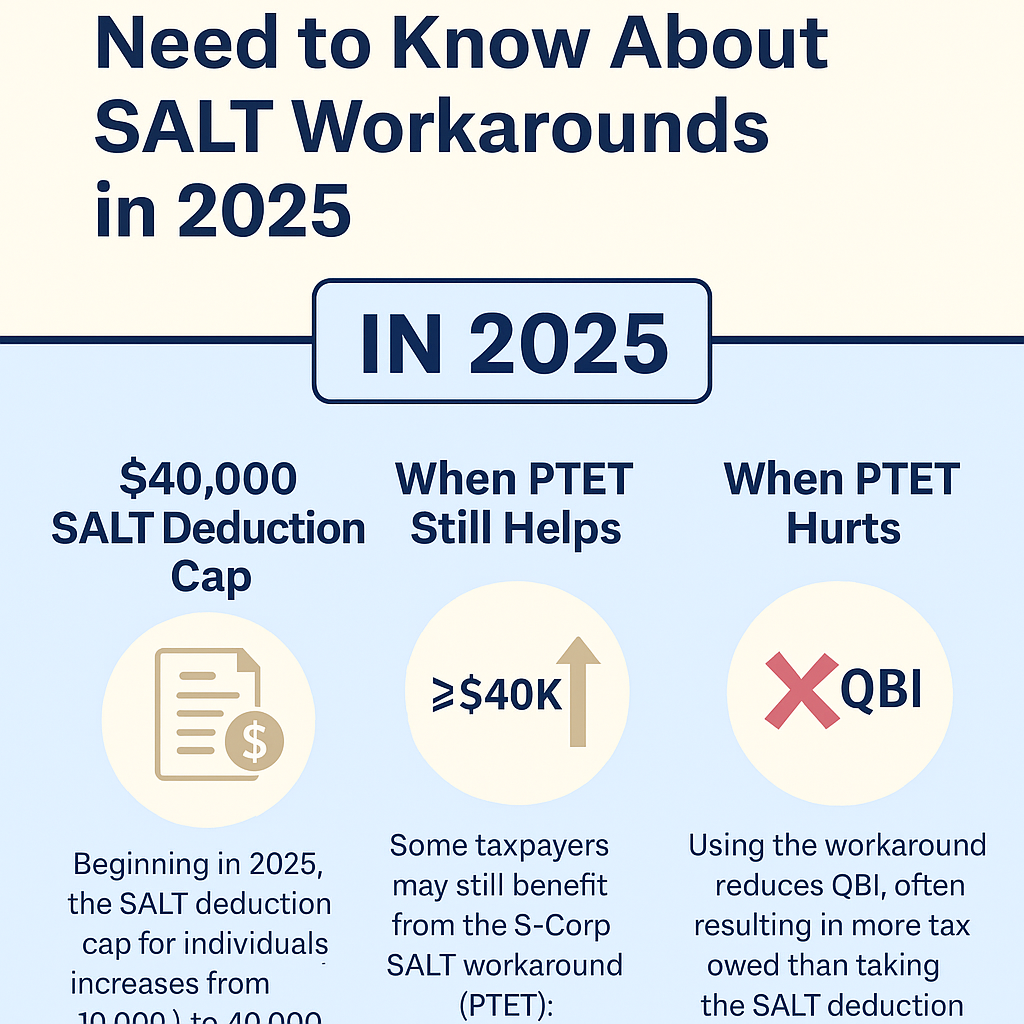
Updated for the 2025 increase of the SALT deduction cap from $10,000 to $40,000.

📌 Quick Summary

Starting in 2025, the federal SALT (State and Local Tax) deduction cap increases from $10,000 to $40,000. This is a major shift for S-Corp owners who used Utah’s PTET workaround to bypass the previous limit.

With a much higher personal deduction threshold, the PTET workaround becomes less necessary—but still strategically useful in certain cases.

This guide explains when Utah business owners should (and shouldn’t) continue using PTET in 2025.


1. What Is the SALT Workaround for S-Corporations?

During the years when federal SALT deductions were capped at $10,000, states (including Utah) created a workaround called:

Pass-Through Entity Tax (PTET)

This allows an S-Corp to pay the owner’s state income tax at the business level and deduct it as a business expense—avoiding the individual SALT cap.

Example under 2024 rules:

  • Utah tax: $15,000
  • Individual SALT limit: $10,000
  • PTET bypasses the cap
  • Entire $15K becomes a business deduction → reduces federal taxable income

This was an extremely valuable strategy for many small business owners.


2. What Changes in 2025?

Beginning January 1, 2025:

The SALT deduction cap increases from $10,000 to $40,000.

This means:

  • Most Utah S-Corp owners can now deduct a much larger portion of their state taxes personally
  • The PTET workaround becomes optional, not essential

Does PTET go away?

No — Utah still allows PTET.
But the math changes in 2025.

Now the question is:
Does the PTET deduction save more than the QBI deduction it reduces?

For many owners, the answer is no.


3. When PTET Still Makes Sense in 2025

Even with a $40,000 SALT deduction available personally, there are situations where PTET still produces better outcomes.

✔ 1. When your state tax exceeds $40,000

High-income earners may still benefit.

Example:

  • State tax owed: $62,000
  • Personal deduction cap: $40,000
  • Remaining $22,000 is nondeductible personally
  • But PTET allows the entire $62,000 to be deducted at the business level

This is still a major PTET advantage.


✔ 2. When you claim the standard deduction

If you do NOT itemize, personal SALT deductions are worthless.

In this case, PTET creates a new business deduction that would otherwise be lost.


✔ 3. When you want to reduce K-1 income

PTET lowers federal K-1 income, which can:

  • Reduce federal tax
  • Reduce 3.8% Net Investment Income Tax
  • Reduce phaseouts tied to AGI
  • Improve certain credit qualifications

This remains a planning tool, even in 2025.


4. When NOT to Use PTET in 2025

There are now more situations where PTET hurts more than it helps.

❌ 1. When PTET reduces your QBI deduction

Because:

  • PTET reduces K-1 income
  • Lower K-1 = lower QBI deduction (20%)

If lowering QBI costs more than the PTET deduction saves → PTET is a bad deal.

This will apply to many small and mid-sized Utah S-Corp owners.


❌ 2. When your Utah taxes fall under the new $40,000 SALT cap

If:

  • Your Utah tax < $40,000
  • You itemize deductions

Then you can deduct 100% of your state tax personally without reducing QBI.

PTET offers no advantage, and may reduce QBI unnecessarily.


❌ 3. When you already itemize (mortgage, charity, state tax)

If you are already itemizing, a larger SALT cap makes personal deduction more efficient than PTET.


5. Examples: PTET vs Personal SALT Deduction in 2025

📘 Example 1: PTET Helps

  • Utah tax: $55,000
  • Personal SALT cap: $40,000
  • $15,000 would be nondeductible personally
  • PTET allows full $55K deduction at entity level

PTET is the better option.


📕 Example 2: PTET Hurts

  • Utah tax: $18,000
  • Well under the $40K cap
  • Owner itemizes
  • K-1 income: $150,000
  • PTET would reduce K-1 → reduces QBI deduction by ~$3,600

Paying SALT personally is superior.


6. Strategic Recommendation for Utah S-Corp Owners in 2025

Recommended for MOST business owners in 2025:

✔ Pay your state tax personally
✔ Itemize and use the increased $40,000 SALT cap
✔ Preserve the full QBI deduction

Use PTET only when:

  • Your state tax exceeds $40K
  • You take the standard deduction
  • You must lower K-1/AGI for tax purposes
  • You’re subject to NIIT or phaseouts

7. Madsen & Company’s Advisory Approach

Because of the new SALT cap, PTET is no longer an automatic strategy.

We now run:

  • Side-by-side QBI comparisons
  • PTET vs personal SALT deduction analyses
  • Itemized vs standard deduction projections
  • Full 2025 tax strategy optimization

This ensures you choose the path that minimizes your total tax, not just one line item.


8. Final Takeaway

In 2024, PTET was usually the best choice.

In 2025, the increased SALT deduction changes everything.

For most Utah S-Corp owners, PTET will NOT be the best option in 2025.

But for high-income or high-tax situations, it can still be a powerful tool.

If you want a custom PTET vs SALT analysis for 2025, Madsen & Company can run the numbers and show the exact tax difference.

Filed Under: Business Tax Tagged With: tax

Business Tax Reduction 101: Smart Strategies to Keep More of What You Earn

July 1, 2025 by admin

For every business owner, managing taxes is one of the most important parts of running a successful operation. Overpaying taxes can eat into profits, while smart planning can significantly improve your bottom line. The good news? With the right strategies, you can reduce your business tax liability legally and effectively.

This guide breaks down the basics of business tax reduction—what it is, why it matters, and how to do it.

Why Business Tax Reduction Matters
Paying taxes is a non-negotiable part of doing business, but how much you pay is often within your control. By leveraging deductions, credits, and smart planning, you can:

  • Improve cash flow
  • Boost profitability
  • Reinvest more into your business
  • Avoid costly penalties and audits

The key is understanding your options and taking a proactive approach throughout the year—not just during tax season.

Top Strategies for Reducing Business Taxes

1. Maximize Business Deductions
The IRS allows you to deduct “ordinary and necessary” expenses related to running your business. Some common deductions include:

  • Office rent or home office expenses
  • Business travel and meals (50% deductible)
  • Equipment and software
  • Marketing and advertising
  • Professional services (legal, accounting, consultants)
  • Employee wages and benefits

Keep detailed records and receipts to support your deductions in case of an audit.

2. Leverage Section 179 and Bonus Depreciation
If you purchase equipment or vehicles for your business, you can often deduct the full cost in the year of purchase through Section 179 or bonus depreciation. These incentives can provide huge tax savings, especially for capital-intensive businesses.

3. Hire Strategically
Hiring employees or independent contractors may qualify you for tax credits and deductions. The Work Opportunity Tax Credit (WOTC), for example, rewards businesses that hire veterans, ex-felons, or long-term unemployed workers.

Also, offering tax-advantaged benefits like retirement plans, health insurance, or commuter benefits can reduce your payroll tax burden.

4. Contribute to a Retirement Plan
Setting up a retirement plan—like a SEP IRA, SIMPLE IRA, or Solo 401(k)—not only helps you and your employees save for the future, but also reduces your taxable income. Employer contributions are typically tax-deductible.

5. Choose the Right Business Structure
The way your business is structured (sole proprietorship, LLC, S-corp, C-corp, partnership) can have a major impact on your tax bill. For example:

  • S-corporations allow profits (and losses) to pass through to the owner’s personal tax return, avoiding double taxation.
  • LLCs offer flexibility—you can elect how you want to be taxed.
  • C-corporations may benefit from a flat corporate tax rate, but may also be subject to double taxation unless handled carefully.

Work with a tax professional to determine the best structure for your business.

6. Defer Income and Accelerate Expenses
If your business operates on a cash basis, you can defer income (delay invoices or payments) to the next tax year and accelerate expenses (prepay for goods or services) in the current year to reduce your taxable income.

7. Take Advantage of Tax Credits
Credits directly reduce your tax liability dollar for dollar. Some examples include:

  • R&D Tax Credit: For businesses investing in innovation, technology, or product development.
  • Energy Efficiency Credits: For eco-friendly building upgrades or equipment.
  • Small Business Health Care Tax Credit: If you offer health insurance and meet eligibility criteria.

Tax credits often require documentation and qualifications, so consult a tax advisor before applying.

Common Mistakes to Avoid

  • Failing to keep accurate and updated financial records
  • Mixing personal and business expenses
  • Ignoring quarterly estimated tax payments
  • Waiting until year-end to plan taxes
  • Overlooking tax credits and deductions you’re eligible for

Final Thoughts
Reducing your business taxes doesn’t mean cutting corners—it means planning smartly and using the tax code to your advantage. Whether you’re a solo entrepreneur or run a growing enterprise, these strategies can help you legally reduce your tax burden and improve your financial health.

Partner with a qualified accountant or tax advisor to tailor a tax reduction plan that fits your specific business model. With the right support, you can keep more of what you earn—and reinvest it into the success of your business.

Filed Under: Business Tax

  • « Go to Previous Page
  • Page 1
  • Interim pages omitted …
  • Page 3
  • Page 4
  • Page 5
  • Page 6
  • Page 7
  • Page 8
  • Go to Next Page »

Primary Sidebar

Search

Archives

  • March 2026
  • February 2026
  • January 2026
  • December 2025
  • November 2025
  • July 2025
  • May 2025
  • April 2025
  • March 2025
  • January 2025
  • August 2024
  • July 2024
  • June 2024
  • February 2024
  • January 2024
  • November 2023
  • August 2023
  • March 2023
  • February 2023

Categories

  • Business Best Practices
  • Business Tax
  • Individual Tax
  • Real Estate
  • Retirement
  • S-Corporation Tax
  • Small Business
  • Small Business Taxes
  • Tax Deadlines & Compliance
  • Tax Planning
  • Uncategorized

Copyright © 2026 · https://www.madsencpa.com/blog