• Skip to main content
  • Skip to primary sidebar

  • Home
  • About
  • Contact

South Jordan CPA

The South Jordan Business Owner’s Guide to 2026: Taxes, S-Corporations, and Smart Planning

March 1, 2026 by Steve Madsen

South Jordan Utah business district near City Hall where local S-Corporation owners and small businesses operate
South Jordan, Utah — a fast-growing business hub where proactive tax planning matters more than ever.

Running a business in South Jordan, Utah in 2026 looks very different compared to just a few years ago. Rapid growth across the south end of the Salt Lake Valley, rising property values, and continued shifts toward virtual-first operations now change how local businesses pay taxes — especially S-Corporation owners and real estate investors.

What’s Changed for South Jordan Businesses in 2026

We work with South Jordan business owners year-round, not just during tax season, which lets us make planning decisions before they become permanent.

Whether you operate from a home office in Daybreak, manage crews across Salt Lake County, or run a professional service business serving clients nationwide, this guide focuses on the South Jordan-specific tax and compliance issues we see most often — and where proactive planning actually saves money.


Why South Jordan Business Owners Overpay in Taxes

Most South Jordan business owners don’t overpay taxes because they’re careless. They overpay because:

  • They operate under an outdated entity structure.
  • They fail to plan payroll and distributions correctly.
  • City- and state-level compliance issues surface after the year ends.

By the time tax returns are prepared in April, many of the biggest savings opportunities are already gone.

That’s why smart owners shift from tax preparation to tax planning.


South Jordan Business Licensing: What Still Causes Problems

South Jordan has continued improving its digital licensing systems, but Home Occupation Licenses remain a frequent point of confusion for virtual-first businesses.

What we see in practice:

  • Many virtual-only S-Corporations still need to register, even when no in-person clients visit the home
  • Licensing fees and renewal requirements can change periodically
  • Moving from one South Jordan address to another typically requires a new license, not a transfer

Why this matters:
Licensing gaps often surface during tax preparation or financing reviews, forcing teams to fix them under pressure.


South Jordan Sales Tax (7.45%) — Where Mistakes Happen

The combined sales tax rate in South Jordan is approximately 7.45%, reflecting Utah state tax, Salt Lake County options, and municipal components.

The issue is rarely the rate itself.

Common problems we see:

  • Misclassified digital or mixed services
  • Short-term rental owners missing Transient Room Tax obligations
  • Incorrect nexus assumptions for virtual or multi-state S-Corporations

Sales tax errors don’t just create penalties — they create audit exposure.

Basic tax preparation rarely catches these issues because businesses classify transactions throughout the year.


Utah Income Tax Changes and Why S-Corp Planning Matters More in 2026

Utah’s flat tax structure continues to evolve. Legislative triggers such as Utah Senate Bill 116 (SB 116) allow the state to reduce individual and corporate income tax rates when revenue thresholds are met.

Why Federal Payroll Taxes Matter More Than Utah Income Tax

For South Jordan S-Corporation owners, this reinforces an important truth:

State income tax savings are incremental.
Federal payroll tax planning is where the real money is.

The most expensive mistakes we see come from:

  • “Safe” salaries that are far too high
  • Distributions taken without proper support
  • No written reasonable-salary analysis

Business owners create meaningful savings when they plan these items before the year locks in.


Real Estate Investors in South Jordan: Planning Gaps We See

South Jordan continues to attract real estate investors, especially in newer developments and mixed-use areas.

Common planning gaps include:

  • Depreciation schedules not aligned with entity structure
  • Short-term rental compliance issues
  • Passive vs. non-passive classification errors
  • Missed planning opportunities tied to income timing

Real estate tax planning is not a once-a-year event — it requires coordination across the entire year.


Local Business Resources That Actually Matter

Serious business owners don’t grow in isolation.

The following resources tend to be most useful for South Jordan business owners who are actively growing or restructuring.

  • South Valley Chamber — Practical networking across South Jordan, Riverton, and Draper
  • Miller Business Resource Center — Targeted mentoring and education for scaling businesses
  • Madsen and Company — Virtual-first tax planning and S-Corporation advisory grounded in real South Jordan client experience

Serving the South Valley

While this guide focuses on South Jordan, we regularly work with business owners across the south end of the Salt Lake Valley, including Riverton, Herriman, Draper, and West Jordan. Each area has unique patterns — but the planning principles remain the same.

(Individual city guides coming soon.)

Additional Guidance for South Jordan Business Owners

FAQ Section — South Jordan Business Owners (2026)

What is the biggest tax mistake South Jordan business owners make?

The biggest tax mistake South Jordan business owners make is waiting until tax season to address planning issues. By April, entity structure, payroll strategy, and S-Corporation salary decisions are already locked in, which often results in higher taxes that could have been avoided with earlier planning.

Do I need a business license to operate a home-based business in South Jordan?

Many home-based and virtual-first businesses in South Jordan are still required to register for a business license, even if no clients visit the home. While some businesses may not owe a fee, registration and renewal requirements can still apply and should be reviewed annually.

How does South Jordan’s sales tax rate affect small businesses?

South Jordan’s combined sales tax rate is approximately 7.45%. The most common problems are not the rate itself, but misclassified services, incorrect nexus assumptions, and missed obligations such as Transient Room Tax for short-term rental owners. These errors can lead to penalties and audit exposure.

Why is S-Corporation planning so important for South Jordan business owners?

S-Corporation planning is critical because most tax savings come from properly balancing reasonable salary and distributions. While Utah’s income tax rate is relatively low, federal payroll taxes are significant. Poor salary planning is one of the most common reasons South Jordan S-Corp owners overpay taxes.

More Common Questions from South Jordan Business Owners


Do real estate investors in South Jordan need year-round tax planning?

Yes. Real estate investors in South Jordan often face issues with depreciation timing, passive activity classification, and short-term rental compliance. These items cannot be fully corrected after year-end, making ongoing tax planning essential rather than relying solely on annual tax preparation.

Should South Jordan business owners work with a local CPA or a virtual CPA?

Many South Jordan business owners benefit from working with a CPA who understands local tax issues while offering virtual-first planning and advisory services. This combination allows for proactive strategy, flexibility, and year-round support without being limited to in-office meetings.

Is tax preparation the same as tax planning?

No. Tax preparation focuses on reporting what already happened, while tax planning focuses on making decisions throughout the year that reduce taxes legally. South Jordan business owners who rely only on tax preparation typically miss meaningful savings opportunities.

When should South Jordan business owners start tax planning for the year?

Tax planning should begin early in the year — ideally before payroll, distributions, and major purchases are finalized. Waiting until April usually limits options and turns planning into simple tax reporting instead of proactive strategy.

Final Thought for South Jordan Business Owners

Waiting until April turns tax strategy into tax reporting.

For South Jordan S-Corporation owners and real estate investors, proactive planning often means:

  • Lower payroll taxes
  • Fewer compliance surprises
  • Clearer cash-flow decisions

f you want clarity before the year becomes locked in, tax planning needs to happen early — not after the return is filed.

South Jordan business owners:
Schedule a discovery call to see how proactive tax planning can reduce taxes and eliminate surprises in 2026.


Filed Under: S-Corporation Tax, Tax Planning Tagged With: proactive tax planning, small business CPA, small business tax planning, South Jordan CPA, South Jordan Tax Planning, Utah CPA, virtual CPA

Tax Planning vs Tax Preparation: Why March Is Too Late

February 14, 2026 by Steve Madsen

Calendar marked ‘March – Too Late’ next to tax forms and calculator illustrating why a CPA cannot fix a bad 2025 tax year after year-end.
Most tax decisions are locked in after December 31. By March, tax filing is no longer a strategy session — it is a reporting exercise.

Tax planning vs tax preparation is the difference between shaping your tax outcome and simply reporting it.
Most tax decisions are locked in after December 31, making March tax filing a reporting process—not a strategy session.

If you want a deeper explanation of the difference between tax preparation and tax planning, start with our guide on business tax preparation vs tax planning.


Why can’t tax strategy be fixed after December 31?

This is the core distinction between tax planning vs tax preparation — planning changes outcomes before year-end, while preparation only reports what already happened.

Because most tax-saving strategies must be implemented before the year closes.

Once the calendar year ends, the IRS treats your financial activity as final. At that point, your CPA can only report the results accurately, not restructure them.

Key examples of what becomes fixed after year-end include:

  • Income timing: You cannot shift income to a different year once it has been earned and received.
  • Entity structure: You cannot retroactively change your entity type under IRS S-Corporation tax rules once the tax year has closed.
  • Retirement plan design: You cannot create new employer plans after year-end and apply them backward.
  • Depreciation strategy: You cannot change how assets were purchased or placed in service.
  • Payroll strategy: You cannot correct a missing reasonable salary after the year closes.

As a result, March tax work becomes historical reporting, not strategic planning.


What decisions are already locked in by tax season?

Your major tax drivers are determined by how your business operated during the year.

By the time tax documents arrive, the following decisions are already embedded in your return:

  • How your business was structured (sole prop, LLC, S-Corp, partnership)
  • How much you paid yourself versus distributions
  • When you recognized revenue
  • What expenses you documented and categorized
  • Whether assets were purchased strategically or reactively
  • Whether estimated payments matched actual liability

Each of these choices affects tax liability. However, none of them can be meaningfully changed during tax preparation.

For many business owners, choosing the right entity type—such as an S corporation—must be done early to take advantage of S-Corporation tax planning strategies.


Tax Planning vs Tax Preparation: What Your CPA Can Do in March?

Your CPA can optimize reporting but not redesign outcomes.

Tax preparation still adds value, even late in the cycle. However, the value comes from accuracy and compliance, not from strategy creation.

At this stage, your CPA can:

  • Ensure deductions are properly classified
  • Apply existing tax elections correctly
  • Catch missing documents or data errors
  • Verify depreciation and carryforwards
  • File extensions when needed
  • Prevent penalties and filing mistakes

These actions protect you from overpaying due to errors, but they cannot reduce tax caused by poor planning.

At this stage, your CPA can still ensure deductions are properly classified and returns are filed accurately through professional business tax preparation services.


Why does waiting create higher tax bills?

Because tax planning only works when there is still time to make different choices.

When business owners wait until filing season, they often discover:

  • They should have switched entity types earlier
  • They should have paid themselves differently
  • They should have timed income and expenses more intentionally
  • They should have created retirement plans sooner
  • They should have purchased equipment differently
  • They should have adjusted quarterly estimates

Unfortunately, realization does not create retroactive authority. The IRS measures behavior, not intention.


When does real tax planning actually happen?

Effective tax planning happens during the year, not after it ends.

Proactive tax planning focuses on future periods instead of past transactions.

This process typically includes:

  • Mid-year tax projections
  • Entity structure evaluations
  • Compensation strategy reviews
  • Asset purchase timing
  • Retirement contribution planning
  • Cash flow and estimated tax modeling
  • Multi-year tax forecasting

Each of these actions changes the numbers before they become permanent.

This principle applies equally to business owners and real estate investors who rely on real estate tax planning to manage depreciation and income timing.

Effective tax planning services focus on income timing, entity structure, and long-term strategy before deadlines pass.

I explain this timing difference in more detail in this short video on tax planning vs tax preparation, including why waiting until filing season limits what a CPA can actually change.


Bottom Line

  • Tax preparation reports history.
  • Tax planning shapes outcomes.
  • Once a tax year ends, most meaningful tax strategies expire with it.

Waiting until March limits your CPA to compliance instead of strategy.


How Madsen and Company Can Help

Madsen and Company provides both tax preparation and proactive tax planning for business owners, S-Corporation owners, and real estate investors.

We help clients:

  • Identify tax risks before year-end
  • Implement entity and compensation strategies
  • Project future tax liability
  • Coordinate business and personal tax planning
  • Use tax preparation as execution, not discovery

If you only need tax filing, we provide accurate, compliant returns.
If you want lower taxes going forward, we offer year-round tax planning and advisory services.

Schedule a tax planning consultation to see what can still be changed for the current year — and what should be done before this one closes.


Frequently Asked Questions

Can my CPA reduce my taxes after the year is over?

No, your CPA cannot implement most tax-saving strategies after the year closes.
They can apply existing rules correctly, but they cannot retroactively change income, structure, or timing decisions.

Is tax preparation the same as tax planning?

No, tax preparation reports results, while tax planning changes future results.
Preparation looks backward. Planning looks forward.

What is the best time to start tax planning?

The best time is before the year ends and preferably during the year.
Quarterly or mid-year reviews allow strategy adjustments while time remains.

Does this apply to small businesses only?

No, this applies to individuals, investors, and business owners.
Anyone with variable income, assets, or business activity benefits from proactive planning.

What if I already filed my return?

You can still plan for the next tax year even after filing.
Filing closes one chapter. Planning controls the next one.

Ready to stop guessing and start planning?
Tax preparation shows you what already happened. Tax planning helps you change what happens next.

Madsen and Company works with business owners to identify tax-saving opportunities before the year closes — not after the damage is done.

👉 Schedule a Tax Planning Consultation
👉 Start Tax Preparation

Filed Under: Small Business Taxes, Tax Planning Tagged With: S corporation tax planning, Small Business Tax Strategy, South Jordan CPA, tax planning vs tax preparation, year end tax planning

Why Tax Season Is the Worst Time to “Start” Tax Planning

February 5, 2026 by Steve Madsen

Written by Steve Madsen, CPA — licensed since 1993.

Business owner reviewing finances early in the year, illustrating why tax season is the worst time to start tax planning
Tax season focuses on reporting the past — proactive tax planning happens before deadlines arrive.

Tax planning timing matters more than most business owners realize. Tax season is when many people start thinking about strategy, but it’s also when most tax-saving opportunities are already gone.

By the time January through April arrives, the decisions that could have made the biggest difference for the prior year have already been locked in. This is why proactive planning is a core part of our business tax planning and advisory services, not something that happens only during filing season.

For Utah-based business owners, proactive tax planning often affects both federal and state tax outcomes, making timing and structure especially important.

Why Doesn’t Tax Season Allow Real Planning?

During this period, the focus shifts to reporting what already happened.

Once the calendar year ends, your CPA’s role shifts from strategic advisor to compliance specialist. The work becomes about accurately documenting the past, not shaping the future.

During tax season, the focus is on:

  • Accurately reporting income and expenses
  • Filing required federal and state tax returns
  • Applying any elections that are still available
  • Ensuring IRS and state compliance

At that point, your tax return is a historical document, not a planning tool.

What Tax Decisions Are Usually Locked In After December 31?

Most high-impact tax decisions must be made before the year ends.

After December 31, many of the strategies that could significantly reduce your taxes are no longer on the table.

Common examples include:

  • S-Corporation salary levels
  • Timing of income and expenses
  • Bonus depreciation and Section 179 elections
  • Retirement contribution structure
  • Accountable plan reimbursements
  • Health insurance handling for owners

Because of this, waiting until tax season often means reviewing missed opportunities rather than creating new ones.

What Is January Actually Good For?

January is ideal for reviewing results and preparing for proactive planning — not fixing the past.

While tax season limits what you can change about the prior year, it provides valuable insight for the year ahead.

January is best used to:

  • Review the prior year objectively
  • Identify planning opportunities that were missed
  • Set payroll and entity strategy correctly for the new year
  • Adjust estimates before issues compound
  • Build a proactive tax plan early

Smart business owners use January to prepare for planning, not to undo last year.

This is why proactive tax planning timing early in the year makes such a difference.

What’s the Difference Between Tax Filing Season and Tax Planning Season?

Tax filing and tax planning serve very different purposes.

Filing Season

  • Looks backward
  • Emphasizes accuracy and compliance
  • Offers limited ability to change results
  • Often results in surprise balances due

Planning Season

  • Looks forward
  • Shapes outcomes intentionally
  • Happens throughout the year
  • Improves cash flow and predictability

The biggest tax savings are created before tax season — not during it.

Who Should Be Thinking About Tax Planning Early?

Tax planning matters most when your situation involves decisions, not just reporting.

January planning is especially valuable for:

  • S-Corporation owners
  • Business owners with growing profits
  • Service-based businesses and consultants
  • Real estate investors
  • Anyone earning $150,000 or more

If your tax situation includes strategy, structure, or timing, waiting until filing season puts you behind.

Need help with tax preparation this season? Filing is easier when it supports a bigger plan.

What Do Proactive Business Owners Do Differently?

Proactive business owners treat tax planning as a process, not an annual event.

Instead of waiting for a finished tax return, they:

  • Review income projections early
  • Set reasonable S-Corp salaries intentionally
  • Coordinate retirement contributions with payroll
  • Plan deductions throughout the year
  • Adjust estimates before surprises arise

These decisions tie directly into ongoing tax planning, not just tax preparation.

The Bottom Line

Tax planning timing determines whether your tax return reflects strategy or missed opportunity.

If tax season is the first time strategy comes up, opportunities have already been missed. The best outcomes happen when planning starts early and continues throughout the year.

For many Utah-based business owners, waiting until filing season often leads to repeat surprises year after year.

Frequently Asked Questions

Why isn’t tax season the best time to start tax planning?

Because most high-impact tax decisions must be made before the year ends. Tax season is primarily about reporting and compliance, not creating new savings opportunities.

Can a CPA still help reduce taxes during tax season?

A CPA can ensure accuracy and apply limited elections, but major strategies are usually no longer available. Most meaningful savings come from decisions made earlier.

Is January too late to do tax planning?

No, January is ideal for reviewing results and planning for the current year. It’s just too late to change many outcomes for the prior year.

Do small business owners really need year-round tax planning?

Yes, especially if income fluctuates or decisions affect payroll, deductions, or cash flow. One-time planning rarely produces optimal results.

What’s the difference between tax preparation and tax planning?

Tax preparation reports what happened, while tax planning shapes what happens next. Both are important, but they serve different roles.

How Madsen and Company Can Help

At Madsen and Company, we help business owners move beyond reactive tax season thinking and into proactive, year-round tax strategy.

That includes:

  • Strategic tax planning throughout the year
  • Coordinated business and personal tax preparation
  • Clear guidance before deadlines pass

Need tax preparation this season? We ensure your returns are accurate, compliant, and aligned with your overall strategy.

Want to reduce future tax surprises? A proactive tax planning review can help you start the year intentionally — not reactively.

👉 Schedule a Proactive Tax Planning Review

Filed Under: Business Tax, Tax Planning Tagged With: proactive tax planning, Small Business Tax Strategy, small business taxes, South Jordan CPA, tax planning

Maximizing Tax Savings for S-Corporation Owners: Proactive Strategies That Work

February 3, 2026 by Steve Madsen

Written by Steve Madsen, CPA — licensed since 1993.

Header image showing S-Corporation tax documents, calculator, coins, and chart representing proactive tax savings strategies.
Proactive S-Corporation tax planning strategies can reduce taxable income and improve cash flow when implemented during the year.

For Utah-based S-Corporation owners, proactive tax planning also interacts with state and federal tax rules — and timing these decisions correctly can make a measurable difference in your overall tax outcome.

S-Corporation owners can legally reduce taxes by combining reasonable salary planning, strategic distributions, and depreciation deductions.
However, the biggest tax savings opportunities happen during the year—not at filing time.

This proactive mindset is foundational to our S-Corporation tax planning services, which help business owners structure payroll and distributions intentionally rather than reactively.

CPA Insight:

S-Corporation tax savings are created by proactive decision-making during the year — not by filing the S-Corporation return after year-end.


What tax advantages does an S-Corporation provide?

In general, an S-Corporation allows business owners to reduce overall taxes by separating compensation into salary and distributions.

By comparison, S-Corporation income flows through the owner’s personal return while allowing payroll tax flexibility. When structured properly, this can significantly lower self-employment tax exposure.

In practice, the primary tax benefits include:

  • Pass-through taxation with no entity-level federal income tax
  • Ability to pay owner income partially as distributions not subject to payroll tax
  • More planning flexibility for retirement contributions and deductions
  • Opportunities to time income and expenses strategically

However, these benefits only work when paired with proactive planning and proper documentation.

Because of this, salary and distribution planning becomes the next critical step.


How should S-Corporation owners structure salary and distributions?

To comply with IRS rules, owners who actively work in the business must receive W-2 wages that reflect market compensation.

In practice, effective salary and distribution strategies involve:

  • First, evaluating job duties, experience, and time spent in the business
  • Next, comparing industry compensation benchmarks
  • Finally, coordinating distributions with cash flow and estimated taxes

At the same time, too little salary increases audit risk, while too much salary increases unnecessary payroll taxes. The goal is defensible balance, not extremes.

Beyond compensation strategy, depreciation deductions offer another powerful way to reduce taxable income.


How do depreciation deductions reduce taxable income?

Specifically, depreciation deductions lower taxable income by allowing businesses to expense qualifying assets over time—or accelerate those deductions when tax law allows.

For example, S-Corporations commonly depreciate:

  • Vehicles used for business purposes
  • Equipment and machinery
  • Computers and technology
  • Furniture and office improvements

As part of a broader tax strategy, strategic depreciation planning may include:

  • Section 179 expensing for immediate write-offs
  • Bonus depreciation when applicable
  • Proper asset classification to avoid errors

Because depreciation elections are time-sensitive, planning before purchases occur is critical.


Why does timing matter in S-Corporation tax planning?

The timing of business decisions determines tax savings—not the filing of the return.

Once the year ends

  • Payroll amounts cannot be retroactively changed
  • Businesses often lose missed depreciation elections once the year closes.
  • Owners may already exceed their shareholder basis through distributions.

By contrast, proactive planning allows:

  • Income and deductions to be matched intentionally
  • Estimated taxes to be calculated accurately
  • Cash flow to remain predictable throughout the year

As a result, tax planning becomes a financial strategy rather than a compliance exercise.


What are the most common S-Corporation tax mistakes?

Most S-Corporation tax problems stem from lack of planning, not aggressive behavior.

For this reason, many S-Corporation owners encounter tax problems even when they are trying to do the right thing.

Common issues include:

  • Paying no salary or an unreasonably low salary
  • Taking distributions without tracking shareholder basis
  • Misclassifying personal expenses as business deductions
  • Waiting until tax season to ask planning questions

These mistakes often result in higher taxes, penalties, or missed deductions that cannot be corrected later.


Bottom Line

Ultimately, S-Corporation tax savings depend on proactive planning, not last-minute filing.
Reasonable salary, strategic distributions, and depreciation deductions work best when coordinated.
Business owners who plan during the year consistently pay less tax than those who only prepare returns.

With these strategies in mind, professional guidance becomes essential to implement them correctly.


How Madsen and Company Can Help

At Madsen and Company, we work with S-Corporation owners year-round—not just at tax time. Our approach focuses on proactive tax planning that aligns with your business goals while staying fully compliant.

We help S-Corporation owners with:

  • Reasonable salary analysis and documentation
  • Distribution and basis planning
  • Depreciation strategy and asset timing
  • Ongoing tax projections and estimated payments
  • Business and individual tax preparation

Whether you need proactive S-Corporation tax planning services or ongoing tax preparation support, the goal is simple: pay the tax you legally owe—and not more.


Frequently Asked Questions (FAQ)

Do S-Corporation owners have to pay themselves a salary?

Yes. If the owner performs services for the business, the IRS requires a reasonable salary before distributions are taken.

Are S-Corporation distributions subject to payroll tax?

No. Distributions are not subject to Social Security or Medicare taxes, provided a reasonable salary has already been paid.

Can depreciation create tax losses in an S-Corporation?

Yes. Depreciation deductions can reduce or eliminate taxable income, but losses may be limited by shareholder basis and other rules.

Is S-Corporation tax planning only for high-income businesses?

No. While higher profits increase the impact, many S-Corporations benefit once annual profits exceed approximately $50,000–$75,000.

When should S-Corporation tax planning start?

Ideally at the beginning of the year and revisited quarterly, especially before major purchases or income changes.


Ready to Take the Next Step?

If you own an S-Corporation and want clarity instead of surprises at tax time, proactive planning is the next move.

Schedule a tax planning conversation or get help with your S-Corporation tax preparation today.
A clear strategy now can prevent unnecessary taxes later—and that’s where real peace of mind begins.

Filed Under: S-Corporation Tax, Small Business Taxes Tagged With: depreciation, reasonable salary, S corporation tax planning, Small Business Tax Strategy, South Jordan CPA

The S-Corp Deadline Is Closer Than You Think: 5 Things to Do Before March 15

February 1, 2026 by Steve Madsen

Written by Steve Madsen, CPA — licensed since 1993.

March 15 business tax deadline for S-Corporation owners
S-Corporation owners must file by March 15 to avoid IRS penalties and delays.

The March 15 tax deadline is one of the most important — and most misunderstood — deadlines for S-Corporation owners and partnerships.

This deadline is also a key checkpoint in proactive S-Corporation tax planning, where payroll, distributions, and documentation decisions must be finalized before opportunities disappear.

For Utah-based S-Corporation owners, the March 15 deadline often impacts both business filings and personal tax planning timelines, making early action especially important.

Each year, business owners are caught off guard by March 15, assuming they still have time or that filing an extension means nothing is due. That misunderstanding can lead to penalties, rushed decisions, and avoidable stress.

What Is Due on the March 15 Business Tax Deadline?

March 15 is the federal filing deadline for S-Corporations and partnerships, regardless of income or tax owed.

This deadline applies to:

  • S-Corporations (Form 1120-S)
  • Partnerships (Form 1065)

The March 15 deadline applies whether:

  • the business has one owner or multiple owners
  • the business made money or not
  • the business ultimately owes tax or not

If your business is required to file, the deadline applies.


March 15 in plain terms:

March 15 is the deadline for filing the business return so income can flow correctly to the owner’s personal tax return; missing it can trigger penalties and downstream personal tax issues.


CPA Insight:

For S-Corporation owners, March 15 is not just a filing deadline — it’s the last meaningful checkpoint to ensure business income is reported correctly and personal tax planning can still happen on time.

The Hidden Cost of Missing March 15

Missing the March 15 business tax deadline can trigger IRS penalties even if no income tax is owed.

One of the biggest misconceptions is that penalties only apply if tax is owed.

For S-Corporations, that’s not true.

If an S-Corp return is late and no extension is filed, the IRS can assess penalties of approximately $245 per shareholder, per month, up to 12 months—even if the business itself owes no income tax.

That means a “harmless delay” can quietly turn into thousands of dollars in penalties.

Filing an Extension Doesn’t Mean Doing Nothing

An extension:

  • gives you more time to file, not more time to plan
  • does not delay taxes owed or required estimated payments
  • still requires reasonable estimates and coordination with personal returns

Waiting until after March 15 to think about the business return often limits your options and forces reactive decisions instead of intentional ones.

What Smart Business Owners Do Before March 15

Proactive business owners use the weeks leading up to March 15 to:

  • Confirm the correct business structure is still working
  • Review profit levels before returns are finalized
  • Ensure S-Corp payroll is reasonable and defensible
  • Coordinate business results with personal tax planning
  • Decide whether filing now or extending makes the most sense

Many of these decisions tie directly into ongoing tax planning, not just tax preparation.

Unsure whether to file or extend? A short planning review before March 15 can clarify your next steps.

The goal isn’t just to meet a deadline—it’s to file returns that reflect deliberate strategy, not last-minute scrambling.

Why March 15 Impacts Your Personal Taxes Too

Business returns don’t exist in a vacuum.

For S-Corp owners and partners, the business return directly affects:

  • personal taxable income
  • estimated tax requirements
  • retirement planning
  • cash flow planning for the year ahead

Rushing the business return often creates downstream issues on the personal side—including surprises in April.

The Bottom Line

March 15 isn’t just a filing date—it’s a decision point.

When business tax returns are treated as a formality instead of part of a broader plan, opportunities get missed and risks increase.

The best outcomes happen when:

  • the business return is handled intentionally
  • deadlines are used strategically
  • and planning happens before options disappear

FAQs

What business tax returns are due on March 15?

March 15 is the federal filing deadline for S-Corporations (Form 1120-S) and partnerships (Form 1065). This deadline applies even if the business has only one owner or did not generate taxable income.

What happens if an S-Corp misses the March 15 deadline?

Missing the March 15 deadline can trigger IRS penalties even if no tax is owed. The IRS may assess penalties of approximately $245 per shareholder, per month, up to 12 months, if no extension is filed.

Does filing an extension delay taxes owed?

No, filing an extension only delays the deadline to file the return, not to pay taxes. Any tax owed must still be paid by the original due date to avoid penalties and interest.

Do single-member S-Corps still have to file by March 15?

Yes, single-shareholder S-Corporations are subject to the same March 15 deadline as multi-owner S-Corps. The filing requirement and penalty structure apply regardless of the number of shareholders.

Can I still make tax planning decisions after March 15?

Most high-impact tax planning decisions must be made before the year ends, not after March 15. While some elections may still be available, key items like payroll levels, income timing, and certain deductions are usually already locked in.

Is it better to file or extend an S-Corp return?

Whether to file or extend depends on your business’s income, documentation readiness, and coordination with personal taxes. The best choice is an intentional one based on planning, not a default reaction to timing pressure.

Why does the March 15 deadline affect my personal tax return?

S-Corporation and partnership income flows directly into the owner’s personal tax return. Delays or rushed filings at the business level can create surprises in personal tax liability, estimates, and cash flow planning.

How Madsen and Company Can Help

At Madsen and Company, we help business owners approach the March 15 deadline with clarity—not panic.

That means:

  • understanding what decisions still matter
  • coordinating business and personal tax strategy
  • and ensuring filings support long-term goals, not just compliance

👉 Want to know what decisions matter most right now?

Unsure whether to file or extend? A short planning review before March 15 can clarify next steps.
Schedule a Proactive Tax Planning Review.

Filed Under: Business Tax, Tax Deadlines & Compliance Tagged With: business tax planning, proactive tax planning, S corporation tax planning, Small Business Tax Strategy, small business taxes, South Jordan CPA, tax planning, Utah tax planning

Small Business Tax Planning: Strategies to Reduce Taxes Legally

January 28, 2026 by Steve Madsen

Written by Steve Madsen, CPA — licensed since 1993.

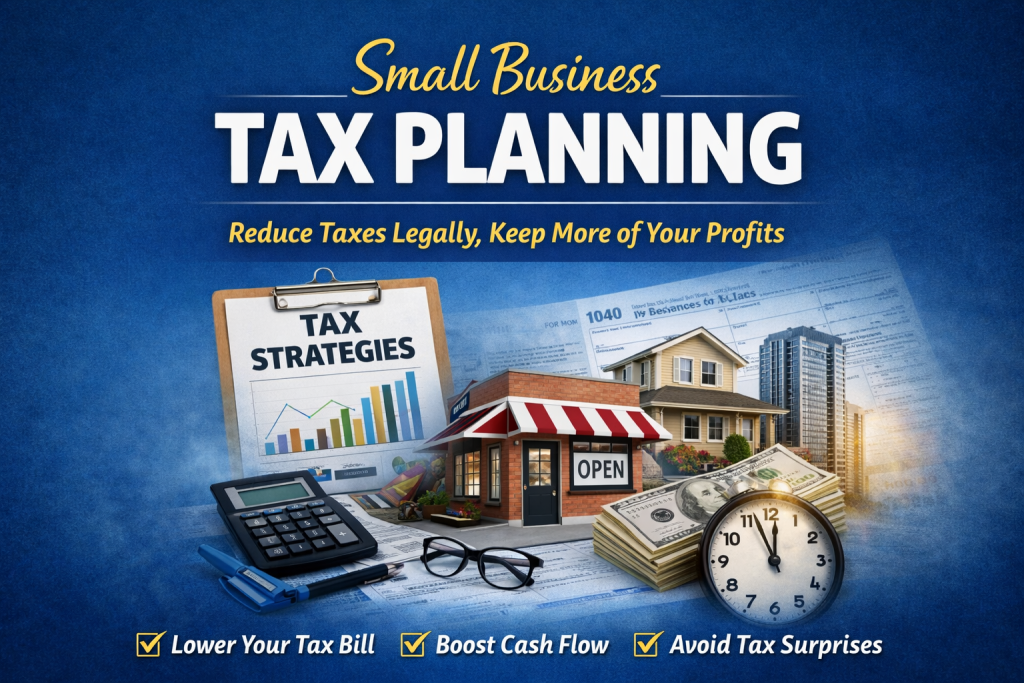
Small business tax planning strategies to reduce taxes legally for business owners and real estate investors
Proactive tax planning helps small business owners lower taxes, improve cash flow, and avoid filing-season surprises.

Most business owners focus entirely on tax filing. However, the real savings are not found in April. They are created through strategic small business tax planning done well before the year ends.

CPA Insight:
The biggest tax savings for small business owners are created by decisions made during the year, not by what shows up on a tax return.

If you own a small business, an S-Corporation, or rental property, proactive tax planning is the difference between writing a large check to the IRS and keeping more of your cash to reinvest in your business and future.


Tax Planning vs. Tax Preparation: What’s the Difference?

It is a common misconception that tax planning and tax preparation are the same thing.

Tax preparation is historical. It reports what has already happened.

By the time you are “doing your taxes,” most opportunities to change the outcome are gone.

CPA Insight:
Tax preparation records results. Tax planning influences them. Understanding this difference is the foundation of effective small business tax strategy.

By contrast, tax planning is forward-looking. It focuses on shaping financial decisions today to legally reduce what you owe tomorrow.

As a result, effective planning allows you to:

  • Legally lower taxable income through smart deductions
  • Improve cash flow so you are not hit with an unexpected bill
  • Align business growth with current tax strategies
  • Reduce filing-season surprises

Learn how tax preparation fits into the process and how proactive planning works


Optimize Your Business Structure

First, your business structure is the foundation of your tax bill. Whether you operate as a sole proprietor, LLC, partnership, or S-Corporation affects how much tax you pay.

For many profitable businesses, the S-Corporation remains a powerful tool for reducing self-employment taxes. By paying a reasonable salary and taking the remaining profit as distributions, many owners can save thousands.

However, this strategy requires proper payroll compliance. If your business income has increased, it may be time to review whether your current structure still makes sense.

CPA Insight:
An outdated business structure is one of the most common reasons profitable small businesses overpay taxes year after year.

Learn more about S-Corporation planning

Strategic Timing of Income & Expenses

Next, the timing of income and expenses can be just as important as how much you earn.

Common strategies include:

  • Accelerating expenses before year-end
  • Deferring income into the next tax year when appropriate
  • Making retirement contributions before December 31
  • Planning equipment purchases for depreciation benefits

These decisions must be made before the year ends to be effective.

For many Utah-based small business owners, these planning strategies also affect state tax estimates and cash-flow planning, making early coordination especially important.

Meanwhile, large purchases such as vehicles, equipment, and technology should not be made without considering their tax impact.

Leverage Depreciation & Asset Planning

Strategic planning allows you to:

  • Use Section 179 and bonus depreciation when appropriate
  • Match deductions to higher-income years
  • Avoid wasting deductions in low-profit years

Depreciation is not just an accounting concept. It is a powerful tax planning tool when used intentionally.

Maximize Retirement & Health Benefits

Furthermore, planning is not only about business deductions. It also plays a major role in personal wealth building.

Common strategies include:

  • Solo 401(k) or SEP IRA contributions
  • Health Savings Accounts (HSAs)
  • Owner-only retirement plans for S-Corporation owners

These tools reduce taxable income while helping you prepare for the future.

Likewise, real estate investors face a separate set of planning considerations.

Real Estate Tax Strategy

Real estate investors operate under a different set of tax rules than operating businesses.

Key planning areas include:

  • Cost segregation and depreciation strategies
  • Repairs versus improvements classification
  • Short-term rental tax treatment
  • Passive activity rules
  • Timing of property sales

With proper planning, rental income can be taxed far more efficiently.

Learn more about real estate tax planning strategies for investors

For this reason, waiting until tax season often leads to missed opportunities.

These strategies only deliver meaningful savings when implemented before year-end, not during tax preparation.

CPA Insight:
Most small business tax strategies fail not because they’re wrong, but because they’re applied too late to matter.


Why Waiting Until April Costs You Money

By the time tax season arrives, your CPA becomes a historian.

They can:

  • Report what happened
  • Apply limited remaining elections
  • Ensure compliance

But they cannot undo past decisions. The best tax results come from decisions made during the year, not during filing season.

CPA Insight:
Once the year ends, most tax-saving opportunities are locked in. At that point, even good advice often comes too late.

The Bottom Line: You work too hard for your money to give away more than is legally required.


Frequently Asked Questions

Below are answers to common questions business owners have about tax planning.

How often should I do tax planning?

Most growing businesses benefit from a mid-year review and a final fourth-quarter strategy session.

Is this only for large corporations?

No. Small businesses often see the greatest percentage savings because they have more flexibility in how they pay owners and time expenses.

Can tax planning reduce my audit risk?

Yes. High-quality planning improves documentation, consistency, and reporting accuracy, which reduces audit risk.


Related articles

Specific tax planning strategies for S-Corporation owners

How S-Corp owners can reduce taxes proactively

How owner compensation affects taxes

How entity choice impacts your tax strategy

Using equipment purchases as part of a tax plan

Take Control of Your Tax Future

Stop guessing what your tax bill will be.

Without proactive planning, even well-intentioned small business owners often implement these strategies too late to fully benefit from them.

Madsen and Company provides specialized tax planning for S-Corp owners, real estate investors, and small businesses nationwide.

Schedule A Proactive Tax Planning Review
Learn More About Our Business Tax Service

Filed Under: Small Business, Tax Planning, Uncategorized Tagged With: proactive tax planning, real estate tax planning, S-Corporation, Small Business Tax Strategy, South Jordan CPA, tax planning

Primary Sidebar

Search

Archives

  • March 2026
  • February 2026
  • January 2026
  • December 2025
  • November 2025
  • July 2025
  • May 2025
  • April 2025
  • March 2025
  • January 2025
  • August 2024
  • July 2024
  • June 2024
  • February 2024
  • January 2024
  • November 2023
  • August 2023
  • March 2023
  • February 2023

Categories

  • Business Best Practices
  • Business Tax
  • Individual Tax
  • Real Estate
  • Retirement
  • S-Corporation Tax
  • Small Business
  • Small Business Taxes
  • Tax Deadlines & Compliance
  • Tax Planning
  • Uncategorized

Copyright © 2026 · https://www.madsencpa.com/blog