• Skip to main content
  • Skip to primary sidebar

  • Home
  • About
  • Contact

S-Corporation

March Tax Planning: Why Waiting Until April Costs Business Owners Thousands

March 4, 2026 by Steve Madsen

March tax planning meeting between CPA and business owner reviewing S-Corp payroll and tax strategy
March is the final month when business owners can still change how the current year will be taxed — before payroll, entity, and estimated tax decisions become locked in.

For Utah business owners — especially construction, trade, and service firms — March tax planning often determines whether S-Corporation savings actually materialize.

Quick Answer

March tax planning is when smart business owners lock in tax strategies for the current year, not just finish last year’s return. In March, S-Corporation elections, reasonable salary planning, payroll setup, and estimated tax adjustments can still change outcomes. By April, many of those options are limited or gone.

Once April begins, most S-Corporation, payroll, and reasonable salary decisions for the year can no longer be fixed retroactively.


Why does March tax planning matter more than most business owners realize?

For S-Corporation owners, March is not just busy — it’s decisive, because the March 15 S-Corporation deadline quietly determines which tax strategies are still available and which are permanently off the table.

March tax planning is not just an extension of tax season. Instead, it is the last practical window to influence how the current year will be taxed.

By contrast, once April arrives:

  • Income decisions are already set
  • Payroll mistakes may be locked in
  • Entity elections may be late
  • Estimated tax penalties may already be accruing

After more than 30 years advising small business owners, S-Corporation owners, and real estate investors, the pattern is clear: the biggest tax savings come from March tax planning, not April tax filing.

That’s because tax preparation is the most expensive time to get advice, once payroll, entity, and estimated tax decisions are already locked in.

This timing matters most for:

  • Service-based businesses
  • Construction and trade contractors
  • S-Corporation owners
  • Real estate investors (including short-term rentals)
  • Businesses operating in multiple states

March tax planning means reviewing entity structure, payroll, and estimated taxes early enough in the year to still change the outcome.


How does March tax planning work for S-Corporation owners?

For many businesses, March tax planning centers on confirming whether S-Corporation taxation is still the right structure and whether it is being executed correctly.

During March tax planning, proactive owners:

  • confirm the S-Corporation election is valid and timely
  • review payroll setup for the current year
  • align owner distributions with IRS reasonable salary rules
  • correct compliance gaps before they become expensive

Waiting until April often leads to rushed questions such as, “Can we still fix this?” At that point, most high-impact strategies are no longer available.

This is why proactive owners focus on executing S-Corporation tax planning correctly early in the year.


When does reasonable salary planning actually matter?

Reasonable salary planning is a core part of March tax planning for S-Corporation owners.

From an IRS perspective, shareholders who perform services must be paid a reasonable wage before taking distributions. Because of that, timing matters.

Early-year tax planning reviews, smart owners:

  • set or adjust salary based on role and profitability
  • ensure payroll withholding is appropriate
  • document salary decisions properly
  • reduce audit exposure before issues arise

By comparison, owners who wait until filing season often discover:

  • salary is too low (compliance risk)
  • salary is too high (lost tax savings)
  • payroll was never run correctly

Reasonable salary decisions must be addressed early in the year to avoid compliance risk and lost tax savings.


Why is March tax planning critical for estimated taxes?

Many business owners assume estimated taxes will “even out.” However, the IRS does not operate on assumptions.

As part of March tax planning, smart business owners:

  • review year-to-date profit
  • project realistic full-year income
  • adjust quarterly estimates or withholding
  • coordinate business income with household income

As a result, underpayment penalties are often avoided before they start compounding.

Ignoring estimated tax timing often leads to penalties that could have been avoided months earlier.


What mistakes do business owners make by skipping March tax planning?

The most common mistake is treating tax planning as paperwork rather than timing.

Specifically, business owners often:

  1. Wait until April to ask strategic questions
  2. Assume an S-Corp election automatically saves taxes
  3. Delay payroll setup until “later”
  4. Ignore estimated taxes until a balance due appears
  5. Overlook multi-state obligations

This is why experienced advisors consistently warn that tax season is the worst time to start tax planning, because the year’s most important decisions have already been made.

Each of these errors becomes harder to fix once March has passed.

Many of these issues stem from confusing tax planning with tax preparation — two fundamentally different processes with very different financial outcomes.


Scenario comparison: March tax planning vs April tax filing

AreaMarch Tax PlanningApril Tax Filing
S-Corp strategyReviewed and confirmedToo late to optimize
Reasonable salarySet proactivelyBackfilled or incorrect
PayrollRunning correctlyCleanup required
Estimated taxesAdjusted earlyPenalties triggered
OutcomeLower taxes + complianceLimited options

The difference is not effort. It is timing.


How does March tax planning apply to real estate investors?

This March planning window is equally important for real estate investors, especially those with multiple properties or short-term rentals.

In March, proactive investors:

  • confirm passive vs active loss treatment
  • plan depreciation timing
  • evaluate cost segregation opportunities
  • prepare for multi-state filing requirements

Waiting until filing season often results in missed elections and avoidable tax friction.


Why March tax planning matters for Utah and virtual businesses

In South Jordan and across Utah, many construction, trade, and service businesses grow faster than their tax structure evolves. As a result, outdated planning quietly increases tax exposure.

For virtual and multi-state businesses, use proactive tax planning in March also helps:

  • identify nexus and filing obligations early
  • align payroll across states
  • avoid “we didn’t realize we had to file there” surprises

Madsen and Company serves Utah statewide and works virtually with clients nationwide, allowing us to address both local and multi-state planning realities.

Utah-based and multi-state businesses must also account for state-specific filing rules and compliance requirements, which can change year to year.


What should you do next?

If you wait until April to evaluate whether your strategy worked, the outcome is already locked in. For that reason, March tax planning is the best time to review structure, payroll, and estimated taxes while changes still matter.

The difference between proactive owners and everyone else is simple: proactive owners act in March, because waiting until April costs business owners far more than most realize.


How Madsen and Company approaches March tax planning

At Madsen and Company, proactive tax planning in March is not a filing scramble. Instead, it is a proactive review focused on decisions that protect profit.

With over 30 years of CPA experience, we specialize in:

  • proactive tax planning for business owners
  • S-Corporation strategy and payroll alignment
  • real estate tax planning
  • multi-state compliance
  • plain-English explanations
  • Serving South Jordan, Utah, and business owners nationwide through a virtual-first CPA firm

Contact Madsen and Company


Final Thought

Smart business owners do not hope tax season goes well. They use proactive tax planning in March to shape the outcome while it still can.
More March Tax Planning Guidance for Business Owners

  • What to do before the March 15 S-Corporation deadline
  • Why tax preparation is not the same as tax planning
  • The most common S-Corporation tax planning mistakes business owners make

Filed Under: Small Business, Tax Planning Tagged With: business tax planning, March tax deadlines, S-Corporation, small business taxes, Tax deadlines, Utah CPA

S-Corp Tax Planning: Why Waiting Until April Costs You

February 18, 2026 by Steve Madsen

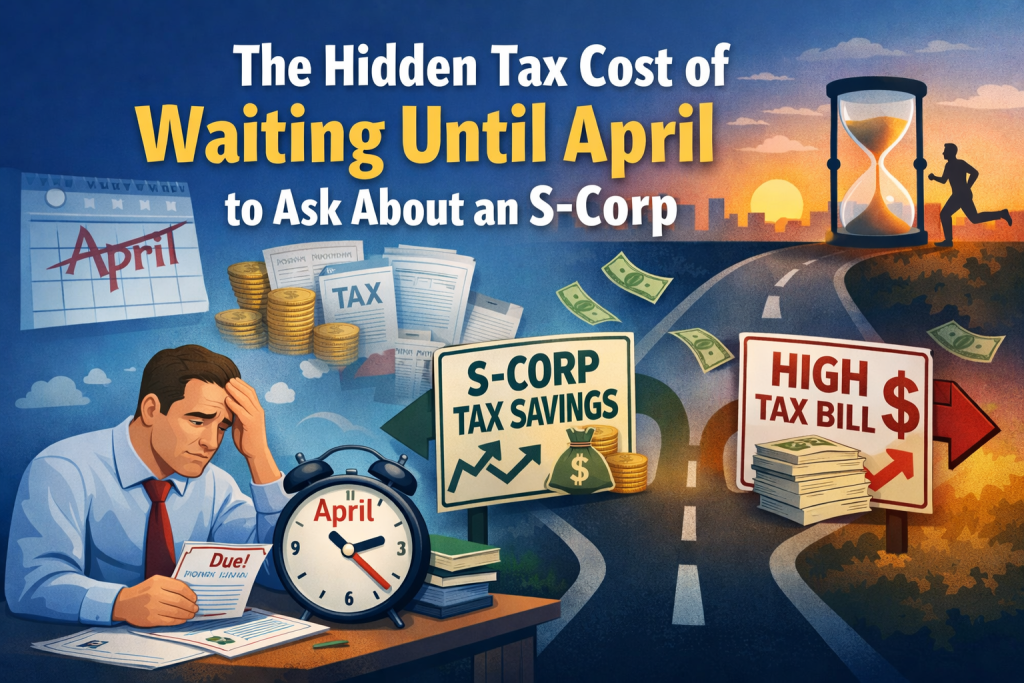
Business owner reviewing tax documents in April while choosing between S-Corp tax savings and a high tax bill
Waiting until tax season to evaluate S-Corp status can mean missing out on significant payroll tax savings.

Quick answer: S-Corp tax savings depend on timing, not just entity choice. Waiting until April usually eliminates the payroll strategies that make S-Corp taxation effective.

Waiting until April to ask whether you should be taxed as an S-Corporation often costs business owners thousands in avoidable self-employment taxes. By the time tax season arrives, most of the planning opportunities tied to S-Corp status have already expired. Proactive timing — not last-minute filing — determines whether an S-Corp actually saves you money.

For many service-based businesses, including Utah professional firms, S-Corp timing directly affects payroll compliance and tax outcomes.


Why does waiting until April eliminate most S-Corp tax savings?

Waiting until April eliminates most S-Corp tax savings because S-Corp elections must generally be made by March 15 to apply for that tax year.

Once the year has closed, income and payroll decisions are already set. As a result:

  • The business owner is stuck paying full self-employment tax on all profits.
  • No reasonable salary was established or paid through payroll.
  • Payroll tax strategies cannot be applied retroactively.
  • Retirement contributions tied to wages may be limited.

Therefore, waiting until April turns S-Corp planning into a missed opportunity rather than a tax strategy.

Already past the deadline? We can still help you file accurately and plan ahead for next year.


What tax benefits are lost when an S-Corp is chosen too late?

The main tax benefit lost is the ability to split income between salary and distributions.

When timing is missed:

  • All business profit is taxed as self-employment income.
  • Social Security and Medicare taxes apply to the full amount.
  • Health insurance and fringe benefits may be structured incorrectly.
  • Quarterly estimates may already be wrong.

In contrast, proper timing allows:

  • A reasonable salary to be taxed through payroll.
  • Remaining profit to avoid self-employment tax.
  • Payroll withholding to support retirement contributions.

Thus, timing determines whether an S-Corp produces real savings or simply adds paperwork.


Who actually benefits from S-Corp taxation?

Not every business benefits from S-Corp taxation, but many profitable service businesses do.

S-Corp taxation usually helps when:

  • Net profit is consistently above $40,000–$50,000.
  • The owner materially participates in operations.
  • Income is stable and predictable.
  • Payroll can be run consistently.

However, S-Corp status is usually a poor fit when:

  • Profits fluctuate wildly.
  • The business is still in startup mode.
  • Owners cannot support payroll compliance.

Therefore, S-Corp status works best as part of a larger tax strategy rather than a reaction to tax season.


Why should S-Corp planning happen before the year starts?

S-Corp planning must happen before the year starts because payroll structure drives tax savings.

When planning happens early:

  • Salary can be set correctly from January.
  • Payroll taxes can be optimized across the year.
  • Estimated payments align with actual tax strategy.
  • Retirement contributions can be maximized.

When planning happens late:

  • Salary cannot be fixed retroactively.
  • Distributions are already misclassified.
  • Compliance risk increases.
  • Savings are permanently lost.

As a result, S-Corp strategy works best as a proactive decision — not an emergency response.


How does this affect small business owners specifically?

Small business owners are most affected because they control both income and compensation.

This means:

  • Their timing decisions directly affect tax liability.
  • Their structure determines payroll exposure.
  • Their planning window closes once the year ends.

Without early guidance:

  • Owners often overpay self-employment tax.
  • Business cash flow suffers unnecessarily.
  • Long-term planning becomes reactive instead of strategic.

Consequently, S-Corp decisions should be evaluated during the year — not after it.


Bottom Line

Waiting until April to ask about S-Corp taxation usually eliminates the tax benefits it is meant to provide.
S-Corp status is most effective when salary, payroll, and profit distributions are structured in advance.
Proactive tax planning — not tax preparation — determines whether an S-Corp reduces tax or simply increases complexity.

View Our Business Tax Preparation Services


How Madsen and Company Can Help

Madsen and Company helps business owners evaluate S-Corp taxation before deadlines pass — not after the savings are gone.

We help Utah-based and nationwide service businesses plan S-Corp taxation before deadlines pass — not after savings are gone.

Our tax planning process includes:

  • Analyzing whether S-Corp taxation actually lowers your total tax
  • Structuring reasonable salary and payroll correctly
  • Coordinating income timing and retirement contributions
  • Integrating tax planning with tax preparation for full compliance

If you want your tax return to reflect strategy instead of surprises, proactive planning is the first step.


Frequently Asked Questions

Can I still elect S-Corp status after March 15?

Yes, but it usually applies to the following tax year unless special relief applies. Late elections often eliminate current-year tax savings.

Does forming an LLC automatically make me an S-Corp?

No. An LLC must file a separate election with the IRS to be taxed as an S-Corporation

How much tax can an S-Corp save?

Savings depend on profit level and salary structure. Many owners save several thousand dollars per year when structured correctly.

Is an S-Corp right for every business?

No. Low-profit or startup businesses often gain little benefit and may increase compliance costs.

Should I ask about S-Corp status during tax season?

Tax season is often too late. S-Corp strategy should be reviewed before or during the tax year to be effective.

Schedule a Tax Planning Consultation

Find out whether S-Corp tax planning could lower your self-employment tax before another year of savings is lost.

Filed Under: Small Business Taxes, Tax Planning Tagged With: business tax planning, proactive tax planning, S corporation tax planning, S-Corporation, small business CPA, South Jordan Tax Planning

Small Business Tax Planning: Strategies to Reduce Taxes Legally

January 28, 2026 by Steve Madsen

Written by Steve Madsen, CPA — licensed since 1993.

Small business tax planning strategies to reduce taxes legally for business owners and real estate investors
Proactive tax planning helps small business owners lower taxes, improve cash flow, and avoid filing-season surprises.

Most business owners focus entirely on tax filing. However, the real savings are not found in April. They are created through strategic small business tax planning done well before the year ends.

CPA Insight:
The biggest tax savings for small business owners are created by decisions made during the year, not by what shows up on a tax return.

If you own a small business, an S-Corporation, or rental property, proactive tax planning is the difference between writing a large check to the IRS and keeping more of your cash to reinvest in your business and future.


Tax Planning vs. Tax Preparation: What’s the Difference?

It is a common misconception that tax planning and tax preparation are the same thing.

Tax preparation is historical. It reports what has already happened.

By the time you are “doing your taxes,” most opportunities to change the outcome are gone.

CPA Insight:
Tax preparation records results. Tax planning influences them. Understanding this difference is the foundation of effective small business tax strategy.

By contrast, tax planning is forward-looking. It focuses on shaping financial decisions today to legally reduce what you owe tomorrow.

As a result, effective planning allows you to:

  • Legally lower taxable income through smart deductions
  • Improve cash flow so you are not hit with an unexpected bill
  • Align business growth with current tax strategies
  • Reduce filing-season surprises

Learn how tax preparation fits into the process and how proactive planning works


Optimize Your Business Structure

First, your business structure is the foundation of your tax bill. Whether you operate as a sole proprietor, LLC, partnership, or S-Corporation affects how much tax you pay.

For many profitable businesses, the S-Corporation remains a powerful tool for reducing self-employment taxes. By paying a reasonable salary and taking the remaining profit as distributions, many owners can save thousands.

However, this strategy requires proper payroll compliance. If your business income has increased, it may be time to review whether your current structure still makes sense.

CPA Insight:
An outdated business structure is one of the most common reasons profitable small businesses overpay taxes year after year.

Learn more about S-Corporation planning

Strategic Timing of Income & Expenses

Next, the timing of income and expenses can be just as important as how much you earn.

Common strategies include:

  • Accelerating expenses before year-end
  • Deferring income into the next tax year when appropriate
  • Making retirement contributions before December 31
  • Planning equipment purchases for depreciation benefits

These decisions must be made before the year ends to be effective.

For many Utah-based small business owners, these planning strategies also affect state tax estimates and cash-flow planning, making early coordination especially important.

Meanwhile, large purchases such as vehicles, equipment, and technology should not be made without considering their tax impact.

Leverage Depreciation & Asset Planning

Strategic planning allows you to:

  • Use Section 179 and bonus depreciation when appropriate
  • Match deductions to higher-income years
  • Avoid wasting deductions in low-profit years

Depreciation is not just an accounting concept. It is a powerful tax planning tool when used intentionally.

Maximize Retirement & Health Benefits

Furthermore, planning is not only about business deductions. It also plays a major role in personal wealth building.

Common strategies include:

  • Solo 401(k) or SEP IRA contributions
  • Health Savings Accounts (HSAs)
  • Owner-only retirement plans for S-Corporation owners

These tools reduce taxable income while helping you prepare for the future.

Likewise, real estate investors face a separate set of planning considerations.

Real Estate Tax Strategy

Real estate investors operate under a different set of tax rules than operating businesses.

Key planning areas include:

  • Cost segregation and depreciation strategies
  • Repairs versus improvements classification
  • Short-term rental tax treatment
  • Passive activity rules
  • Timing of property sales

With proper planning, rental income can be taxed far more efficiently.

Learn more about real estate tax planning strategies for investors

For this reason, waiting until tax season often leads to missed opportunities.

These strategies only deliver meaningful savings when implemented before year-end, not during tax preparation.

CPA Insight:
Most small business tax strategies fail not because they’re wrong, but because they’re applied too late to matter.


Why Waiting Until April Costs You Money

By the time tax season arrives, your CPA becomes a historian.

They can:

  • Report what happened
  • Apply limited remaining elections
  • Ensure compliance

But they cannot undo past decisions. The best tax results come from decisions made during the year, not during filing season.

CPA Insight:
Once the year ends, most tax-saving opportunities are locked in. At that point, even good advice often comes too late.

The Bottom Line: You work too hard for your money to give away more than is legally required.


Frequently Asked Questions

Below are answers to common questions business owners have about tax planning.

How often should I do tax planning?

Most growing businesses benefit from a mid-year review and a final fourth-quarter strategy session.

Is this only for large corporations?

No. Small businesses often see the greatest percentage savings because they have more flexibility in how they pay owners and time expenses.

Can tax planning reduce my audit risk?

Yes. High-quality planning improves documentation, consistency, and reporting accuracy, which reduces audit risk.


Related articles

Specific tax planning strategies for S-Corporation owners

How S-Corp owners can reduce taxes proactively

How owner compensation affects taxes

How entity choice impacts your tax strategy

Using equipment purchases as part of a tax plan

Take Control of Your Tax Future

Stop guessing what your tax bill will be.

Without proactive planning, even well-intentioned small business owners often implement these strategies too late to fully benefit from them.

Madsen and Company provides specialized tax planning for S-Corp owners, real estate investors, and small businesses nationwide.

Schedule A Proactive Tax Planning Review
Learn More About Our Business Tax Service

Filed Under: Small Business, Tax Planning, Uncategorized Tagged With: proactive tax planning, real estate tax planning, S-Corporation, Small Business Tax Strategy, South Jordan CPA, tax planning

Business Tax Preparation vs Tax Planning: Why Confusing Them Costs Business Owners Thousands

January 24, 2026 by Steve Madsen

Written by Steve Madsen, CPA — licensed since 1993.

CPA explaining the difference between tax preparation and tax planning to a small business owner
Understanding the difference between tax preparation and tax planning helps business owners make smarter financial decisions.

Most business owners assume tax preparation and tax planning are the same thing. Understanding the difference can determine whether a business owner simply reports taxes — or strategically reduces them. In reality, they serve very different purposes — and confusing the two is one of the main reasons small business owners overpay in taxes.

In simple terms, tax preparation reports the past, while tax planning shapes the future. Tax preparation focuses on filing accurate returns based on what already happened during the year. By contrast, tax planning involves making proactive decisions before deadlines pass so business owners can legally reduce taxes and improve cash flow.

CPA Insight:
Tax preparation reports what already happened. Tax planning determines what happens next.

This distinction forms the foundation of proactive tax planning and cannot be fixed once filing season begins.

On one hand, tax preparation focuses on reporting what already happened. On the other hand, tax planning focuses on shaping what will happen next.

Because these services occur at different stages of the year, business owners who understand the distinction can often save thousands of dollars and avoid costly surprises.

What Is Business Tax Preparation?

Once the year closes, most major tax-saving decisions are already set.

In simple terms, business tax preparation is the process of reporting income, expenses, and deductions for a year that has already ended.

Common examples of tax preparation include:

  • Filing Form 1120-S for an S-Corporation
  • Filing Schedule C for a sole proprietor
  • Filing partnership returns
  • Preparing W-2s and 1099s
  • Submitting extensions

Tax preparation answers the question:
“What do I owe based on what already happened?”

What Business Tax Preparation Does Not Do

Tax preparation is important, but it does not usually:

  • change how much salary you paid yourself
  • restructure your business entity after year-end
  • retroactively shift income or expenses
  • redesign depreciation decisions after assets are placed in service
  • fix missed retirement or benefit planning opportunities

What Is Business Tax Planning?

By contrast, tax planning is the process of making intentional financial and business decisions to reduce future tax liability.

It focuses on:

  • Structuring income and expenses
  • Choosing the right business entity
  • Timing deductions and purchases
  • Managing payroll and owner compensation
  • Coordinating retirement and benefit strategies

Tax planning looks forward. It influences future tax results before the year is over.

Common examples of tax planning include:

  • Setting reasonable S-Corporation salary levels
  • Planning retirement contributions
  • Timing equipment purchases
  • Structuring health insurance benefits
  • Using accountable plans
  • Managing income timing

Tax planning answers the question:
“What should I do now to legally reduce my taxes later?”

For many Utah-based business owners, understanding this difference also affects state tax estimates and cash-flow planning throughout the year.


Tax Preparation vs Tax Planning: Key Differences

Tax PreparationTax Planning
Looks backwardLooks forward
Reports resultsShapes results
Compliance-focusedStrategy-focused
Happens once a yearHappens year-round
Limited savings potentialOften significant savings potential
ReactiveProactive

This comparison helps explain why tax preparation and tax planning serve different purposes, even though many business owners assume they are the same service.

Example: How Tax Planning Changes the Outcome

Consider two business owners who each earn $250,000 from their company.

Owner A waits until tax season and focuses only on tax preparation. By that point, the business has already earned the income, processed payroll, and missed most planning opportunities.

Owner B works with a CPA earlier in the year and engages in proactive tax planning. That owner evaluates S-Corporation salary strategy, retirement contributions, equipment purchases, and estimated tax payments before the year ends.

Both owners file accurate tax returns. However, the second owner often pays significantly less tax because planning decisions were made before deadlines passed.

Why Tax Season Is the Worst Time to Start Tax Planning

By the time tax season arrives, most major financial decisions for the year have already been made.

For example, businesses have already earned the income, processed payroll, and locked in many deductions. Entity structures and benefit elections are typically finalized before the year ends.

At that stage, a CPA mainly reports what already happened instead of changing the outcome. Business owners must implement most major tax-saving strategies before the year ends. Once December 31 passes, many planning opportunities disappear.

That is why tax season is often the most expensive time to ask tax planning questions.


How Business Owners End Up Overpaying in Taxes

Business owners often overpay when they treat tax preparation as tax planning.

For instance, many meet with a CPA only once per year, make financial decisions without tax guidance, or wait until filing time to ask questions. As a result, opportunities to reduce taxes are frequently missed.

Without proactive planning, income is taxed inefficiently, deductions are overlooked, and entity structures go unreviewed. Over time, this leads to reduced cash flow and more tax surprises.

Although filing a tax return ensures compliance, it does not automatically minimize taxes.


Why Smart Business Owners Use Both

In practice, tax preparation and tax planning work best when they are used together.

First, tax preparation ensures accuracy, maintains compliance, and files the required forms. In contrast, tax planning reduces future tax liability, supports business decisions, improves cash flow, and creates predictability.

Rather than replacing tax preparation, tax planning builds on it. In other words, filing the return becomes part of a larger strategy instead of a one-time event.


Which One Do You Need Right Now?

Generally, you likely need tax preparation if you:

  • Have not filed your return yet
  • Need help meeting IRS deadlines
  • Own a business that must file this season

You likely need tax planning if you:

  • Want to reduce next year’s taxes
  • Own an S-Corporation
  • Own rental or short-term rental property
  • Expect income growth
  • Want fewer tax surprises

Most business owners start with tax preparation and later realize tax planning would have helped earlier.


Our Approach

At Madsen and Company, we view tax preparation as the execution phase of a larger plan.

We help business owners:

  • File accurate returns
  • Understand their financial results
  • Identify planning opportunities
  • Make informed tax decisions going forward

Our goal is not just to file your return.
Our goal is to help you stop overpaying in future years.

Why Waiting Until Tax Season Is Too Late

We explain this timing issue in more detail in why tax preparation is too late for many business owners.

This becomes especially clear during filing season, which is why many business owners realize too late that March is often too late for meaningful tax planning.

By the time a CPA prepares the tax return, the business owner has usually already earned the income, processed payroll, and made most major tax decisions before December 31.

What a CPA Can Still Do During Tax Season

That does not mean tax preparation has no value during filing season. At that stage, a CPA can still ensure deductions are properly classified, apply available elections correctly, catch missing information, verify carryforwards, and file accurate returns on time. The limitation is not compliance. The limitation is that most high-impact planning decisions can no longer be redesigned after year-end.

For example, S-Corporation salary decisions are typically made throughout the year through payroll. Retirement contributions, accountable plan reimbursements, and equipment purchases often need to be structured before year-end to produce the intended tax results. Once the calendar year closes, business owners lose access to most high-impact tax strategies.

This is why proactive tax planning happens throughout the year rather than during filing season. When planning occurs early, business owners can adjust compensation, coordinate retirement contributions, manage deductions, and make strategic decisions before deadlines pass. Waiting until tax preparation begins usually means the focus shifts from strategy to compliance.

For many Utah business owners and S-Corporation owners in South Jordan, this distinction often determines whether tax planning actually produces meaningful savings.


Frequently Asked Questions

Q1: Is tax preparation the same as tax planning?

No. Tax preparation reports past results. Tax planning helps shape future tax outcomes.

Q2: Can a CPA do tax planning during tax season?

Limited planning can be done, but most major strategies must be implemented before year-end.

Q3: Do I need tax planning if I already file a tax return?

Filing a return does not reduce taxes. Planning is what reduces future tax liability.

Q4: Is tax planning only for large businesses?

No. Small business owners and S-Corporation owners often benefit the most.

Q5: When should I start tax planning?

Tax planning should be done throughout the year, not just during tax season.

CPA Insight:
Tax preparation keeps you compliant. Tax planning keeps you in control.

Related articles on tax planning for business owners

Why waiting until tax season limits your options

Why March deadlines are too late for planning

Why Your Tax Return Is Not a Financial Strategy

What proactive tax planning looks like in practice

Ready to Get Started?

If you need help filing your business return, we can help you get compliant and meet your deadlines.

When business owners rely on tax preparation alone, strategy often comes too late to change outcomes.

If you want to reduce what you pay in future years, we can help you build a proactive tax strategy.

Schedule a Proactive Tax Planning Review

A planning review helps determine whether preparation alone is costing you opportunities.
Learn About Our Tax Planning Services

Filed Under: Business Tax, Tax Planning Tagged With: CPA, S-Corporation, small business taxes, tax planning

Primary Sidebar

Search

Archives

  • March 2026
  • February 2026
  • January 2026
  • December 2025
  • November 2025
  • July 2025
  • May 2025
  • April 2025
  • March 2025
  • January 2025
  • August 2024
  • July 2024
  • June 2024
  • February 2024
  • January 2024
  • November 2023
  • August 2023
  • March 2023
  • February 2023

Categories

  • Business Best Practices
  • Business Tax
  • Individual Tax
  • Real Estate
  • Retirement
  • S-Corporation Tax
  • Small Business
  • Small Business Taxes
  • Tax Deadlines & Compliance
  • Tax Planning
  • Uncategorized

Copyright © 2026 · https://www.madsencpa.com/blog