• Skip to main content
  • Skip to primary sidebar

  • Home
  • About
  • Contact

S Corp Payroll

Can S-Corp Owners Take Distributions Instead of Salary?

March 12, 2026 by Steve Madsen

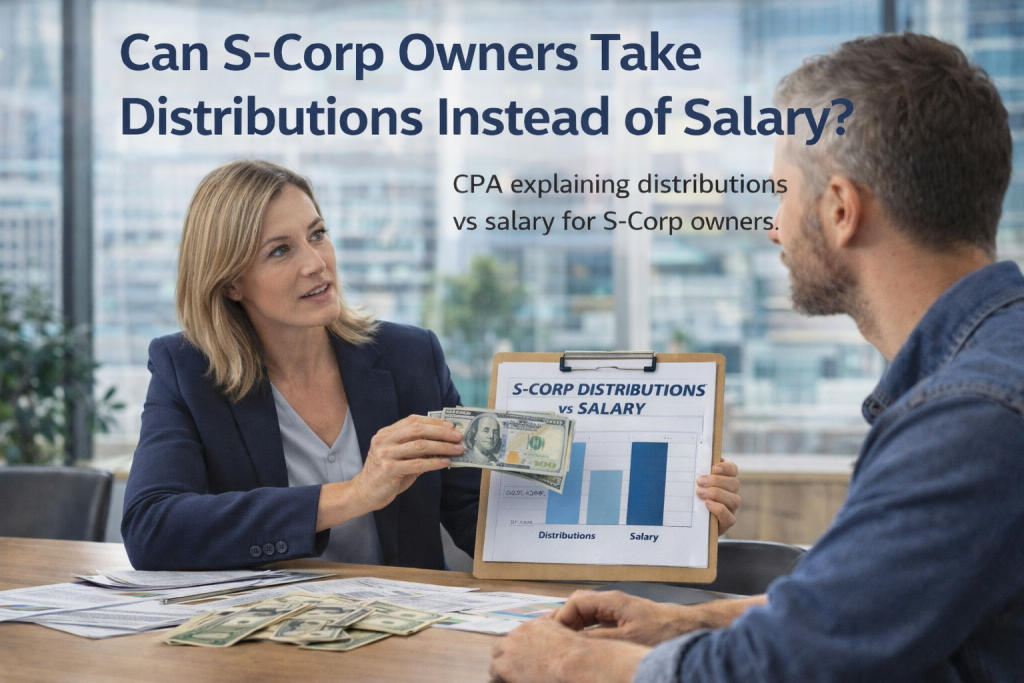
CPA explaining the difference between S-Corp distributions and salary to a business owner

Written by Steve Madsen, CPA (licensed since 1993)

Many business owners elect S-Corporation tax treatment because they believe it will reduce self-employment taxes. That is true in the right situation, but one of the most misunderstood parts of S-Corp taxation is how owners must pay themselves. A common question is whether an S-Corp owner can simply skip payroll and take distributions instead of salary.

This issue matters because many owners assume that once they have an S-Corporation, they can pull money out of the business however they want. That is where expensive mistakes happen. For owners who actively work in the business, the IRS generally expects owners to pay reasonable compensation before taking profits as shareholder distributions.

Quick Answer

In most cases, an S-Corp owner who actively works in the business cannot take distributions instead of salary. If the owner provides substantial services to the business, the IRS generally requires owners to run reasonable compensation through payroll. Shareholder distributions may still be allowed, but they generally should not replace wages for work performed.

Why This Question Matters

This is not just a technical payroll issue. It is one of the most important compliance and tax planning areas for S-Corporation owners.

If an owner takes only distributions and no salary, the IRS may argue that the owner should have run those distributions through payroll as wages.
This situation can trigger payroll taxes, penalties, interest, amended filings, and credibility problems if the IRS examines the return.

In other words, the tax savings opportunity of an S-Corp is real, but it works only when the owner follows the rules correctly.

The Basic Rule for S-Corp Owners

An S-Corporation owner who works in the business is generally considered both:

  • an owner, and
  • an employee

That means two different types of payments may exist:

Salary

Salary is compensation for services performed for the business. It is paid through payroll and subject to normal payroll tax reporting.

Distributions

A distribution pays business profit to the shareholder as an owner rather than as compensation for labor.

This distinction is critical because the IRS does not allow an active owner to label all business withdrawals as distributions when those withdrawals are really compensation for the owner’s work.

What the IRS Looks At

The IRS focuses on whether the owner performed meaningful services for the company and whether the compensation paid was reasonable for those services.

If the owner is actively involved in revenue generation, management, operations, client service, or decision-making, the IRS expects active owners to run reasonable compensation through payroll before taking shareholder distributions.

This is especially important in businesses where the owner is the main driver of income. If the business earns money primarily because of the owner’s work, skill, relationships, or labor, trying to take only distributions creates significant risk.

What Is Reasonable Compensation?

Reasonable compensation means the amount the business would ordinarily pay someone else to do the same work under similar facts and circumstances.

There is no single IRS formula that applies to every business. The right amount depends on factors such as:

  • the owner’s duties
  • time devoted to the business
  • training and experience
  • type of business
  • profit level
  • industry pay norms
  • geographic market
  • what the business would need to pay a non-owner employee to perform similar work

That is why this issue should never be handled with a random number or a guess. A salary that is far too low can undermine the S-Corporation tax strategy.

Why Owners Want to Take Distributions Instead of Salary

The reason is simple: distributions are generally not treated the same way as wages for payroll tax purposes.

So owners often think:

“If I skip salary and just take distributions, I can save more tax.”

That assumption is exactly the problem. Once the owner actively works in the business, the IRS expects reasonable compensation through payroll before taking profits as shareholder distributions.

The goal of an S-Corp is not to eliminate payroll taxes entirely. The goal is to create a proper balance between:

  • reasonable salary for work performed, and
  • profit distributions as a return on ownership

Can S-Corp Owners Take Both Salary and Distributions?

Yes. In fact, that is often how an S-Corporation is intended to work.

A properly structured S-Corp often pays the owner:

  • a reasonable W-2 salary for services performed, and
  • additional distributions if the business has remaining profit

This is where the planning opportunity exists. But it only works if the salary is legitimate and supportable.

If the salary is artificially low and most of the cash comes out as distributions, that can create audit risk and reclassification risk.

What Happens If an Owner Takes No Salary?

If an active S-Corp owner takes no salary and only takes distributions, the IRS may reclassify some or all of those distributions as wages.

That can lead to:

  • payroll tax assessments
  • penalties
  • interest
  • late payroll filing issues
  • amended reporting
  • additional accounting and CPA costs

It can also create problems with how the business books were handled during the year.

This issue is especially dangerous when the owner is clearly performing the work that generates the company’s income. In those situations, “no salary” is often difficult to defend.

When No Salary Might Be Less Problematic

There are narrow situations where low or even no compensation may be less concerning, but owners should be very careful here.

For example:

  • the business had little or no activity
  • the owner performed minimal services
  • the company had no meaningful profit
  • the owner was not actively involved in operations

Even then, the facts matter. Many owners assume “small profit” automatically means “no salary required,” but that is not always the right analysis. The question is not only how much money came out. The question is also what services the owner actually performed.

Common Mistakes S-Corp Owners Make

1. Taking owner draws like a sole proprietor

Many new S-Corp owners continue operating as if nothing changed after the election. They move money in and out of the business casually and call everything an owner draw. That is a problem because S-Corporations require more structure.

2. Running payroll only at year-end without planning

Some owners wait until the tax return is being prepared and then try to “fix” compensation after the fact. That can create payroll compliance issues and poor documentation.

3. Setting salary too low just to maximize tax savings

This is one of the most common mistakes. A salary that cannot be defended based on the owner’s actual role weakens the entire tax position.

4. Assuming distributions are always tax-free

Distributions are not automatically tax-free in every situation. Basis, accumulated adjustments, prior losses, and other factors can affect treatment.

5. Ignoring state and payroll compliance

Federal tax savings do not remove the need for proper payroll setup, payroll filings, and state compliance obligations.

How Salary and Distributions Should Work Together

A well-run S-Corp generally follows a cleaner structure:

First, the owner receives payroll compensation for work performed.
Then, if the business has remaining profit, the owner may also receive distributions as a shareholder.

That sequence matters because it reflects the two different roles the owner has in the business.

The owner is not just a shareholder. The owner is often also the worker, manager, rainmaker, and operator. Salary addresses the labor side. Distributions address the ownership side.

When those two roles are blurred, the tax reporting becomes vulnerable.

Example Scenario

Suppose an S-Corp owner is the primary person providing services, managing client relationships, supervising operations, and generating most of the company’s income. If that owner takes substantial cash from the business during the year but reports no wages, the IRS may reasonably argue that at least part of those payments should have been compensation.

By contrast, if the owner takes a supportable W-2 salary and then also receives distributions after that, the tax treatment is usually much easier to defend.

Why This Is a Tax Planning Question, Not Just a Payroll Question

Many owners think this issue can be solved by asking a payroll company what number to use. That is not enough.

The real analysis should consider:

  • business profit
  • the owner’s role
  • reasonable compensation
  • timing of payroll
  • distribution planning
  • bookkeeping treatment
  • shareholder basis
  • state tax implications
  • long-term strategy

This is why the best S-Corp advice is usually planning-first, not just compliance-first.

South Jordan, Utah S-Corp Tax Planning Perspective

For business owners in South Jordan, Utah, and beyond, this question often comes up after an LLC elects S-Corporation taxation and the owner starts asking how to pay themselves. At Madsen and Company, we help business owners review whether their payroll structure, salary level, and distributions are aligned with the way an S-Corp is supposed to operate.

For many owners, the bigger issue is not just “Can I take distributions instead of salary?” The better question is “How do I structure compensation correctly so the S-Corp actually delivers the tax benefit without creating IRS risk?”

Final Answer

So, can S-Corp owners take distributions instead of salary?

In most cases, no. If the owner actively works in the business, distributions generally should not replace reasonable compensation. A properly run S-Corp usually pays the owner a reasonable salary through payroll first and then allows distributions if the business has additional profit.

The tax savings opportunity comes from getting that balance right, not from avoiding salary altogether. When owners ignore that distinction, they increase the risk of payroll tax problems, penalties, and a much weaker tax position.

If you own an S-Corp and are unsure whether your salary and distributions follow the correct S-Corp rules, this is usually a tax planning issue worth reviewing before the problem grows.


FAQ SECTION

Can an S-Corp owner take only distributions?

In most cases, an active S-Corp owner should not take only distributions. If the owner performs substantial services for the business, reasonable compensation is generally expected first.

Do S-Corp owners have to put themselves on payroll?

If the owner actively works in the business, payroll is often required because compensation for services should generally be handled as wages rather than only as shareholder distributions.

What happens if an S-Corp owner takes no salary?

That can create risk that the IRS will reclassify some or all distributions as wages, which may lead to payroll taxes, penalties, and interest.

Can S-Corp distributions reduce taxes?

They can be part of a tax-efficient structure when used correctly, but they do not eliminate the need for reasonable compensation for an active owner.

Is owner draw the same as an S-Corp distribution?

Not exactly. Sole proprietors often use owner draws, but S-Corporations require more formal treatment of wages, shareholder distributions, and payroll compliance.

Filed Under: S-Corporation Tax Tagged With: business tax planning, IRS reasonable compensation, Owners Compensation, reasonable salary, S Corp Payroll, s Corporation distributions, S corporation tax planning

Missed the S-Corp Deadline? Here’s What You Can Still Do

March 10, 2026 by Steve Madsen

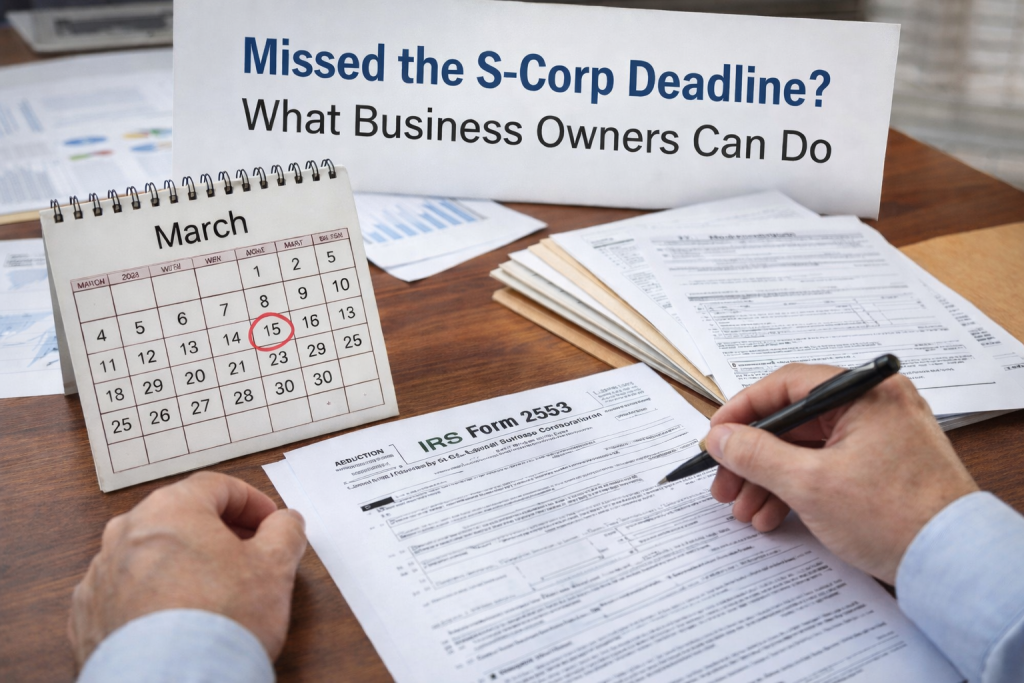
Business owner reviewing IRS Form 2553 with a March 15 calendar deadline after missing the S-Corp election deadline

Business owner reviewing IRS Form 2553 with a March 15 calendar deadline after missing the S-Corporation election deadline

If you missed the S-Corp deadline, you are not alone. Many business owners discover too late that electing S-Corporation status requires filing IRS Form 2553 by a specific deadline.

The good news is that missing the deadline does not always mean the opportunity is lost. In many cases, businesses may still qualify for late election relief or elect S-Corporation status for a future tax year.

This situation often happens because the election deadline was not clearly explained, paperwork was started but never completed, or the business was formed quickly and tax elections were postponed. In other cases, owners are told to “become an S-Corp” without realizing that the IRS requires a separate election form.

Even when the deadline is missed, business owners often still have planning options available — including requesting late election relief or preparing for a clean S-Corporation election in the following tax year.

For business owners in South Jordan, throughout Utah, and across the country, the most important step is addressing the issue quickly and correctly so mistakes do not compound.

The earlier you review the situation, the more options are usually available.

Quick Answer

If you missed the S-Corp deadline, you may still be able to fix it. Many businesses can request late election relief by filing Form 2553 properly and showing reasonable cause for missing the original deadline. When relief is not available, the election can often be made effective for a future tax year with better planning. The earlier you address the problem, the more options you usually have.

What Is the S-Corp Election Deadline?

The S-Corporation election deadline is typically March 15 for calendar-year businesses, which is two months and fifteen days after the beginning of the tax year. A business receives S-Corporation tax treatment when it files Form 2553 on time.

CPA Insight

Many business owners think they missed the S-Corp opportunity permanently. In reality, the bigger issue is usually not the missed form itself — it is the incorrect payroll, compensation, and tax reporting decisions made after the deadline was missed.

Key Takeaways

  • Missing the S-Corp deadline does not always mean you permanently lost the election.
  • The standard filing deadline is generally 2 months and 15 days after the beginning of the tax year the election is supposed to take effect.
  • Many businesses may qualify for late election relief if they act within the IRS relief window and meet the requirements.
  • If relief is not available, you may still be able to make the election effective next year.
  • A missed S-Corp election should trigger broader tax planning, not panic.

What the Missed S-Corp Deadline Actually Means

An S-Corporation is not created automatically just because you formed an LLC or corporation.

To be taxed as an S-Corporation, an eligible business generally must file Form 2553 on time. For a calendar-year business, that usually means the election must be filed by March 15 if you want S-Corporation treatment for that year. Businesses can also file during the prior tax year for the upcoming year.

This is where many owners get tripped up.

They may:

  • form an LLC and assume it is already an S-Corp,
  • tell their payroll company they are an S-Corp without filing the election,
  • start running payroll before the election is actually accepted,
  • or discover the issue only after tax season is already underway.

That is why this issue often shows up in March, when business owners are making payroll, deduction, and entity-planning decisions too late.

What Happens If You Miss the S-Corp Deadline

If you miss the S-Corp election deadline, your business will typically remain taxed under its default classification for that tax year. However, many businesses may still qualify for late election relief by filing Form 2553 and explaining the reason for the late filing.

The immediate consequence is simple: your business may not be treated as an S-Corporation for the year you intended, which can create larger tax consequences than many owners expect.

Depending on how your business is structured, missing the election may mean:

  • your LLC remains taxed under its default classification,
  • your corporation remains taxed as a C corporation,
  • payroll decisions may need to be revisited,
  • distributions may need to be recharacterized or reviewed,
  • your expected self-employment tax savings may disappear for that year,
  • and tax filings may have to be handled very differently than you originally planned.

It can also create confusion when the business owner already acted as though the S election were in place. That is one of the biggest reasons this problem should be addressed early, before incorrect payroll, owner compensation, or tax return reporting makes the cleanup harder.

Can You Fix a Missed S-Corp Deadline?

Often, yes.

The IRS provides a path for many eligible businesses to request late S-Corporation election relief. Under Revenue Procedure 2013-30, relief may be available when the business intended to elect S-Corporation status, failed to file on time, had reasonable cause, and acted diligently to correct the issue.

According to IRS guidance, businesses that miss the S-Corp election deadline may still qualify for late election relief if they meet specific eligibility requirements and act within the allowable time window.

That does not mean every late election is automatically accepted.

It means the business may have a route to request relief if the facts support it.

Situations Where Late Relief May Be Possible

A missed election may still be fixable when:

  • the business was otherwise eligible to be an S-Corporation,
  • the owners intended S-Corp treatment from the start,
  • the business has consistently acted like an S-Corp or planned to,
  • the failure was due to oversight, misunderstanding, or another explainable error,
  • and the issue is corrected promptly after discovery.

This is where details matter. A rushed filing with weak facts can create more problems instead of fewer. The explanation must be consistent with how the business actually operated.

Situations Where Relief May Not Solve Everything

Even when late relief is available, it does not erase every underlying issue.

For example:

  • the business may still need to correct payroll filings,
  • shareholder compensation may need review,
  • prior filings may need to be corrected,
  • state tax treatment may not line up automatically,
  • and bookkeeping may need to be adjusted so the return matches reality.

Also, if too much time has passed, or if the business was never actually eligible for S-Corp treatment, relief may not be available.

That is why the real question is not only, “Did you miss the deadline?”
It is also, “What did the business do after missing it?”

What to Do After You Miss the S-Corp Deadline

If you missed the S-Corp deadline, take these steps immediately.

1. Confirm your entity type

Start with the basics. Are you operating as an LLC or a corporation? That affects how the missed election impacts your tax treatment.

2. Confirm the intended effective date

You need to know which tax year you were trying to elect.

3. Review whether the business was eligible

Not every entity qualifies, and eligibility must be confirmed before trying to fix the election.

4. Gather your supporting facts

Document when the business was formed, when the owners intended to elect S-Corp status, what advice was given, whether payroll was started, and how the business has been filing and operating.

5. Determine whether late election relief applies

This is usually the key decision point. If relief is available, the correction path may be much better than you expected.

6. Build a backup plan if relief is not available

Sometimes the best move is to elect S-Corp status for the next year and improve tax planning now rather than forcing a weak fix.

Mistakes to Avoid After Missing the S-Corporation Deadline

Once the deadline is missed, business owners often make the situation worse by reacting too quickly.

Common mistakes include:

  • filing payroll as if the S election were already valid,
  • taking owner distributions without reviewing tax treatment,
  • assuming the IRS will “understand what you meant,”
  • filing returns inconsistently,
  • waiting until the return is due before addressing the issue,
  • or relying on generic online advice that does not match the business facts.

This is exactly why a planning-first approach matters. Entity elections affect payroll, compensation, bookkeeping, estimated taxes, and how profits flow to the owner. It is never just one form.

Why This Matters So Much for Business Owners

Many owners pursue S-Corporation status for one reason: tax savings.

But the S election only works well when the entire structure is handled correctly. That includes:

  • reasonable owner compensation,
  • clean payroll reporting,
  • accurate bookkeeping,
  • proper distributions,
  • and year-round tax planning.

So even if you missed the deadline, this can still be a valuable turning point. It forces the business to step back and build the tax structure the right way instead of layering mistakes on top of confusion.

That is especially important for service businesses, consultants, contractors, and other profitable owner-operated businesses in Utah where S-Corporation planning often becomes one of the biggest drivers of tax efficiency.

This is why understanding reasonable salary for S-Corporation owners is also a critical part of the planning process.

Many of these businesses also benefit from proactive S-Corporation tax planning strategies implemented before the March deadline.

Local Insight for Utah Business Owners

We often see this issue with Utah business owners who formed an LLC quickly, started earning income, and were told later that they “should be an S-Corp.”

By then, payroll may not be set up correctly, bookkeeping may be behind, and the owner may have already taken draws with no clear compensation strategy.

For South Jordan and Salt Lake County business owners, this is a strong reminder that entity strategy should happen before the year gets too far along. Waiting until return preparation season usually limits your options.

Business owners in South Jordan, Salt Lake County, and across Utah frequently discover the missed S-Corp election issue during tax season, which is why proactive entity planning earlier in the year can prevent costly mistakes.

Final Thoughts

Missing the S-Corp deadline is a problem, but it is not always a disaster.

In many cases, there is still a path forward. The right next step depends on whether late election relief is available, how the business has operated so far, and whether the tax savings still justify the structure going forward.

What matters most is acting quickly, understanding the facts, and making a clean decision based on the real IRS rules rather than assumptions.

If you missed the S-Corp deadline, your business may still qualify for late election relief by filing Form 2553 and demonstrating reasonable cause. When relief is not available, the election can often be made effective for a future tax year with better planning.

If you missed the S-Corp deadline, do not guess. Review the election, review the entity, and build the next step carefully.

Business owners often discover too late that electing S-Corporation status requires filing Form 2553.

Reviewing your entity structure now can help prevent the same problem next year.

Need Help Fixing a Missed S-Corp Election Deadline?

If you missed the S-Corp deadline and want to know whether late election relief may still apply, reviewing the details before filing your tax return can prevent costly mistakes.

At Madsen and Company, we help business owners evaluate entity elections, late S-Corporation filings, and proactive tax planning strategies.

Many business owners in South Jordan, Salt Lake County, and across Utah discover the missed S-Corp election issue during tax season and want a second opinion before filing.

If you want to review your situation before filing your return, now is the time to determine whether late election relief or a future S-Corporation strategy makes sense for your business.

Frequently Asked Questions

What is the deadline to elect S-Corporation status?

In general, Form 2553 must be filed no later than 2 months and 15 days after the start of the tax year the election is meant to apply to. For many calendar-year businesses, that means March 15.

Can I file Form 2553 late?

Sometimes. The IRS allows late election relief in many cases if the business qualifies and acts within the applicable relief period.

How long do I have to request late S election relief?

In many cases, the relief request must be made within 3 years and 75 days of the intended effective date, assuming the business otherwise qualifies.

What if I missed the deadline and do not qualify for relief?

You may still be able to elect S-Corporation status for a future year and use other tax-planning strategies in the meantime.

Does missing the S-Corp deadline mean I should never become an S-Corp?

No. It may still be a good strategy. It just needs to be evaluated based on profit level, payroll requirements, compliance costs, and timing.

Related S-Corporation Planning Resources

• S-Corporation Tax Planning Strategies
• Reasonable Salary for S-Corp Owners
• Business Tax Preparation vs Tax Planning

Filed Under: Business Tax, Tax Planning Tagged With: Form 2553, Late S-Corp election, March tax deadlines, S Corp Payroll, S Corporation Election

S-Corp Reasonable Salary: How to Calculate Owner Compensation

March 7, 2026 by Steve Madsen

CPA and business owner reviewing payroll and compensation planning for reasonable S Corp salary

Reasonable salary for S corporation owners is one of the most important tax planning issues in an S-Corp. If you own an S Corporation, one of the most important tax decisions you make each year is how much to pay yourself in W-2 wages.

This is where many business owners get it wrong.

The IRS does not provide a fixed formula for determining reasonable compensation for S-Corporation owners.

Written by Steve Madsen, CPA (licensed since 1993). After advising business owners for more than 30 years, we regularly see reasonable salary mistakes when owners set payroll without understanding IRS expectations.

Quick Answer

A reasonable salary for an S Corporation owner is the amount the business would normally pay someone else to perform the same work under similar circumstances. The IRS requires S Corporation owners who actively work in their business to take reasonable W-2 compensation before taking profit distributions. If salary is set too low, the IRS may reclassify distributions as wages and assess additional payroll taxes, penalties, and interest.

Many either set up an S Corporation too early, copy a salary number from social media, or let payroll run for years without reviewing whether the compensation still makes sense.

Key Takeaways

  • S Corporation owners must take reasonable W-2 compensation before taking profit distributions.
  • The IRS determines reasonable salary based on duties performed, time spent working, industry pay, and company profitability.
  • Setting salary too low may trigger payroll tax reclassification and penalties.
  • Reviewing owner compensation each year helps ensure the S Corporation structure works properly.
  • Paying yourself too little increases audit risk, while paying too much may increase payroll taxes unnecessarily.

For S Corporation owners, the goal is not to pick an arbitrary number or copy what a friend is doing. The goal is to determine a reasonable salary based on the work you actually perform, the value of that work in the market, and the overall economics of the business.

For South Jordan and Utah business owners, this decision often affects much more than payroll. It can influence tax savings, retirement contributions, audit exposure, and whether the S Corporation structure is really working the way it should.

What Is a Reasonable Salary for S Corporation Owners?

The IRS defines reasonable compensation as the amount a business would pay an unrelated employee to perform the same services under similar circumstances. For active S-Corp owners, that means W-2 wages should reflect the value of the work actually performed in the business.

There is no universal percentage or fixed formula. Reasonable salary depends on the owner’s duties, time commitment, experience, market compensation, and the profitability of the business.

Why Reasonable Salary Matters for S-Corp Owners

The tax advantage of an S Corporation comes from splitting business income into two categories.

First, the owner-employee receives W-2 wages, which are subject to payroll taxes.

Second, the remaining profit may be distributed to the owner as an S Corporation distribution, which is generally not subject to self-employment tax in the same way.

That creates a planning opportunity, but only if the salary is reasonable.

The IRS does not allow S Corporation owners to avoid payroll taxes by paying themselves little or nothing while still taking substantial distributions. If you actively work in the business, your compensation has to reflect the services you provide.

This is one of the most common planning issues we see with Utah business owners.

How Does the IRS Determine Reasonable Salary for S Corporation Owners?

The IRS evaluates several factors when determining whether an S-Corp owner’s compensation is reasonable. Instead of using a fixed formula, the IRS reviews the facts and circumstances of the business and the services performed by the owner.

Common factors include:

• Duties performed in the business
• Training, experience, and credentials
• Time spent working in the business
• Compensation paid for similar roles in the market
• Business profitability
• Historical compensation practices

S-Corp Salary vs Distribution: How They Work Together

S-Corp owners typically receive income in two ways:

Owner Salary (W-2 Wages)
These wages are subject to payroll taxes such as Social Security and Medicare.

Profit Distributions
Remaining profits may be distributed to the owner and are generally not subject to self-employment tax.

This structure creates potential tax savings. However, the IRS requires owners who actively work in the business to take reasonable compensation before taking distributions.

If an owner takes large distributions while paying themselves little or no salary, the IRS may reclassify distributions as wages and assess additional payroll taxes.

How S-Corp Salary Affects Tax Savings

The potential tax savings of an S-Corporation largely come from how income is divided between owner salary and profit distributions.

Wages paid to the owner are subject to payroll taxes, including Social Security and Medicare. Profit distributions, however, are generally not subject to self-employment tax.

Because of this difference, setting a reasonable salary is critical. A salary that is too high can reduce the tax advantages of the S-Corporation structure, while a salary that is too low can create IRS risk.

The goal is not to minimize salary at all costs. The goal is to set compensation that accurately reflects the value of the work performed while still allowing the S-Corporation structure to function as intended.

What Factors Determine Reasonable Salary for S Corporation Owners?

The IRS considers several factors when determining whether an S Corporation owner’s compensation is reasonable.

A reasonable salary for an S Corporation owner is the compensation the business would pay an unrelated employee to perform the same services under similar circumstances.

Key Factors the IRS Considers

The IRS commonly evaluates these factors when determining reasonable compensation:

  • duties performed in the business
  • training and professional experience
  • time devoted to the business
  • market compensation for similar roles
  • company profitability
  • compensation history and payroll practices

1. The work you actually perform

Start with the real role you play in the business.

Are you doing sales, operations, management, production, bookkeeping, estimating, client service, or supervision? In many small businesses, the owner performs multiple high-value roles. That usually increases the salary that should be considered reasonable.

If you are the primary revenue driver in the business, that matters.

2. Your training, experience, and credentials

A licensed professional, highly skilled consultant, or specialized contractor often commands a higher market rate than someone doing more routine administrative work.

For example, a CPA, engineer, or industry specialist may justify a very different compensation level than a passive owner who is only overseeing broad strategy.

3. Time spent working in the business

A full-time owner who works throughout the year should not be compared to a mostly passive investor. Hours matter. If you are working forty to fifty hours a week, your salary should generally reflect that level of involvement.

4. What similar businesses would pay

This is one of the most important benchmarks.

What would you have to pay a qualified employee to replace the work you do? That market-based lens is often the best reality check.

5. The business’s profitability

The company has to support the compensation level. A business with modest profit may not justify a very high salary, while a highly profitable business with an active owner often supports stronger compensation.

But profitability alone does not control the answer. The IRS looks at the services performed, not just the size of distributions.

6. Compensation history and payroll consistency

Wild swings in salary from one year to the next without a clear business reason can create unnecessary questions. Compensation should make sense in light of how the business is operated.

Where to Find Market Data for Reasonable S-Corp Salary

Determining reasonable compensation usually involves reviewing market salary data for similar roles. This helps establish what the business would need to pay an unrelated employee to perform the same services.

Common sources used when evaluating S-Corp owner compensation include:

Bureau of Labor Statistics (BLS)
The BLS publishes wage data for hundreds of occupations across the United States. This can provide a baseline for typical compensation levels within specific industries.

Salary.com and compensation databases
Sites such as Salary.com or compensation benchmarking tools provide estimates based on job titles, location, and experience.

Industry compensation surveys
Many industries publish salary surveys that provide compensation ranges for executives, professionals, and managers.

Local hiring data
Job listings and recruiting firms can also provide insight into what businesses in your local market are paying for similar work.

These data sources help create a defensible framework when evaluating whether an S-Corp owner’s compensation is reasonable.

In practice, CPAs often review several data sources together and adjust for the owner’s actual duties, time commitment, and the profitability of the business.

How to Calculate Reasonable Salary for S Corporation Owners

A practical approach usually works better than chasing a fake formula.

Step 1: List the roles you perform

Write down the major roles you handle in the business. Be specific.

A business owner might act as:

  • CEO
  • salesperson
  • operations manager
  • estimator
  • technician
  • bookkeeper
  • client relationship manager

The more hats you wear, the more carefully compensation should be analyzed.

Step 2: Estimate the market value of those roles

Consider what it would cost to hire someone else to do that work. In some cases, one blended salary may make sense. In others, it helps to think through the value of multiple roles.

Step 3: Adjust for time spent and business realities

A part-time owner may justify less compensation than a full-time owner. A newer business may support a lower level than a mature, highly profitable firm. The number still has to be grounded in reality.

Step 4: Compare salary to distributions

If the owner takes large distributions but a very small W-2, that is a red flag. The numbers should look rational together.

Step 5: Document the reasoning

This is where many business owners fail. Even when the number is reasonable, they often keep no documentation showing how they got there.

A short internal memo can go a long way. It should explain the owner’s duties, time commitment, market comparisons, and why the final salary was selected. Keeping copies of compensation data or salary benchmarks used during this analysis can also help support the reasoning if questions ever arise.

Example of how this works

Assume a South Jordan S Corporation owner runs a profitable service business and performs sales, client delivery, team oversight, and strategic planning. The business earns $220,000 before owner wages. The owner works full-time and is the main driver of revenue.

In that case, paying a salary of $20,000 while taking large distributions would likely be very difficult to defend.

On the other hand, if the owner evaluates comparable market compensation, reviews their actual role, and sets W-2 wages at a level that reflects full-time executive and operational work, the compensation position becomes much stronger.

The point is not to eliminate distributions. The point is to support them with a defensible wage structure.

Example Reasonable Salary Ranges for S-Corp Owners (Illustrations)

While every S-Corporation must evaluate its own facts and circumstances, reviewing general compensation ranges for similar roles can provide helpful context. The examples below illustrate how owner duties and industry can influence reasonable salary levels.

Business TypeOwner RoleExample Salary Range
Consultant / Professional ServicesPrimary service provider$80,000 – $150,000
Construction Company OwnerManager, estimator, project oversight$70,000 – $130,000
Online Business OwnerMarketing, operations, product management$60,000 – $120,000
Real Estate ProfessionalAcquisitions, property management, investor relations$70,000 – $140,000
Small Agency OwnerSales, management, client delivery$75,000 – $140,000

These ranges are examples only. Reasonable compensation ultimately depends on the services the owner performs, time spent working in the business, industry compensation data, and the profitability of the company.

These examples are illustrations only and should not be treated as IRS-approved safe harbor amounts.

Because each S-Corporation operates differently, compensation should be evaluated as part of a broader tax planning strategy rather than relying on a simple rule of thumb.

What Happens If an S-Corp Salary Is Too Low?

If the IRS determines that an S-Corp owner’s salary is unreasonably low, it may reclassify some or all distributions as wages. This can result in:

  • additional payroll taxes
  • penalties
  • interest on unpaid tax

In some cases, the IRS may review multiple tax years if compensation practices appear intentionally structured to avoid payroll tax.

This is why documenting reasonable compensation and reviewing salary periodically is important for S-Corp owners.

Common Reasonable Salary Mistakes S-Corp Owners Make

Paying no salary at all

This is the clearest mistake. If you work in the business, the IRS generally expects compensation.

Picking an arbitrary number

Using a round number with no support is not real planning. It is guessing.

Copying what another business owner does

Your friend’s compensation strategy may be wrong for your facts. Different industries, margins, roles, and hours lead to different answers.

Setting salary once and never revisiting it

As revenue changes, duties expand, or the business matures, salary may need to be adjusted. What was reasonable two years ago may not be reasonable now.

Ignoring local and industry context

A Utah construction company owner, a South Jordan real estate professional, and an online consultant may each require a different compensation analysis. Industry context matters.

Is There a Standard Percentage for S-Corp Salary?

Many business owners ask whether there is a standard rule such as:

• 60% salary / 40% distributions
• 50% salary / 50% distributions

The IRS does not use a fixed percentage rule.

Compensation must be based on the value of the services performed, not a formula. While percentages may appear in examples online, they do not determine whether compensation is reasonable.

Each S-Corp must evaluate its own facts, including the owner’s role, time commitment, industry compensation, and business profitability.

When Should You Review Your Reasonable Salary?

Ideally, reasonable salary should be reviewed before year-end and often much earlier.

Waiting until tax season creates problems because payroll has already happened and the opportunity to make clean adjustments may be limited. If you’re unsure how payroll and owner compensation interact, our guide explaining how S-Corp payroll really works breaks down the key rules business owners should understand. This is one reason a Planning-First CPA approach matters so much. Tax planning works best before deadlines pass, not after the year is over.

If your revenue is growing, your role has changed, or you started taking larger distributions, that is a sign your compensation should be reviewed now rather than later.

Many South Jordan and Utah business owners first revisit this issue when preparing their annual tax return, which is often too late for effective planning.

Why this matters for Utah business owners

For Utah and South Jordan business owners, S Corporation planning often gets oversimplified.

Many owners are told to elect S Corporation status because it “saves taxes,” but the savings only work when payroll is handled correctly. If reasonable salary is ignored, the structure can create risk instead of savings.

This issue is especially important for Utah business owners in service, construction, consulting, and real estate-related businesses, where owner involvement often drives a large share of company profit.

A smarter approach is to treat compensation as part of a broader tax strategy that includes payroll, distributions, retirement planning, estimated taxes, and year-round projections.

CPA Insight

The biggest mistake S Corporation owners make is assuming reasonable salary is just a payroll number. It is really a tax-planning decision. If the salary is too low, the structure becomes hard to defend. If it is too high, the tax savings from the S Corporation may shrink unnecessarily. The right answer usually comes from looking at the owner’s real job, market value, and overall business profitability together.

How this fits into a Planning-First tax strategy

Reasonable salary should not be decided in isolation as part of S Corporation tax planning.

It works best when reviewed alongside:

  • projected business profit
  • owner distributions
  • retirement contributions
  • estimated tax payments
  • entity structure
  • long-term compensation planning

That is why many business owners benefit from proactive tax planning rather than waiting until the return is being prepared.

If your current accountant only records what already happened, you may never get clear guidance on whether your S Corporation salary is helping or hurting your overall tax strategy.

Frequently Asked Questions

Is there a standard percentage for reasonable salary?

No. There is no universal IRS percentage that automatically makes compensation reasonable. The answer depends on the owner’s role, time spent, market compensation, and business facts.

Can I take distributions if I own an S Corporation?

Yes, but if you actively work in the business, the IRS generally expects you to take reasonable W-2 wages before relying heavily on distributions.

What happens if my salary is too low?

The IRS may reclassify part of your distributions as wages and assess additional payroll taxes, penalties, and interest.

Can I change my salary later in the year?

Sometimes, but the cleaner approach is to review compensation proactively. Waiting until tax season often limits your options.

Does this matter for single-owner S Corporations?

Yes. In fact, it often matters most for single-owner S Corporations because the owner is usually performing multiple high-value roles.

How do you determine reasonable salary for S corporation owners?

A reasonable salary is typically based on the value of the services the owner provides to the business. The IRS expects owner-employees to take compensation similar to what the business would pay an unrelated employee performing the same duties under similar circumstances.

Can an S-Corp owner take draws instead of salary?

An active S-Corp owner generally cannot replace reasonable W-2 wages with draws or distributions. If the owner provides substantial services to the business, the IRS expects reasonable compensation to be paid through payroll before relying heavily on profit distributions.

Final Thought: Reasonable Salary Is a Tax Planning Decision

S Corporation tax savings are real, but only when the structure is handled correctly. Reasonable salary is one of the most important parts of that structure.

If you are a business owner in South Jordan, Utah, or the surrounding area and you are unsure whether your current compensation is defensible, this is the kind of issue that should be reviewed before tax season, not after.

A well-planned salary strategy can help support distributions, reduce risk, and make sure your S Corporation is actually working the way it should.

Review Your S Corporation Salary Before Year-End

Many business owners discover their salary was set arbitrarily when they compare it to market compensation data and IRS guidance.

If you want to review whether your S-Corp compensation strategy is defensible, schedule a consultation with Madsen and Company to evaluate whether your S-Corporation structure is actually producing the tax benefits it should.

Filed Under: Business Tax, Small Business Taxes Tagged With: Business owner taxes, reasonable salary, S Corp Payroll, S Corp Salary, S corporation tax planning, small business tax planning

Primary Sidebar

Search

Archives

  • March 2026
  • February 2026
  • January 2026
  • December 2025
  • November 2025
  • July 2025
  • May 2025
  • April 2025
  • March 2025
  • January 2025
  • August 2024
  • July 2024
  • June 2024
  • February 2024
  • January 2024
  • November 2023
  • August 2023
  • March 2023
  • February 2023

Categories

  • Business Best Practices
  • Business Tax
  • Individual Tax
  • Real Estate
  • Retirement
  • S-Corporation Tax
  • Small Business
  • Small Business Taxes
  • Tax Deadlines & Compliance
  • Tax Planning
  • Uncategorized

Copyright © 2026 · https://www.madsencpa.com/blog