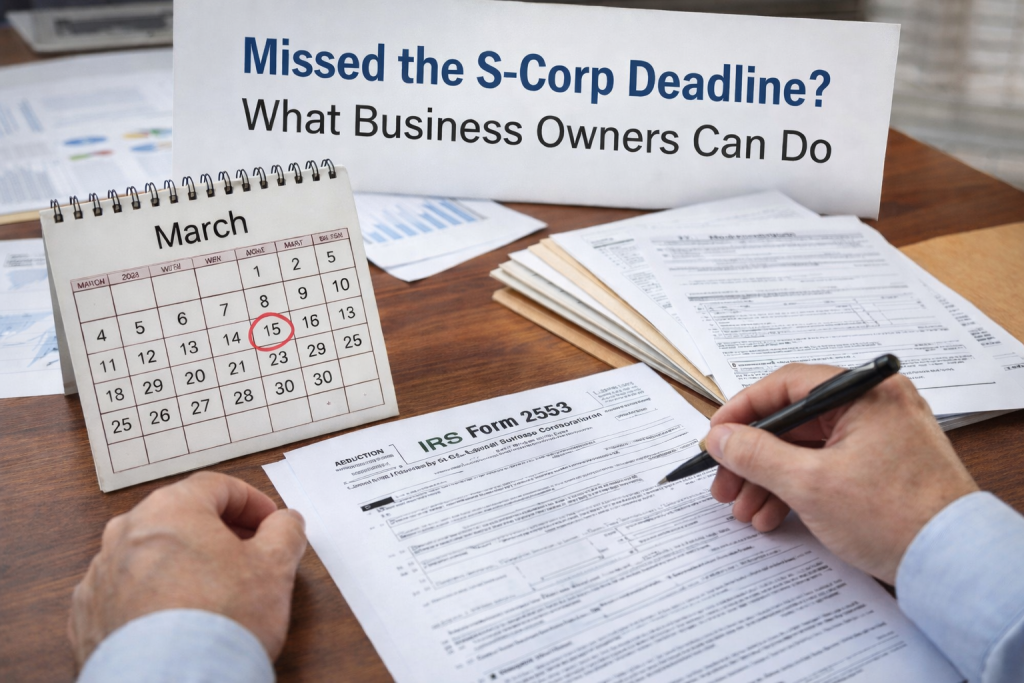
Business owner reviewing IRS Form 2553 with a March 15 calendar deadline after missing the S-Corporation election deadline
If you missed the S-Corp deadline, you are not alone. Many business owners discover too late that electing S-Corporation status requires filing IRS Form 2553 by a specific deadline.
The good news is that missing the deadline does not always mean the opportunity is lost. In many cases, businesses may still qualify for late election relief or elect S-Corporation status for a future tax year.
This situation often happens because the election deadline was not clearly explained, paperwork was started but never completed, or the business was formed quickly and tax elections were postponed. In other cases, owners are told to “become an S-Corp” without realizing that the IRS requires a separate election form.
Even when the deadline is missed, business owners often still have planning options available — including requesting late election relief or preparing for a clean S-Corporation election in the following tax year.
For business owners in South Jordan, throughout Utah, and across the country, the most important step is addressing the issue quickly and correctly so mistakes do not compound.
The earlier you review the situation, the more options are usually available.
Quick Answer
If you missed the S-Corp deadline, you may still be able to fix it. Many businesses can request late election relief by filing Form 2553 properly and showing reasonable cause for missing the original deadline. When relief is not available, the election can often be made effective for a future tax year with better planning. The earlier you address the problem, the more options you usually have.
What Is the S-Corp Election Deadline?
The S-Corporation election deadline is typically March 15 for calendar-year businesses, which is two months and fifteen days after the beginning of the tax year. A business receives S-Corporation tax treatment when it files Form 2553 on time.
CPA Insight
Many business owners think they missed the S-Corp opportunity permanently. In reality, the bigger issue is usually not the missed form itself — it is the incorrect payroll, compensation, and tax reporting decisions made after the deadline was missed.
Key Takeaways
- Missing the S-Corp deadline does not always mean you permanently lost the election.
- The standard filing deadline is generally 2 months and 15 days after the beginning of the tax year the election is supposed to take effect.
- Many businesses may qualify for late election relief if they act within the IRS relief window and meet the requirements.
- If relief is not available, you may still be able to make the election effective next year.
- A missed S-Corp election should trigger broader tax planning, not panic.
What the Missed S-Corp Deadline Actually Means
An S-Corporation is not created automatically just because you formed an LLC or corporation.
To be taxed as an S-Corporation, an eligible business generally must file Form 2553 on time. For a calendar-year business, that usually means the election must be filed by March 15 if you want S-Corporation treatment for that year. Businesses can also file during the prior tax year for the upcoming year.
This is where many owners get tripped up.
They may:
- form an LLC and assume it is already an S-Corp,
- tell their payroll company they are an S-Corp without filing the election,
- start running payroll before the election is actually accepted,
- or discover the issue only after tax season is already underway.
That is why this issue often shows up in March, when business owners are making payroll, deduction, and entity-planning decisions too late.
What Happens If You Miss the S-Corp Deadline
If you miss the S-Corp election deadline, your business will typically remain taxed under its default classification for that tax year. However, many businesses may still qualify for late election relief by filing Form 2553 and explaining the reason for the late filing.
The immediate consequence is simple: your business may not be treated as an S-Corporation for the year you intended, which can create larger tax consequences than many owners expect.
Depending on how your business is structured, missing the election may mean:
- your LLC remains taxed under its default classification,
- your corporation remains taxed as a C corporation,
- payroll decisions may need to be revisited,
- distributions may need to be recharacterized or reviewed,
- your expected self-employment tax savings may disappear for that year,
- and tax filings may have to be handled very differently than you originally planned.
It can also create confusion when the business owner already acted as though the S election were in place. That is one of the biggest reasons this problem should be addressed early, before incorrect payroll, owner compensation, or tax return reporting makes the cleanup harder.
Can You Fix a Missed S-Corp Deadline?
Often, yes.
The IRS provides a path for many eligible businesses to request late S-Corporation election relief. Under Revenue Procedure 2013-30, relief may be available when the business intended to elect S-Corporation status, failed to file on time, had reasonable cause, and acted diligently to correct the issue.
According to IRS guidance, businesses that miss the S-Corp election deadline may still qualify for late election relief if they meet specific eligibility requirements and act within the allowable time window.
That does not mean every late election is automatically accepted.
It means the business may have a route to request relief if the facts support it.
Situations Where Late Relief May Be Possible
A missed election may still be fixable when:
- the business was otherwise eligible to be an S-Corporation,
- the owners intended S-Corp treatment from the start,
- the business has consistently acted like an S-Corp or planned to,
- the failure was due to oversight, misunderstanding, or another explainable error,
- and the issue is corrected promptly after discovery.
This is where details matter. A rushed filing with weak facts can create more problems instead of fewer. The explanation must be consistent with how the business actually operated.
Situations Where Relief May Not Solve Everything
Even when late relief is available, it does not erase every underlying issue.
For example:
- the business may still need to correct payroll filings,
- shareholder compensation may need review,
- prior filings may need to be corrected,
- state tax treatment may not line up automatically,
- and bookkeeping may need to be adjusted so the return matches reality.
Also, if too much time has passed, or if the business was never actually eligible for S-Corp treatment, relief may not be available.
That is why the real question is not only, “Did you miss the deadline?”
It is also, “What did the business do after missing it?”
What to Do After You Miss the S-Corp Deadline
If you missed the S-Corp deadline, take these steps immediately.
1. Confirm your entity type
Start with the basics. Are you operating as an LLC or a corporation? That affects how the missed election impacts your tax treatment.
2. Confirm the intended effective date
You need to know which tax year you were trying to elect.
3. Review whether the business was eligible
Not every entity qualifies, and eligibility must be confirmed before trying to fix the election.
4. Gather your supporting facts
Document when the business was formed, when the owners intended to elect S-Corp status, what advice was given, whether payroll was started, and how the business has been filing and operating.
5. Determine whether late election relief applies
This is usually the key decision point. If relief is available, the correction path may be much better than you expected.
6. Build a backup plan if relief is not available
Sometimes the best move is to elect S-Corp status for the next year and improve tax planning now rather than forcing a weak fix.
Mistakes to Avoid After Missing the S-Corporation Deadline
Once the deadline is missed, business owners often make the situation worse by reacting too quickly.
Common mistakes include:
- filing payroll as if the S election were already valid,
- taking owner distributions without reviewing tax treatment,
- assuming the IRS will “understand what you meant,”
- filing returns inconsistently,
- waiting until the return is due before addressing the issue,
- or relying on generic online advice that does not match the business facts.
This is exactly why a planning-first approach matters. Entity elections affect payroll, compensation, bookkeeping, estimated taxes, and how profits flow to the owner. It is never just one form.
Why This Matters So Much for Business Owners
Many owners pursue S-Corporation status for one reason: tax savings.
But the S election only works well when the entire structure is handled correctly. That includes:
- reasonable owner compensation,
- clean payroll reporting,
- accurate bookkeeping,
- proper distributions,
- and year-round tax planning.
So even if you missed the deadline, this can still be a valuable turning point. It forces the business to step back and build the tax structure the right way instead of layering mistakes on top of confusion.
That is especially important for service businesses, consultants, contractors, and other profitable owner-operated businesses in Utah where S-Corporation planning often becomes one of the biggest drivers of tax efficiency.
This is why understanding reasonable salary for S-Corporation owners is also a critical part of the planning process.
Many of these businesses also benefit from proactive S-Corporation tax planning strategies implemented before the March deadline.
Local Insight for Utah Business Owners
We often see this issue with Utah business owners who formed an LLC quickly, started earning income, and were told later that they “should be an S-Corp.”
By then, payroll may not be set up correctly, bookkeeping may be behind, and the owner may have already taken draws with no clear compensation strategy.
For South Jordan and Salt Lake County business owners, this is a strong reminder that entity strategy should happen before the year gets too far along. Waiting until return preparation season usually limits your options.
Business owners in South Jordan, Salt Lake County, and across Utah frequently discover the missed S-Corp election issue during tax season, which is why proactive entity planning earlier in the year can prevent costly mistakes.
Final Thoughts
Missing the S-Corp deadline is a problem, but it is not always a disaster.
In many cases, there is still a path forward. The right next step depends on whether late election relief is available, how the business has operated so far, and whether the tax savings still justify the structure going forward.
What matters most is acting quickly, understanding the facts, and making a clean decision based on the real IRS rules rather than assumptions.
If you missed the S-Corp deadline, your business may still qualify for late election relief by filing Form 2553 and demonstrating reasonable cause. When relief is not available, the election can often be made effective for a future tax year with better planning.
If you missed the S-Corp deadline, do not guess. Review the election, review the entity, and build the next step carefully.
Business owners often discover too late that electing S-Corporation status requires filing Form 2553.
Reviewing your entity structure now can help prevent the same problem next year.
Need Help Fixing a Missed S-Corp Election Deadline?
If you missed the S-Corp deadline and want to know whether late election relief may still apply, reviewing the details before filing your tax return can prevent costly mistakes.
At Madsen and Company, we help business owners evaluate entity elections, late S-Corporation filings, and proactive tax planning strategies.
Many business owners in South Jordan, Salt Lake County, and across Utah discover the missed S-Corp election issue during tax season and want a second opinion before filing.
If you want to review your situation before filing your return, now is the time to determine whether late election relief or a future S-Corporation strategy makes sense for your business.
Frequently Asked Questions
In general, Form 2553 must be filed no later than 2 months and 15 days after the start of the tax year the election is meant to apply to. For many calendar-year businesses, that means March 15.
Sometimes. The IRS allows late election relief in many cases if the business qualifies and acts within the applicable relief period.
In many cases, the relief request must be made within 3 years and 75 days of the intended effective date, assuming the business otherwise qualifies.
You may still be able to elect S-Corporation status for a future year and use other tax-planning strategies in the meantime.
No. It may still be a good strategy. It just needs to be evaluated based on profit level, payroll requirements, compliance costs, and timing.
Related S-Corporation Planning Resources
• S-Corporation Tax Planning Strategies
• Reasonable Salary for S-Corp Owners
• Business Tax Preparation vs Tax Planning
