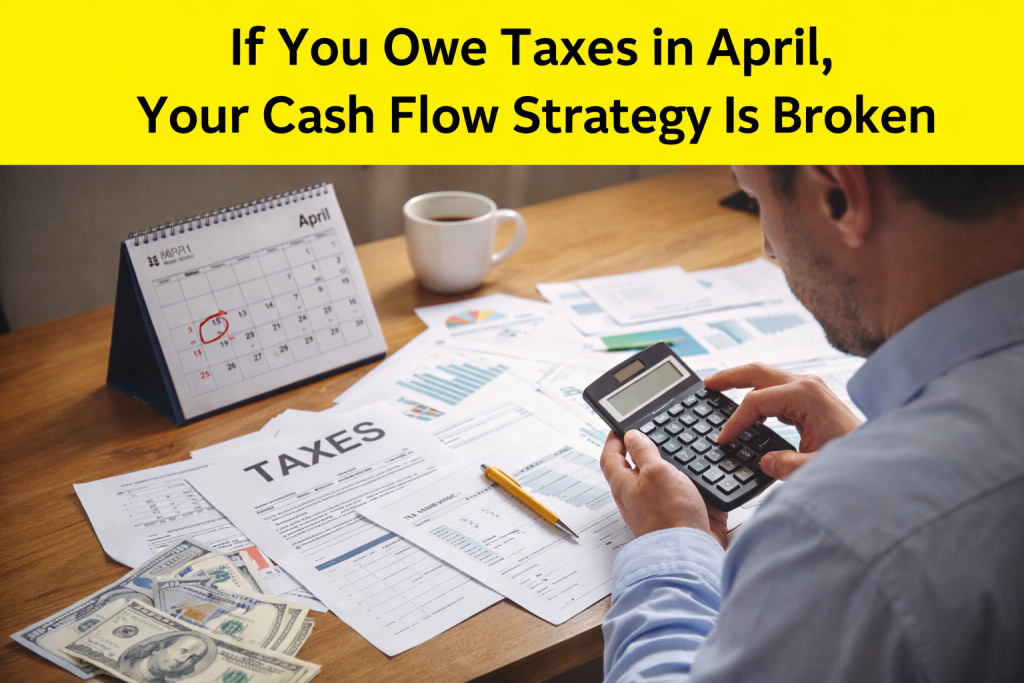
If you owe taxes in April, it often means your cash flow strategy is not accounting for taxes throughout the year. Many business owners treat taxes as something to deal with at filing time, but when you consistently owe taxes in April, it usually signals that tax planning and cash flow management are not working together.
Taxes should not be a surprise expense that appears once a year. For profitable businesses, taxes are simply another operating cost that should be planned for and managed throughout the year.
When a large tax bill shows up unexpectedly in April, it usually means the business owner was reacting to taxes instead of planning for them.
Quick Answer
If you owe taxes in April, it usually means taxes were not planned for throughout the year. Business owners who manage taxes effectively make estimated payments, adjust withholding, and work with a CPA on proactive tax planning strategies so taxes are paid gradually instead of appearing as a large bill at filing time.
Key Takeaways
- If you owe taxes in April every year, your tax strategy may be reactive
- Taxes should be treated as a regular operating expense
- Quarterly estimated payments spread tax costs throughout the year
- Proactive tax planning strategies help business owners avoid surprises
- Year-round CPA guidance improves both tax outcomes and cash flow
Why Business Owners Owe Taxes in April
When business owners owe taxes in April, it is rarely because the tax return itself caused the problem. The real issue usually occurs months earlier when taxes were not built into the company’s cash flow strategy.
Many business owners focus on revenue and expenses but forget that taxes are another cost of operating a profitable business.
When taxes are not planned for during the year, the result is often a large bill when the tax return is filed.
Cash Flow Stress
A large tax bill can strain business or personal finances.
Missed Planning Opportunities
Many tax strategies must be implemented before the end of the tax year.
Emergency Decisions
Business owners sometimes take loans, drain savings, or delay other investments to cover taxes.
A better approach is managing taxes as part of the business’s normal financial operations.
What a Healthy Tax Cash Flow Strategy Looks Like
Businesses that rarely face tax surprises typically follow a structured approach.
1. Taxes Are Built Into Cash Flow Forecasts
Smart business owners treat taxes like payroll or rent — a predictable expense.
Each month, a portion of profits is set aside specifically for taxes.
2. Quarterly Estimated Payments Are Managed
The IRS expects many business owners to make quarterly estimated payments.
These payments help prevent underpayment penalties and reduce the likelihood that you will owe taxes in April.
If income changes during the year, estimated payments should be adjusted.
3. Withholding Is Used Strategically
Some business owners increase withholding from W-2 wages to offset business income. This approach can sometimes simplify tax payments because withholding is treated as if it was paid evenly throughout the year for IRS purposes.
4. Tax Planning Happens Before Year-End
The most powerful tax strategies must happen during the tax year, not after.
Examples include:
• Adjusting S-Corporation salary
• Timing equipment purchases
• Retirement contributions
• Managing capital gains and losses
Without planning during the year, these options disappear.
The Real Reason Business Owners Owe Large Tax Bills
The problem is usually not the tax return itself.
The real issue is the lack of planning before the return is prepared.
Many accountants focus primarily on recording what already happened.
A proactive CPA focuses on helping clients influence the outcome before it becomes permanent.
That difference can significantly change both taxes and cash flow.
Common Signs Your Tax Strategy Needs Improvement
You may need a better tax strategy if:
• You are surprised by your tax bill every year
• You scramble to find cash in April
• You do not make quarterly estimated payments
• Your accountant only contacts you during tax season
• Tax planning conversations happen after the year is over
These situations often indicate the tax strategy is reactive instead of proactive.
How Proactive Tax Planning Fixes the Problem
Proactive tax planning focuses on controlling taxes throughout the year instead of reacting after the fact.
This typically includes:
• Mid-year tax projections
• Adjustments to estimated payments
• Reviewing income and deductions before year-end
• Planning retirement contributions
• Structuring S-Corporation compensation properly
When done correctly, business owners gain predictability, reduced stress, and fewer surprises.
Local Insight for Utah Business Owners
Many small business owners across South Jordan, Salt Lake County, and the greater Utah area operate S-Corporations or service-based businesses with fluctuating income.
These businesses often experience large tax swings when profits increase quickly.
Without proactive planning, it is easy to underpay taxes during the year and owe taxes in April when the return is filed.
Working with a CPA who focuses on year-round tax planning instead of once-a-year tax preparation helps stabilize both taxes and cash flow.
CPA Insight
“Taxes should never be a surprise for profitable business owners. When taxes are planned throughout the year, April becomes a filing deadline — not a financial crisis.”
— Steve Madsen, CPA
When to Start Fixing the Problem
The best time to improve your tax strategy is before the next tax year begins.
However, improvements can still be made during the year through:
• Adjusting estimated payments
• Changing withholding
• Implementing mid-year planning strategies
The sooner planning begins, the more options are available.
Final Thought
If you owe taxes in April, it does not necessarily mean something went wrong.
But if it happens every year and catches you off guard, it may signal that your tax and cash flow strategy needs improvement.
Taxes are predictable when they are planned.
Frequently Asked Questions
Owing taxes in April is not necessarily a problem. It can simply mean that not enough tax was paid throughout the year through withholding or estimated payments. However, if you consistently owe large amounts every year, it often signals that your tax planning or cash flow strategy needs adjustment.
Business owners typically avoid owing large tax bills in April by managing estimated tax payments, adjusting withholding, and working with a CPA on proactive tax planning throughout the year. When taxes are planned for regularly, the annual filing deadline becomes much more predictable.
Stop Letting Taxes Surprise You
If you keep owing taxes in April, the issue usually is not the tax return.
It is the lack of proactive tax planning during the year.
Business owners who manage taxes strategically rarely face unexpected tax bills. Instead, they build taxes into their financial planning so April becomes a filing deadline — not a financial emergency.
Madsen and Company helps business owners implement proactive tax strategies that reduce surprises, improve cash flow, and create better long-term financial outcomes.
If you want your tax strategy to work before April arrives, schedule a consultation with Madsen and Company to discuss proactive tax planning for your business.