• Skip to main content
  • Skip to primary sidebar

  • Home
  • About
  • Contact

business tax planning

How Much Should a Small Business Owner Pay Themselves? (W-2 vs Distributions)

February 25, 2026 by Steve Madsen

W-2 salary versus owner distributions for S Corporation small business owners
Understanding the balance between W-2 salary and distributions helps business owners stay compliant while minimizing payroll taxes.

Quick Answer
Most small business owners should pay themselves based on their entity type. S Corporation owners must take a reasonable W-2 salary for the work they perform and then take additional profits as distributions to reduce payroll taxes while staying compliant with Internal Revenue Service rules.

How much should a small business owner pay themselves?

Small business owners should pay themselves differently depending on their business structure, especially if they operate as an S Corporation. The correct mix of W-2 salary and owner distributions must be “reasonable” under IRS rules and aligned with the work performed. Paying yourself incorrectly can trigger payroll tax penalties or missed tax-saving opportunities.

What does “paying yourself” actually mean?

Paying yourself means taking money out of your business in a way that complies with both tax law and your entity type.

How income is taken depends on structure:

  • Sole proprietors and single-member LLCs:
    You do not take a paycheck. Instead, you take owner draws, and all profit is subject to income tax and self-employment tax.
  • Partnerships:
    Owners typically take distributions and possibly guaranteed payments, both subject to self-employment tax.
  • S Corporations:
    Owners must split income between:
    • W-2 salary (subject to payroll taxes)
    • Distributions (not subject to payroll taxes)

Therefore, the real planning question applies mainly to S Corporation owners.

Why does the IRS care how much a small business owner pays themselves?

The IRS requires S Corporation owners to pay themselves a “reasonable salary” for the work they perform.

According to guidance from the Internal Revenue Service, S Corporation owners who perform services for their company must receive reasonable W-2 compensation.

The goal is to prevent owners from avoiding payroll taxes by taking only distributions. The IRS evaluates:

  • Your role in the company (management vs passive owner)
  • Your industry and job function
  • Hours worked and responsibilities
  • Company revenue and profitability
  • Comparable wages for similar work

Because of this, a $20,000 salary with $180,000 in distributions is rarely defensible for an active owner.

When asking how much should a small business owner pay themselves, the goal is to match compensation to actual job duties while remaining tax efficient.

How Much Should an S Corporation Owner Pay Themselves in Salary vs Distributions?

A reasonable salary is what the business would pay someone else to do your job.

Common benchmarks include:

  • 40%–60% of total business profit for many service businesses
  • Industry salary surveys (BLS or private data)
  • Comparable W-2 wages for similar roles

Examples:

  • Consultant earning $150,000 profit → reasonable salary might be $70,000–$90,000
  • Construction company owner earning $250,000 profit → salary might be $100,000–$140,000

However, no single formula fits all cases. Reasonable compensation must be justified annually.

For Utah S Corporation owners—especially those in construction, trades, and professional service businesses—reasonable compensation is one of the most commonly misapplied tax rules we see. Payroll norms in Utah often differ from national averages, and applying generic online formulas without local context can increase audit risk. This is why reasonable salary decisions should be reviewed annually as part of proactive tax planning, not guessed at after the year ends.

Why not take everything as W-2 salary?

Taking all income as salary increases payroll taxes unnecessarily.

W-2 wages are subject to:

  • Social Security tax (12.4% up to the wage cap)
  • Medicare tax (2.9% plus surtax at higher income levels)
  • Federal and state unemployment taxes

Distributions avoid payroll tax. Therefore:

  • More salary = higher payroll tax
  • More distribution = higher audit risk if salary is too low

The strategy is to find the defensible middle ground.

What is the most tax-efficient way for a small business owner to pay themselves?

The tax-efficient strategy is to pay a defensible salary and take the rest as distributions.

Benefits include:

  • Lower total payroll tax burden
  • Cleaner audit trail
  • Better retirement planning accuracy
  • Reduced penalty risk

In addition, timing matters:

  • Salary must be paid regularly through payroll
  • Distributions should follow documented profit
  • Planning should occur before year-end, not after filing

This is where tax planning differs from tax preparation.

When should this be reviewed?

Owner compensation should be reviewed annually or when income changes materially.

Triggers for review include:

  • Revenue growth
  • New responsibilities
  • Hiring staff
  • Adding business partners
  • Switching to S Corporation status

Failing to update salary as profit grows is one of the most common audit red flags.


Bottom Line

Small business owners must align how they pay themselves with their entity type and IRS rules.
S Corporation owners must pay a reasonable W-2 salary before taking distributions.
The goal is not to minimize salary at all costs, but to balance tax efficiency with legal compliance.

How much a small business owner should pay themselves depends on entity type, job role, and IRS reasonable compensation rules.

FAQs

Can I take only distributions and no salary in an S Corp?

No. If you perform services for the company, the IRS requires that you receive W-2 wages.

What happens if my salary is too low?

The IRS can reclassify distributions as wages, assess back payroll taxes, and impose penalties and interest

Is there a fixed percentage I must use?

No. The IRS does not publish a formula. Reasonable pay depends on your role, industry, and company profits.

Can my salary change year to year?

Yes. Salary should change as your business income and responsibilities change.

Does this apply to LLC owners?

Only LLCs taxed as S Corporations use this structure. Single-member LLCs taxed as sole proprietors do not.

What documents support a reasonable salary if I’m audited?

Common support includes payroll records, job descriptions, time spent working in the business, industry wage data, prior-year compensation history, and written tax planning notes explaining how the salary was determined.

Do reasonable salary rules apply if my S Corporation has a loss?

Yes. If you perform services for your S Corporation, reasonable compensation rules still apply even if the business is not profitable. The amount may be lower, but paying zero salary while performing substantial work can still raise audit concerns.

How Madsen and Company Can Help

At Madsen and Company, we help business owners structure compensation that is both tax-efficient and audit-defensible. Our tax planning process includes:

  • Reasonable compensation analysis
  • Payroll and distribution strategy
  • Entity structure review
  • Multi-year tax projections

As a Utah-based CPA firm working with S Corporation owners throughout South Jordan and surrounding areas, we see this issue trigger audits more often than almost any other tax mistake.

What to Do Next if You’re an S Corporation Owner

Schedule a Small Business Tax Planning Consultation

We’ll review your business structure, income, and current pay strategy to determine whether your compensation is optimized for both compliance and tax savings.

Get Started with Business Tax Preparation

If you are ready to file accurately and on time, our CPA-led tax preparation ensures your compensation and distributions are reported correctly.

Filed Under: Small Business Taxes, Tax Planning Tagged With: business tax planning, reasonable salary, S corporation tax planning, S-Corp Taxes

S-Corp Tax Planning: Why Waiting Until April Costs You

February 18, 2026 by Steve Madsen

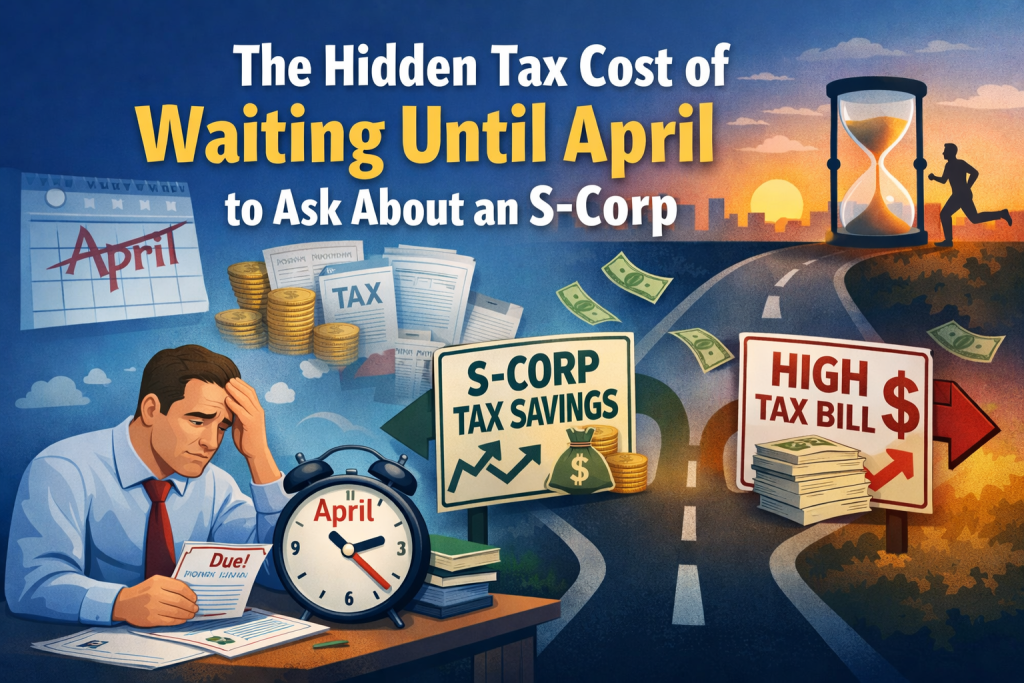
Business owner reviewing tax documents in April while choosing between S-Corp tax savings and a high tax bill
Waiting until tax season to evaluate S-Corp status can mean missing out on significant payroll tax savings.

Quick answer: S-Corp tax savings depend on timing, not just entity choice. Waiting until April usually eliminates the payroll strategies that make S-Corp taxation effective.

Waiting until April to ask whether you should be taxed as an S-Corporation often costs business owners thousands in avoidable self-employment taxes. By the time tax season arrives, most of the planning opportunities tied to S-Corp status have already expired. Proactive timing — not last-minute filing — determines whether an S-Corp actually saves you money.

For many service-based businesses, including Utah professional firms, S-Corp timing directly affects payroll compliance and tax outcomes.


Why does waiting until April eliminate most S-Corp tax savings?

Waiting until April eliminates most S-Corp tax savings because S-Corp elections must generally be made by March 15 to apply for that tax year.

Once the year has closed, income and payroll decisions are already set. As a result:

  • The business owner is stuck paying full self-employment tax on all profits.
  • No reasonable salary was established or paid through payroll.
  • Payroll tax strategies cannot be applied retroactively.
  • Retirement contributions tied to wages may be limited.

Therefore, waiting until April turns S-Corp planning into a missed opportunity rather than a tax strategy.

Already past the deadline? We can still help you file accurately and plan ahead for next year.


What tax benefits are lost when an S-Corp is chosen too late?

The main tax benefit lost is the ability to split income between salary and distributions.

When timing is missed:

  • All business profit is taxed as self-employment income.
  • Social Security and Medicare taxes apply to the full amount.
  • Health insurance and fringe benefits may be structured incorrectly.
  • Quarterly estimates may already be wrong.

In contrast, proper timing allows:

  • A reasonable salary to be taxed through payroll.
  • Remaining profit to avoid self-employment tax.
  • Payroll withholding to support retirement contributions.

Thus, timing determines whether an S-Corp produces real savings or simply adds paperwork.


Who actually benefits from S-Corp taxation?

Not every business benefits from S-Corp taxation, but many profitable service businesses do.

S-Corp taxation usually helps when:

  • Net profit is consistently above $40,000–$50,000.
  • The owner materially participates in operations.
  • Income is stable and predictable.
  • Payroll can be run consistently.

However, S-Corp status is usually a poor fit when:

  • Profits fluctuate wildly.
  • The business is still in startup mode.
  • Owners cannot support payroll compliance.

Therefore, S-Corp status works best as part of a larger tax strategy rather than a reaction to tax season.


Why should S-Corp planning happen before the year starts?

S-Corp planning must happen before the year starts because payroll structure drives tax savings.

When planning happens early:

  • Salary can be set correctly from January.
  • Payroll taxes can be optimized across the year.
  • Estimated payments align with actual tax strategy.
  • Retirement contributions can be maximized.

When planning happens late:

  • Salary cannot be fixed retroactively.
  • Distributions are already misclassified.
  • Compliance risk increases.
  • Savings are permanently lost.

As a result, S-Corp strategy works best as a proactive decision — not an emergency response.


How does this affect small business owners specifically?

Small business owners are most affected because they control both income and compensation.

This means:

  • Their timing decisions directly affect tax liability.
  • Their structure determines payroll exposure.
  • Their planning window closes once the year ends.

Without early guidance:

  • Owners often overpay self-employment tax.
  • Business cash flow suffers unnecessarily.
  • Long-term planning becomes reactive instead of strategic.

Consequently, S-Corp decisions should be evaluated during the year — not after it.


Bottom Line

Waiting until April to ask about S-Corp taxation usually eliminates the tax benefits it is meant to provide.
S-Corp status is most effective when salary, payroll, and profit distributions are structured in advance.
Proactive tax planning — not tax preparation — determines whether an S-Corp reduces tax or simply increases complexity.

View Our Business Tax Preparation Services


How Madsen and Company Can Help

Madsen and Company helps business owners evaluate S-Corp taxation before deadlines pass — not after the savings are gone.

We help Utah-based and nationwide service businesses plan S-Corp taxation before deadlines pass — not after savings are gone.

Our tax planning process includes:

  • Analyzing whether S-Corp taxation actually lowers your total tax
  • Structuring reasonable salary and payroll correctly
  • Coordinating income timing and retirement contributions
  • Integrating tax planning with tax preparation for full compliance

If you want your tax return to reflect strategy instead of surprises, proactive planning is the first step.


Frequently Asked Questions

Can I still elect S-Corp status after March 15?

Yes, but it usually applies to the following tax year unless special relief applies. Late elections often eliminate current-year tax savings.

Does forming an LLC automatically make me an S-Corp?

No. An LLC must file a separate election with the IRS to be taxed as an S-Corporation

How much tax can an S-Corp save?

Savings depend on profit level and salary structure. Many owners save several thousand dollars per year when structured correctly.

Is an S-Corp right for every business?

No. Low-profit or startup businesses often gain little benefit and may increase compliance costs.

Should I ask about S-Corp status during tax season?

Tax season is often too late. S-Corp strategy should be reviewed before or during the tax year to be effective.

Schedule a Tax Planning Consultation

Find out whether S-Corp tax planning could lower your self-employment tax before another year of savings is lost.

Filed Under: Small Business Taxes, Tax Planning Tagged With: business tax planning, proactive tax planning, S corporation tax planning, S-Corporation, small business CPA, South Jordan Tax Planning

The S-Corp Deadline Is Closer Than You Think: 5 Things to Do Before March 15

February 1, 2026 by Steve Madsen

Written by Steve Madsen, CPA — licensed since 1993.

March 15 business tax deadline for S-Corporation owners
S-Corporation owners must file by March 15 to avoid IRS penalties and delays.

The March 15 tax deadline is one of the most important — and most misunderstood — deadlines for S-Corporation owners and partnerships.

This deadline is also a key checkpoint in proactive S-Corporation tax planning, where payroll, distributions, and documentation decisions must be finalized before opportunities disappear.

For Utah-based S-Corporation owners, the March 15 deadline often impacts both business filings and personal tax planning timelines, making early action especially important.

Each year, business owners are caught off guard by March 15, assuming they still have time or that filing an extension means nothing is due. That misunderstanding can lead to penalties, rushed decisions, and avoidable stress.

What Is Due on the March 15 Business Tax Deadline?

March 15 is the federal filing deadline for S-Corporations and partnerships, regardless of income or tax owed.

This deadline applies to:

  • S-Corporations (Form 1120-S)
  • Partnerships (Form 1065)

The March 15 deadline applies whether:

  • the business has one owner or multiple owners
  • the business made money or not
  • the business ultimately owes tax or not

If your business is required to file, the deadline applies.


March 15 in plain terms:

March 15 is the deadline for filing the business return so income can flow correctly to the owner’s personal tax return; missing it can trigger penalties and downstream personal tax issues.


CPA Insight:

For S-Corporation owners, March 15 is not just a filing deadline — it’s the last meaningful checkpoint to ensure business income is reported correctly and personal tax planning can still happen on time.

The Hidden Cost of Missing March 15

Missing the March 15 business tax deadline can trigger IRS penalties even if no income tax is owed.

One of the biggest misconceptions is that penalties only apply if tax is owed.

For S-Corporations, that’s not true.

If an S-Corp return is late and no extension is filed, the IRS can assess penalties of approximately $245 per shareholder, per month, up to 12 months—even if the business itself owes no income tax.

That means a “harmless delay” can quietly turn into thousands of dollars in penalties.

Filing an Extension Doesn’t Mean Doing Nothing

An extension:

  • gives you more time to file, not more time to plan
  • does not delay taxes owed or required estimated payments
  • still requires reasonable estimates and coordination with personal returns

Waiting until after March 15 to think about the business return often limits your options and forces reactive decisions instead of intentional ones.

What Smart Business Owners Do Before March 15

Proactive business owners use the weeks leading up to March 15 to:

  • Confirm the correct business structure is still working
  • Review profit levels before returns are finalized
  • Ensure S-Corp payroll is reasonable and defensible
  • Coordinate business results with personal tax planning
  • Decide whether filing now or extending makes the most sense

Many of these decisions tie directly into ongoing tax planning, not just tax preparation.

Unsure whether to file or extend? A short planning review before March 15 can clarify your next steps.

The goal isn’t just to meet a deadline—it’s to file returns that reflect deliberate strategy, not last-minute scrambling.

Why March 15 Impacts Your Personal Taxes Too

Business returns don’t exist in a vacuum.

For S-Corp owners and partners, the business return directly affects:

  • personal taxable income
  • estimated tax requirements
  • retirement planning
  • cash flow planning for the year ahead

Rushing the business return often creates downstream issues on the personal side—including surprises in April.

The Bottom Line

March 15 isn’t just a filing date—it’s a decision point.

When business tax returns are treated as a formality instead of part of a broader plan, opportunities get missed and risks increase.

The best outcomes happen when:

  • the business return is handled intentionally
  • deadlines are used strategically
  • and planning happens before options disappear

FAQs

What business tax returns are due on March 15?

March 15 is the federal filing deadline for S-Corporations (Form 1120-S) and partnerships (Form 1065). This deadline applies even if the business has only one owner or did not generate taxable income.

What happens if an S-Corp misses the March 15 deadline?

Missing the March 15 deadline can trigger IRS penalties even if no tax is owed. The IRS may assess penalties of approximately $245 per shareholder, per month, up to 12 months, if no extension is filed.

Does filing an extension delay taxes owed?

No, filing an extension only delays the deadline to file the return, not to pay taxes. Any tax owed must still be paid by the original due date to avoid penalties and interest.

Do single-member S-Corps still have to file by March 15?

Yes, single-shareholder S-Corporations are subject to the same March 15 deadline as multi-owner S-Corps. The filing requirement and penalty structure apply regardless of the number of shareholders.

Can I still make tax planning decisions after March 15?

Most high-impact tax planning decisions must be made before the year ends, not after March 15. While some elections may still be available, key items like payroll levels, income timing, and certain deductions are usually already locked in.

Is it better to file or extend an S-Corp return?

Whether to file or extend depends on your business’s income, documentation readiness, and coordination with personal taxes. The best choice is an intentional one based on planning, not a default reaction to timing pressure.

Why does the March 15 deadline affect my personal tax return?

S-Corporation and partnership income flows directly into the owner’s personal tax return. Delays or rushed filings at the business level can create surprises in personal tax liability, estimates, and cash flow planning.

How Madsen and Company Can Help

At Madsen and Company, we help business owners approach the March 15 deadline with clarity—not panic.

That means:

  • understanding what decisions still matter
  • coordinating business and personal tax strategy
  • and ensuring filings support long-term goals, not just compliance

👉 Want to know what decisions matter most right now?

Unsure whether to file or extend? A short planning review before March 15 can clarify next steps.
Schedule a Proactive Tax Planning Review.

Filed Under: Business Tax, Tax Deadlines & Compliance Tagged With: business tax planning, proactive tax planning, S corporation tax planning, Small Business Tax Strategy, small business taxes, South Jordan CPA, tax planning, Utah tax planning

  • « Go to Previous Page
  • Page 1
  • Page 2

Primary Sidebar

Search

Archives

  • March 2026
  • February 2026
  • January 2026
  • December 2025
  • November 2025
  • July 2025
  • May 2025
  • April 2025
  • March 2025
  • January 2025
  • August 2024
  • July 2024
  • June 2024
  • February 2024
  • January 2024
  • November 2023
  • August 2023
  • March 2023
  • February 2023

Categories

  • Business Best Practices
  • Business Tax
  • Individual Tax
  • Real Estate
  • Retirement
  • S-Corporation Tax
  • Small Business
  • Small Business Taxes
  • Tax Deadlines & Compliance
  • Tax Planning
  • Uncategorized

Copyright © 2026 · https://www.madsencpa.com/blog