• Skip to main content
  • Skip to primary sidebar

  • Home
  • About
  • Contact

Tax Planning

Avoid IRS Underpayment Penalties in 2026 (Tax Planning Guide)

March 17, 2026 by Steve Madsen

Business owner reviewing tax payments and IRS estimates to avoid underpayment penalties in 2026
Reviewing estimated tax payments and withholding adjustments can help business owners avoid IRS underpayment penalties in 2026.

Owing taxes this year does not automatically mean you have to repeat the same problem next year.
If you ended up with an unexpected tax bill, one of the smartest moves you can make now is to build a plan that helps you avoid IRS underpayment penalties in 2026. The key is building a strategy now so you can avoid IRS underpayment penalties in 2026 instead of reacting to another unexpected tax bill.

Many business owners and higher-income taxpayers are surprised to learn that the IRS does not just care whether you pay by the filing deadline. It also cares when the tax was paid during the year. That is where underpayment penalties come in.

The good news is that if you owe this year, you still have time to fix the pattern before it becomes more expensive next year.

Quick Answer

To avoid IRS underpayment penalties in 2026, you generally need to make sure enough tax is paid in throughout the year through withholding, quarterly estimated tax payments, or a combination of both. If you owed this year, that is often a sign your current tax payments are too low, uneven, or poorly timed. The best fix is to review your income early, project your tax liability, and adjust your plan before the next year gets away from you.


Why Taxpayers Fail to Avoid IRS Underpayment Penalties in 2026

A lot of taxpayers assume that as long as they pay their balance when they file their return, everything is fine.

That is not always true.

The IRS expects many taxpayers to pay taxes as income is earned, not just at the end of the year. When too little is paid during the year, the IRS may assess an underpayment penalty even if the full tax is eventually paid with the return.

This happens often with:

  • business owners
  • self-employed taxpayers
  • S Corporation owners taking distributions
  • real estate investors
  • retirees with multiple income sources
  • taxpayers with large capital gains
  • people with side income or 1099 income
  • taxpayers who had a big jump in income but never adjusted withholding

In other words, the problem is usually not just that someone owes. The problem is that their payment strategy was not keeping up with their income.


Common Reasons You May Owe This Year

If you are trying to avoid the same issue in 2026, start by identifying what caused the balance due this year.

1. Your withholding was too low

This is common when wages, spouse income, bonuses, retirement distributions, or Social Security withholding were not properly adjusted.

2. You did not make estimated tax payments

Self-employed taxpayers and business owners often need quarterly estimated payments. If those are missed or too low, the balance due can grow fast.

3. Your income increased

A better year in business, large asset sale, Roth conversion, or increased investment income can create a tax bill that your old payment system was never designed to handle.

4. You relied on last year’s results

A lot of people assume this year will look like last year. That works until profits rise, deductions change, or a one-time event pushes income much higher.

5. You took money out but did not reserve for taxes

This is especially common with business owners. Cash was available, so it got used for personal spending, debt payments, or reinvestment, but no tax reserve was set aside.


What the IRS Really Looks At

The IRS is not only measuring whether you paid enough by April. It is also measuring whether you paid enough during the year.

That matters because many taxpayers think they can just “catch up later.” Sometimes they can reduce the damage, but late catch-up payments do not always erase a penalty that already started building earlier in the year.

That is why tax planning needs to happen before year-end and, ideally, throughout the year to help taxpayers avoid IRS underpayment penalties in 2026.

IRS Safe Harbor Rules That Help Avoid Underpayment Penalties

The IRS provides “safe harbor” rules that allow taxpayers to avoid underpayment penalties even if they still owe taxes when they file their return.

In most cases, you can avoid IRS underpayment penalties in 2026 if one of the following is true:

• You paid at least 90% of your current year tax liability, or
• You paid 100% of last year’s total tax liability

Higher-income taxpayers have a slightly higher threshold:

• If adjusted gross income exceeds $150,000, the safe harbor increases to 110% of the prior year tax liability.

These rules are especially helpful for business owners whose income fluctuates from year to year.

However, relying only on the prior-year safe harbor may still leave a balance due at filing. That is why many taxpayers combine safe harbor payments with proactive tax projections during the year.

These safe harbor rules are outlined in IRS guidance for estimated taxes and are commonly used by taxpayers to prevent underpayment penalties when income varies during the year.


How to Avoid IRS Underpayment Penalties in 2026

Here is the practical part.

If you owe this year, these are the smartest ways to reduce the chance of penalties next year.

1. Review your 2025 tax return for the real cause

Do not just look at the amount due. Look at why it happened.

Questions to ask:

  • Was withholding too low?
  • Were quarterly payments missed?
  • Did business profit increase?
  • Did a spouse’s withholding create the issue?
  • Was there a one-time event like a gain, conversion, or retirement distribution?
  • Did you stop payroll or reduce your own wages too much in an S Corporation?

Until you identify the cause, it is easy to repeat the mistake.

2. Adjust withholding early

Adjusting withholding early in the year is one of the most reliable ways to avoid IRS underpayment penalties in 2026, especially for taxpayers with wages, retirement income, or multiple income sources.

For many taxpayers, increasing withholding is one of the cleanest fixes.

Why? Because withholding is often easier to manage than quarterly estimates, especially for people with W-2 wages, pensions, or retirement distributions. A strategic adjustment can help close the gap before the year ends.

This is particularly helpful if you:

  • have a job or your spouse has a job
  • receive pension income
  • take IRA distributions
  • receive Social Security and can manage tax withholding elsewhere
  • want a more automatic system

The earlier this is adjusted, the easier it is to spread the tax burden over the rest of the year.

3. Set up quarterly estimated tax payments

If you are self-employed, own a pass-through business, receive large 1099 income, or have significant untaxed income, quarterly estimates may be necessary.

The mistake many people make is waiting until year-end to guess a number. That usually leads to underpaying, overpaying, or missing deadlines entirely.

A better approach is to calculate estimated payments based on projected income and then revisit them as the year changes.

This matters for:

  • sole proprietors
  • partners
  • S Corporation owners
  • real estate investors
  • consultants and contractors
  • taxpayers with large investment income outside payroll withholding

Quarterly Estimated Tax Deadlines

If you rely on quarterly estimated tax payments, the IRS generally expects payments on the following schedule:

• April 15
• June 15
• September 15
• January 15 of the following year

Missing or underpaying one of these installments is one of the most common triggers for IRS underpayment penalties.

Business owners and investors should review income before each deadline to confirm their estimated payments remain accurate.

4. Build a tax reserve into your cash flow

A lot of underpayment problems start as a cash flow problem, not a tax problem.

If every dollar that comes in gets spent, there is nothing left for quarterly payments. Then the tax bill arrives with penalties attached.

A better system is to move a percentage of income into a separate tax savings account each time money comes in. That way, estimated payments are funded before the cash disappears into operations or lifestyle spending.

For business owners, this one habit alone can prevent a lot of pain.

5. Revisit your plan after major income changes

Even a good tax plan can go stale fast.

You should revisit projections when any of the following happens:

  • business profit rises sharply
  • you add a new income stream
  • you sell property or investments
  • you take a retirement distribution
  • you do a Roth conversion
  • your spouse changes jobs
  • payroll changes
  • distributions increase
  • deductions are lower than expected

The worst time to discover a tax problem is after the year is over.

6. Do not guess based on “what you paid last year”

Last year’s tax payments may not protect you if your situation has changed significantly.

That is especially true for business owners whose income moves around from year to year. A safe number for one year can become a dangerous underpayment in the next.

Using old numbers without current projections is one of the most common reasons taxpayers get surprised.

7. Work from a projection, not a reaction

The best way to avoid penalties is to project before the year closes.

That means reviewing:

  • expected business income
  • payroll and withholding
  • retirement income
  • investment gains
  • deductions
  • filing status
  • major tax elections or strategy moves

When tax planning is proactive, you can make smaller adjustments earlier instead of larger, painful catch-up payments later.


Why Business Owners Must Avoid IRS Underpayment Penalties in 2026

Business owners are especially vulnerable to underpayment penalties because income is often less predictable and less tax is withheld automatically.

For many S Corporation owners, reviewing compensation and estimated tax payments is a key step to avoid IRS underpayment penalties in 2026.

This is even more common when the owner:

  • takes draws instead of wages
  • does not review profit quarterly
  • waits until tax season to look at the numbers
  • uses the bank account balance to judge affordability
  • does not separate tax reserves from operating cash
  • has multiple entities or income streams

If you own an S Corporation, this issue can become even more serious when wages are too low and distributions are high. You may end up with both a tax planning problem and a compliance problem.

That is why underpayment planning should be part of broader year-round tax strategy, not just a quarterly payment guess.

Common Ways to Avoid IRS Underpayment Penalties

StrategyBest ForBenefit
Increase withholdingW-2 employeesAutomatic tax payments
Quarterly estimated paymentsSelf-employed taxpayersMatches tax to income
Safe harbor paymentsVariable incomeAvoids penalties
Tax projectionsBusiness ownersPrevents year-end surprises

Real Estate Investors Can Get Caught Too

Real estate investors often assume depreciation will protect them from tax surprises. Sometimes it does. Sometimes it does not.

Underpayment issues can show up when there is:

  • taxable rental income
  • gain from a sale
  • depreciation recapture
  • short-term rental income
  • passive loss limitation issues
  • interest and dividend income layered on top of real estate income

This is one reason investors benefit from projecting tax before the year ends instead of waiting until returns are prepared.


What to Do Now to Avoid IRS Underpayment Penalties in 2026

If you owe this year, here is the practical next move:

Step 1: Find out why

Do not stop at the balance due. Diagnose the cause.

Step 2: Estimate whether the same pattern will continue in 2026

If income, withholding, and cash flow look similar, the same problem may repeat.

Step 3: Fix the payment method

That may mean:

  • increasing withholding
  • adding or revising estimated payments
  • changing owner compensation strategy
  • creating a separate tax reserve
  • updating bookkeeping and profit reviews

Step 4: Review before year-end

Do not assume the first fix is enough. Review again before the year closes.


The Bigger Problem Is Not the Penalty

The penalty itself matters, but it is rarely the biggest problem.

Usually, the bigger issue is that owing a large tax bill means:

  • cash flow was not planned well
  • the business may not be reserving for taxes correctly
  • compensation strategy may be off
  • estimated payments are reactive instead of intentional
  • no one is projecting the outcome before year-end

That is exactly why proactive tax planning matters.

A tax return tells you what happened.
Tax planning gives you a chance to change what happens next.


CPA Insight

Many taxpayers think the problem is, “I owed too much.”

Usually, the deeper problem is this: no one was monitoring how the tax bill was building during the year.

That is why simply preparing the return is not enough for many business owners. If your income is variable, multi-state, entity-based, or growing, you need a payment strategy that moves with the numbers.


Frequently Asked Questions

Are business owners more likely to have underpayment problems?

Yes. Business income often does not have automatic withholding, which means owners have to be more intentional about estimates, reserves, and year-round review.

Is withholding better than quarterly estimated payments?

Sometimes, yes. For taxpayers with wages, pensions, or distributions that allow withholding, it can be simpler and more consistent. For self-employed taxpayers and many business owners, quarterly estimates are still often necessary.

Can I fix underpayment issues before the end of 2026?

Yes. In many cases, action taken during the year can improve the outcome. The sooner the issue is identified, the more options you usually have.

Does owing taxes automatically mean I will owe an underpayment penalty?

Not always. Owing a balance does not automatically mean a penalty applies. But it can be a warning sign that too little tax was paid during the year.

What is the best way to avoid IRS underpayment penalties in 2026?

The best approach is to review why you owed this year, project next year’s tax liability, and adjust withholding or estimated payments before the problem repeats.

Why This Matters for South Jordan Business Owners

For many business owners in South Jordan, Utah and throughout the Salt Lake Valley, tax surprises do not come from one bad month. They come from a full year of strong revenue, owner draws, uneven bookkeeping, and no proactive payment plan.

That is why year-round planning matters more than “filing on time.”

At Madsen and Company, we work with business owners, S Corporation owners, and real estate investors who want clearer direction before tax problems become expensive.

Related Tax Planning Resources

You may also find these guides helpful:

  • S Corporation Tax Planning Strategies
  • Reasonable Salary for S Corporation Owners
  • Why March Is Too Late for Tax Planning
  • What a Planning-First CPA Actually Does

Stop Repeating the Same Tax Surprise

Owing taxes this year does not mean you have to walk into the same problem in 2026.

If you are a business owner, S Corporation owner, or real estate investor and want a clearer plan for withholding, estimated payments, and proactive tax strategy, Madsen and Company can help you review what happened and build a smarter approach for next year.

Ready for a better tax plan?

The goal is simple: create a plan that helps you avoid IRS underpayment penalties in 2026 and removes tax surprises before they happen.

Schedule a consultation with Madsen and Company to review your current tax situation, identify why you owed, and create a proactive strategy designed to reduce surprises and help you avoid underpayment problems going forward.
Filed Under: Business Tax, Tax Planning Tagged With: Business owner taxes, estimated tax payments, IRS underpayment penalties, quarterly estimated taxes, S corporation tax planning

What Tax Strategies Can S-Corp Owners Use to Reduce Taxes?

March 14, 2026 by Steve Madsen

Written by Steve Madsen, CPA (licensed since 1993)

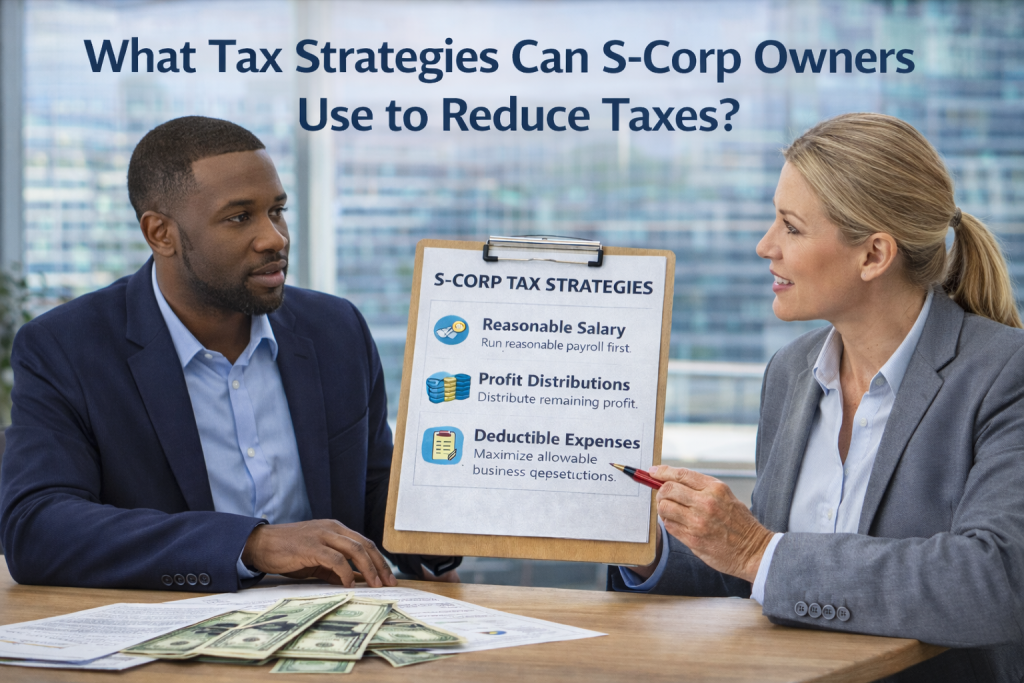
CPA explaining tax strategies S-Corp owners can use to reduce taxes during a business tax planning discussion

Many business owners elect S-Corporation tax treatment because they hear it can save taxes, but simply becoming an S-Corp does not automatically produce the best tax result. The biggest savings usually come from how the S-Corp operates throughout the year, not just from electing S-Corp status with the IRS.

That is why many owners ask: What tax strategies can S-Corp owners use to reduce taxes?

The answer is not one trick or deduction. Good S-Corp tax planning usually combines salary planning, shareholder distributions, retirement contributions, accountable expense reimbursement, depreciation decisions, health insurance treatment, and timing strategies. The right mix depends on profit, payroll, bookkeeping, entity structure, and the owner’s broader financial goals.

Quick Answer

S-Corp owners can reduce taxes by using proactive strategies such as setting a proper reasonable salary, taking distributions correctly, maximizing retirement contributions, using an accountable plan for business reimbursements, reviewing Section 179 and bonus depreciation carefully, timing income and expenses strategically, and coordinating owner health insurance and fringe benefit rules properly. The best results usually come from year-round planning rather than waiting until tax return season.

These S-Corp tax strategies work best when business owners plan throughout the year rather than waiting until tax filing season.

Why S-Corp Tax Planning Matters

An S-Corp can create tax-saving opportunities, but it also creates rules that must be followed correctly.

Setting salary too low increases payroll risk.
Paying too much salary may cause the business to pay unnecessary payroll taxes.
Careless distribution handling can create basis and reporting problems.
Without a plan for deductions, the business may miss better long-term tax outcomes.

That is why S-Corp tax planning is not just about claiming more deductions. It is about structuring the business in a way that legally improves the overall tax result.

1. Set a Reasonable Salary Without Overpaying Payroll Tax

For many S-Corp owners, the most important tax planning decision each year is how much to pay themselves in W-2 wages.

An active owner generally needs to take reasonable compensation for the work they perform. But that does not mean the owner should automatically pay themselves every dollar of business profit as wages.

Careful planning matters here. A well-structured S-Corp often separates:

  • reasonable salary for labor, and
  • shareholder distributions on remaining profit

That balance can help reduce self-employment-type payroll exposure compared with operating as a sole proprietor, while still staying within IRS rules.

The mistake many owners make is focusing only on minimizing salary. The real goal is not the lowest salary. The goal is a defensible salary that still preserves legitimate tax efficiency.

2. Use Shareholder Distributions Correctly

Once reasonable salary is addressed, shareholder distributions may become part of the tax strategy.

Distributions are not the same as wages. They should not replace payroll for an active owner. But when handled correctly, distributions can be an efficient way for an S-Corp owner to receive remaining profit from the business.

This area should still be monitored carefully because:

  • distributions do not fix an unreasonably low salary
  • basis matters
  • bookkeeping needs to be clean
  • shareholder withdrawals should be tracked properly

Many S-Corp tax problems happen because owners take money out of the business casually without coordinating payroll, distributions, and bookkeeping.

3. Maximize Retirement Contributions

Retirement planning is one of the strongest tax strategies available to many S-Corp owners.

Depending on the facts, an owner may be able to use options such as:

  • Solo 401(k)
  • SEP IRA
  • other employer-sponsored retirement strategies where appropriate

The key point is that S-Corp owners often need to understand that certain retirement contribution limits are based on W-2 wages, not just business profit. That means salary planning and retirement planning should be coordinated together.

This is one reason S-Corp tax strategy should not be handled in isolated pieces. A salary number that looks good for payroll tax purposes may unintentionally reduce retirement planning opportunities if not reviewed carefully.

4. Use an Accountable Plan for Owner Expenses

Many S-Corp owners pay business expenses personally at some point during the year. If those expenses are not handled correctly, tax benefits may be lost or the bookkeeping may become messy.

An accountable plan can allow the corporation to reimburse the owner for certain legitimate business expenses properly, rather than leaving those items buried in personal accounts or treated incorrectly.

This strategy can be especially useful for expenses such as:

  • home office costs, when applicable
  • mileage or vehicle use under proper methods
  • business travel
  • cell phone or internet costs with business use components
  • supplies and smaller recurring business expenses paid personally

Handled correctly, an accountable plan can improve tax treatment and create cleaner books.

5. Review Section 179 and Bonus Depreciation Carefully

Equipment purchases can create major deductions, but the biggest current-year deduction is not always the best overall tax strategy.

S-Corp owners often need to evaluate whether to use:

  • Section 179
  • bonus depreciation
  • regular depreciation

The best answer depends on the business’s profit, future income expectations, state tax treatment, and whether the owner needs cash flow savings now or better deductions spread over time.

Many businesses make poor decisions here by focusing only on the largest immediate write-off. Sometimes that is the right answer. Sometimes it is not.

A planning-first review helps determine whether the deduction should be accelerated or preserved for future years.

6. Time Income and Expenses Intentionally

Tax planning is often about timing, not just total dollars.

Depending on the business and accounting method, an S-Corp owner may benefit from reviewing whether to:

  • delay certain income into the following year
  • accelerate needed business expenses into the current year
  • time major equipment purchases intentionally
  • pay bonuses or wages before year-end when appropriate
  • complete retirement contributions by the applicable deadlines

Timing decisions become especially important when income fluctuates, tax brackets change, or the owner expects a materially different year ahead.

The key is to make those decisions before year-end rather than after the year is closed.

7. Coordinate Health Insurance Properly

Health insurance is another area where S-Corp owners often make mistakes.

The treatment of shareholder health insurance can be different for more-than-2% S-Corp shareholders than it is for rank-and-file employees. Proper reporting matters. Incorrect handling can prevent the deduction from flowing through the tax return correctly.

This is not a strategy to improvise at tax time. It should be coordinated through payroll and year-end reporting so the deduction is preserved correctly.

8. Review Family Payroll and Spouse Involvement Carefully

In some businesses, involving a spouse or family members in the business may create planning opportunities, but this area needs to be handled carefully.

The question is not whether payroll can be added just to reduce taxes. The real question is whether family members are performing legitimate services and whether compensation is appropriate and documented.

When the facts support it, family payroll planning can affect:

  • retirement contribution opportunities
  • earned income-based benefits
  • overall family tax strategy

But it must be real, supportable, and properly administered.

9. Keep Books Clean Enough for Planning

This may not sound like a tax strategy, but it is one of the most important ones.

Messy bookkeeping destroys tax planning.

If the books are behind, incorrect, or full of mixed personal and business activity, it becomes much harder to:

  • project profit accurately
  • set salary appropriately
  • track distributions
  • measure basis
  • time deductions properly
  • make intelligent year-end decisions

Many owners assume bookkeeping is just compliance work. In reality, good books are what make real tax planning possible.

10. Monitor Basis and Owner Withdrawals

S-Corp owners often focus on profit and ignore basis until tax filing season. That can be a mistake.

Basis affects whether losses may be deductible and whether certain distributions may create tax consequences. Owners who take frequent distributions or who have prior-year losses should pay close attention to basis and how money is moving through the business.

This is one reason random owner withdrawals can create problems. What looks simple from a cash-flow perspective can become complicated on the tax return.

11. Plan Before the S-Corp Election Deadline and Before Year-End

One of the best S-Corp tax strategies is simply planning early enough to still have options.

For businesses considering electing S-Corp status, decisions should be reviewed before the Form 2553 deadline and before payroll habits are set incorrectly.

For businesses already operating as S-Corps, year-end planning should happen while there is still time to:

  • adjust salary
  • review distributions
  • make retirement decisions
  • purchase equipment intentionally
  • correct bookkeeping
  • structure reimbursements properly

The earlier the review happens, the more useful the planning tends to be.

12. Match the Strategy to the Owner’s Bigger Goals

Not every tax-saving move is the right business move.

A business owner may want to lower current-year taxes, but they may also need to think about:

  • cash flow
  • retirement accumulation
  • loan applications
  • buying a home
  • reducing audit risk
  • future expansion
  • eventual sale of the business

The best tax plan is the one that fits the owner’s full picture, not just the one that creates the lowest immediate tax bill.

Common Mistakes When Using S-Corp Tax Strategies

Many S-Corp owners lose savings because they focus on isolated tactics instead of coordinated planning. Common mistakes include:

Setting salary too low

This can increase IRS risk and weaken the entire tax position.

Taking distributions without tracking basis

That can create avoidable tax problems and messy year-end corrections.

Making equipment purchases only for the deduction

A bad business purchase does not become a good decision just because it creates a write-off.

Ignoring payroll timing

Late payroll setup can create compliance problems and missed opportunities.

Waiting until tax return season

By then, many planning opportunities are already gone.

Example of How S-Corp Tax Planning Works in Real Life

A profitable S-Corp owner might reduce taxes not through one dramatic move, but through several coordinated decisions:

  • setting a supportable reasonable salary
  • taking additional profit as shareholder distributions
  • maximizing retirement contributions tied to wages
  • reimbursing owner-paid business expenses properly
  • choosing the right depreciation method for equipment
  • making year-end timing decisions before December closes

Individually, each move may seem modest. Together, they can significantly improve the overall tax outcome.

South Jordan, Utah S-Corp Tax Planning Perspective

For business owners in South Jordan, Utah and beyond, the most effective S-Corp tax strategies usually come from ongoing planning rather than one-time tax filing decisions. At Madsen and Company, we help business owners review whether their salary, distributions, retirement planning, deductions, and entity structure are working together the way they should.

For many owners, the right question is not simply “What can I deduct?” The better question is “How do I structure my S-Corp so I keep more of what I earn without creating unnecessary complexity or risk?”

Final Answer

So, what tax strategies can S-Corp owners use to reduce taxes?

The strongest strategies usually include setting a proper reasonable salary, using distributions correctly, maximizing retirement contributions, reimbursing owner expenses through an accountable plan, reviewing depreciation choices carefully, coordinating health insurance properly, timing income and expenses intentionally, and keeping books clean enough to make smart decisions during the year.

The biggest tax savings usually do not come from one magic deduction. They come from proactive planning across multiple areas of the business before year-end. That is why the most successful S-Corp owners usually benefit from planning-first tax advice rather than waiting until the return is being prepared.


FAQ SECTION

What is the best tax strategy for an S-Corp owner?

There is no single best strategy for every owner. In many cases, the most important starting point is setting a reasonable salary correctly and then coordinating distributions, retirement contributions, deductions, and timing decisions around that structure.

How do S-Corp owners reduce self-employment tax?

One of the main S-Corp planning opportunities allows active owners to take a reasonable salary for services and then receive additional profit as shareholder distributions. The structure must still be handled correctly and supported by reasonable compensation.

Can S-Corp owners deduct health insurance?

They often can, but the reporting must be handled correctly, especially for more-than-2% shareholder-employees.

Are retirement contributions important for S-Corp tax planning?

Yes. Retirement contributions are often one of the strongest tax planning tools for S-Corp owners, but they should be coordinated with W-2 wages and overall profit planning.

When should an S-Corp owner start tax planning?

The best time is before major year-end decisions are locked in. Planning earlier in the year usually creates more options than waiting until tax return season.

Filed Under: S-Corporation Tax, Tax Planning Tagged With: reasonable salary, retirement planning, S corporation tax planning, shareholder distributions, small business taxes

Missed the S-Corp Deadline? Here’s What You Can Still Do

March 10, 2026 by Steve Madsen

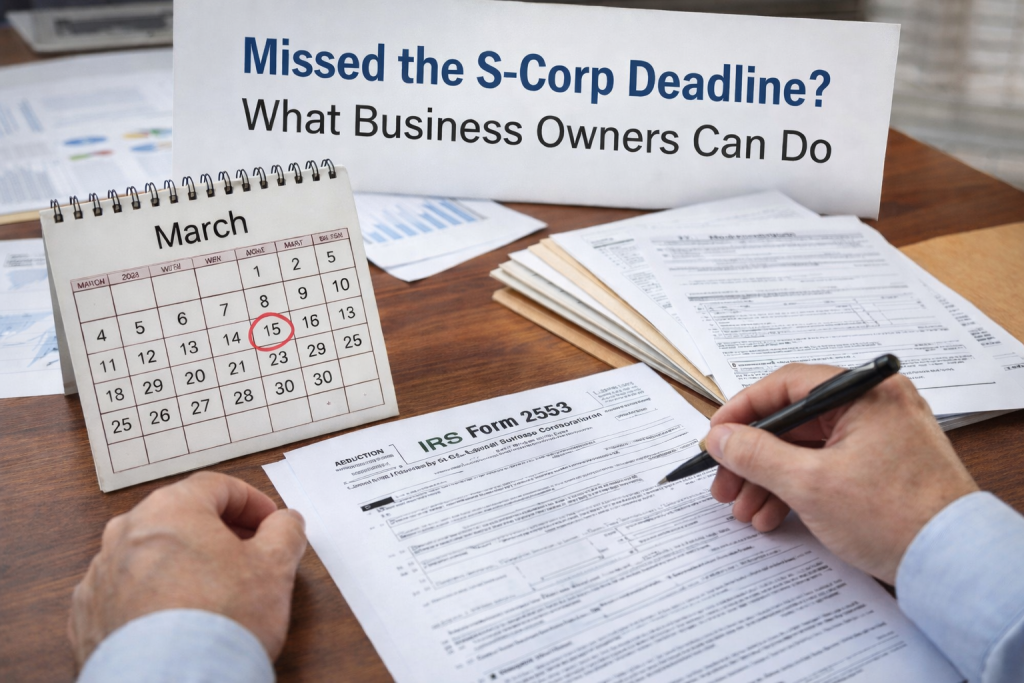
Business owner reviewing IRS Form 2553 with a March 15 calendar deadline after missing the S-Corp election deadline

Business owner reviewing IRS Form 2553 with a March 15 calendar deadline after missing the S-Corporation election deadline

If you missed the S-Corp deadline, you are not alone. Many business owners discover too late that electing S-Corporation status requires filing IRS Form 2553 by a specific deadline.

The good news is that missing the deadline does not always mean the opportunity is lost. In many cases, businesses may still qualify for late election relief or elect S-Corporation status for a future tax year.

This situation often happens because the election deadline was not clearly explained, paperwork was started but never completed, or the business was formed quickly and tax elections were postponed. In other cases, owners are told to “become an S-Corp” without realizing that the IRS requires a separate election form.

Even when the deadline is missed, business owners often still have planning options available — including requesting late election relief or preparing for a clean S-Corporation election in the following tax year.

For business owners in South Jordan, throughout Utah, and across the country, the most important step is addressing the issue quickly and correctly so mistakes do not compound.

The earlier you review the situation, the more options are usually available.

Quick Answer

If you missed the S-Corp deadline, you may still be able to fix it. Many businesses can request late election relief by filing Form 2553 properly and showing reasonable cause for missing the original deadline. When relief is not available, the election can often be made effective for a future tax year with better planning. The earlier you address the problem, the more options you usually have.

What Is the S-Corp Election Deadline?

The S-Corporation election deadline is typically March 15 for calendar-year businesses, which is two months and fifteen days after the beginning of the tax year. A business receives S-Corporation tax treatment when it files Form 2553 on time.

CPA Insight

Many business owners think they missed the S-Corp opportunity permanently. In reality, the bigger issue is usually not the missed form itself — it is the incorrect payroll, compensation, and tax reporting decisions made after the deadline was missed.

Key Takeaways

  • Missing the S-Corp deadline does not always mean you permanently lost the election.
  • The standard filing deadline is generally 2 months and 15 days after the beginning of the tax year the election is supposed to take effect.
  • Many businesses may qualify for late election relief if they act within the IRS relief window and meet the requirements.
  • If relief is not available, you may still be able to make the election effective next year.
  • A missed S-Corp election should trigger broader tax planning, not panic.

What the Missed S-Corp Deadline Actually Means

An S-Corporation is not created automatically just because you formed an LLC or corporation.

To be taxed as an S-Corporation, an eligible business generally must file Form 2553 on time. For a calendar-year business, that usually means the election must be filed by March 15 if you want S-Corporation treatment for that year. Businesses can also file during the prior tax year for the upcoming year.

This is where many owners get tripped up.

They may:

  • form an LLC and assume it is already an S-Corp,
  • tell their payroll company they are an S-Corp without filing the election,
  • start running payroll before the election is actually accepted,
  • or discover the issue only after tax season is already underway.

That is why this issue often shows up in March, when business owners are making payroll, deduction, and entity-planning decisions too late.

What Happens If You Miss the S-Corp Deadline

If you miss the S-Corp election deadline, your business will typically remain taxed under its default classification for that tax year. However, many businesses may still qualify for late election relief by filing Form 2553 and explaining the reason for the late filing.

The immediate consequence is simple: your business may not be treated as an S-Corporation for the year you intended, which can create larger tax consequences than many owners expect.

Depending on how your business is structured, missing the election may mean:

  • your LLC remains taxed under its default classification,
  • your corporation remains taxed as a C corporation,
  • payroll decisions may need to be revisited,
  • distributions may need to be recharacterized or reviewed,
  • your expected self-employment tax savings may disappear for that year,
  • and tax filings may have to be handled very differently than you originally planned.

It can also create confusion when the business owner already acted as though the S election were in place. That is one of the biggest reasons this problem should be addressed early, before incorrect payroll, owner compensation, or tax return reporting makes the cleanup harder.

Can You Fix a Missed S-Corp Deadline?

Often, yes.

The IRS provides a path for many eligible businesses to request late S-Corporation election relief. Under Revenue Procedure 2013-30, relief may be available when the business intended to elect S-Corporation status, failed to file on time, had reasonable cause, and acted diligently to correct the issue.

According to IRS guidance, businesses that miss the S-Corp election deadline may still qualify for late election relief if they meet specific eligibility requirements and act within the allowable time window.

That does not mean every late election is automatically accepted.

It means the business may have a route to request relief if the facts support it.

Situations Where Late Relief May Be Possible

A missed election may still be fixable when:

  • the business was otherwise eligible to be an S-Corporation,
  • the owners intended S-Corp treatment from the start,
  • the business has consistently acted like an S-Corp or planned to,
  • the failure was due to oversight, misunderstanding, or another explainable error,
  • and the issue is corrected promptly after discovery.

This is where details matter. A rushed filing with weak facts can create more problems instead of fewer. The explanation must be consistent with how the business actually operated.

Situations Where Relief May Not Solve Everything

Even when late relief is available, it does not erase every underlying issue.

For example:

  • the business may still need to correct payroll filings,
  • shareholder compensation may need review,
  • prior filings may need to be corrected,
  • state tax treatment may not line up automatically,
  • and bookkeeping may need to be adjusted so the return matches reality.

Also, if too much time has passed, or if the business was never actually eligible for S-Corp treatment, relief may not be available.

That is why the real question is not only, “Did you miss the deadline?”
It is also, “What did the business do after missing it?”

What to Do After You Miss the S-Corp Deadline

If you missed the S-Corp deadline, take these steps immediately.

1. Confirm your entity type

Start with the basics. Are you operating as an LLC or a corporation? That affects how the missed election impacts your tax treatment.

2. Confirm the intended effective date

You need to know which tax year you were trying to elect.

3. Review whether the business was eligible

Not every entity qualifies, and eligibility must be confirmed before trying to fix the election.

4. Gather your supporting facts

Document when the business was formed, when the owners intended to elect S-Corp status, what advice was given, whether payroll was started, and how the business has been filing and operating.

5. Determine whether late election relief applies

This is usually the key decision point. If relief is available, the correction path may be much better than you expected.

6. Build a backup plan if relief is not available

Sometimes the best move is to elect S-Corp status for the next year and improve tax planning now rather than forcing a weak fix.

Mistakes to Avoid After Missing the S-Corporation Deadline

Once the deadline is missed, business owners often make the situation worse by reacting too quickly.

Common mistakes include:

  • filing payroll as if the S election were already valid,
  • taking owner distributions without reviewing tax treatment,
  • assuming the IRS will “understand what you meant,”
  • filing returns inconsistently,
  • waiting until the return is due before addressing the issue,
  • or relying on generic online advice that does not match the business facts.

This is exactly why a planning-first approach matters. Entity elections affect payroll, compensation, bookkeeping, estimated taxes, and how profits flow to the owner. It is never just one form.

Why This Matters So Much for Business Owners

Many owners pursue S-Corporation status for one reason: tax savings.

But the S election only works well when the entire structure is handled correctly. That includes:

  • reasonable owner compensation,
  • clean payroll reporting,
  • accurate bookkeeping,
  • proper distributions,
  • and year-round tax planning.

So even if you missed the deadline, this can still be a valuable turning point. It forces the business to step back and build the tax structure the right way instead of layering mistakes on top of confusion.

That is especially important for service businesses, consultants, contractors, and other profitable owner-operated businesses in Utah where S-Corporation planning often becomes one of the biggest drivers of tax efficiency.

This is why understanding reasonable salary for S-Corporation owners is also a critical part of the planning process.

Many of these businesses also benefit from proactive S-Corporation tax planning strategies implemented before the March deadline.

Local Insight for Utah Business Owners

We often see this issue with Utah business owners who formed an LLC quickly, started earning income, and were told later that they “should be an S-Corp.”

By then, payroll may not be set up correctly, bookkeeping may be behind, and the owner may have already taken draws with no clear compensation strategy.

For South Jordan and Salt Lake County business owners, this is a strong reminder that entity strategy should happen before the year gets too far along. Waiting until return preparation season usually limits your options.

Business owners in South Jordan, Salt Lake County, and across Utah frequently discover the missed S-Corp election issue during tax season, which is why proactive entity planning earlier in the year can prevent costly mistakes.

Final Thoughts

Missing the S-Corp deadline is a problem, but it is not always a disaster.

In many cases, there is still a path forward. The right next step depends on whether late election relief is available, how the business has operated so far, and whether the tax savings still justify the structure going forward.

What matters most is acting quickly, understanding the facts, and making a clean decision based on the real IRS rules rather than assumptions.

If you missed the S-Corp deadline, your business may still qualify for late election relief by filing Form 2553 and demonstrating reasonable cause. When relief is not available, the election can often be made effective for a future tax year with better planning.

If you missed the S-Corp deadline, do not guess. Review the election, review the entity, and build the next step carefully.

Business owners often discover too late that electing S-Corporation status requires filing Form 2553.

Reviewing your entity structure now can help prevent the same problem next year.

Need Help Fixing a Missed S-Corp Election Deadline?

If you missed the S-Corp deadline and want to know whether late election relief may still apply, reviewing the details before filing your tax return can prevent costly mistakes.

At Madsen and Company, we help business owners evaluate entity elections, late S-Corporation filings, and proactive tax planning strategies.

Many business owners in South Jordan, Salt Lake County, and across Utah discover the missed S-Corp election issue during tax season and want a second opinion before filing.

If you want to review your situation before filing your return, now is the time to determine whether late election relief or a future S-Corporation strategy makes sense for your business.

Frequently Asked Questions

What is the deadline to elect S-Corporation status?

In general, Form 2553 must be filed no later than 2 months and 15 days after the start of the tax year the election is meant to apply to. For many calendar-year businesses, that means March 15.

Can I file Form 2553 late?

Sometimes. The IRS allows late election relief in many cases if the business qualifies and acts within the applicable relief period.

How long do I have to request late S election relief?

In many cases, the relief request must be made within 3 years and 75 days of the intended effective date, assuming the business otherwise qualifies.

What if I missed the deadline and do not qualify for relief?

You may still be able to elect S-Corporation status for a future year and use other tax-planning strategies in the meantime.

Does missing the S-Corp deadline mean I should never become an S-Corp?

No. It may still be a good strategy. It just needs to be evaluated based on profit level, payroll requirements, compliance costs, and timing.

Related S-Corporation Planning Resources

• S-Corporation Tax Planning Strategies
• Reasonable Salary for S-Corp Owners
• Business Tax Preparation vs Tax Planning

Filed Under: Business Tax, Tax Planning Tagged With: Form 2553, Late S-Corp election, March tax deadlines, S Corp Payroll, S Corporation Election

The Business Owner’s Guide to Tax Planning

March 8, 2026 by Steve Madsen

Written by Steve Madsen, CPA (licensed since 1993)

CPA discussing business owner tax planning strategies with clients to reduce taxes and improve cash flow.

Most business owners spend a great deal of time trying to increase revenue, control payroll costs, and improve profitability, but many give far less attention to one of their largest expenses: taxes. Business owner tax planning helps entrepreneurs make smarter decisions throughout the year so they can legally reduce taxes, improve cash flow, and avoid costly surprises when filing season arrives.

Most business owners assume their CPA reduces taxes when the tax return is prepared. In reality, by the time tax preparation begins, many of the most important tax decisions have already been made. Tax preparation reports the past. Tax planning changes the future. Learn more in our guide to business tax preparation vs tax planning.

For business owners, proactive tax planning can help reduce unnecessary taxes, improve cash flow, avoid underpayment penalties, and create a more intentional strategy for compensation, deductions, equipment purchases, entity structure, and long-term growth.

Business owners in South Jordan, Utah and throughout the Salt Lake Valley often need proactive guidance on Utah tax issues, pass-through income planning, estimated tax payments, and entity structure decisions as their businesses grow.

Quick Answer:
Business owner tax planning is the process of making tax-smart decisions throughout the year so you can legally reduce taxes, improve cash flow, and avoid costly mistakes before it is too late to act.

Business Owner Tax Planning Overview

Business owner tax planning helps entrepreneurs reduce taxes and improve financial outcomes by making strategic decisions before tax deadlines pass.

Key concepts business owners should understand include:

• Tax planning focuses on future decisions, while tax preparation reports past results
• Entity structure affects self-employment tax, payroll requirements, and planning flexibility
• S-Corporation owners must balance salary and distributions to manage payroll taxes properly
• Estimated tax payments help avoid IRS underpayment penalties and cash-flow surprises
• Strategic timing of deductions, retirement contributions, and equipment purchases can reduce taxes legally

Proactive tax planning allows business owners to make informed decisions throughout the year rather than reacting to taxes once filing season arrives.

Definition: Business Owner Tax Planning
Business owner tax planning is the process of analyzing income, deductions, entity structure, and financial decisions throughout the year so a business owner can legally minimize taxes and improve cash flow before filing deadlines occur.

At Madsen and Company, we help business owners in South Jordan, Utah and across the country make tax decisions before filing season turns those decisions into permanent results.

Why Business Owner Tax Planning Matters

Taxes are not just a filing issue. They are a business planning issue.

If you wait until your return is being prepared to think about taxes, you are often looking backward instead of forward. That usually leads to missed opportunities, unnecessary surprises, and avoidable frustration.

Business tax planning matters because it helps you:

  • legally reduce taxes
  • improve after-tax cash flow
  • avoid underpayment penalties
  • time income and expenses more strategically
  • choose the right entity structure
  • plan owner compensation more effectively
  • make smarter year-end decisions

A profitable business without a tax plan can still create cash flow stress. Many owners discover this when they owe far more than expected in April. That is not always a sign of a bad business. Often, it is a sign of a reactive tax strategy.

CPA Insight:

The goal of tax planning is not just to file accurately. The goal is to make better decisions early enough to change the tax outcome.

What Business Owner Tax Planning Actually Means

Tax planning is the process of reviewing your income, business structure, deductions, payroll strategy, investments, and upcoming decisions before the year is over so you can legally reduce taxes.

It is proactive. It is strategic. And it should happen before tax deadlines close important opportunities.

Tax planning is different from tax preparation in a very important way.

Tax preparation focuses on compliance. It organizes records, reports income and deductions, and files required tax returns based on what already happened.

Tax planning focuses on strategy. It asks questions such as:

  • Are you paying yourself the right salary?
  • Is your entity structure still the best fit?
  • Should you buy equipment this year or next year?
  • Are your estimated tax payments too low?
  • Are you missing retirement or HSA opportunities?
  • Is there income you should accelerate or defer?
  • Are there real estate strategies that could reduce taxes?

If you want a deeper breakdown of this distinction, see our article on business tax preparation vs tax planning.

Why Business Owners Overpay Taxes

Most business owners do not overpay taxes because they are careless. They overpay because they are busy, reactive, or relying on a compliance-only approach.

Here are some of the most common reasons business owners overpay:

1. They wait until tax season

Once the year is over, many strategies are no longer available. Waiting until filing season often means the return becomes a report card instead of a planning tool.

2. They use the wrong entity

A business may start as a sole proprietorship or LLC, but that does not mean it should stay that way forever. As profits grow, the wrong entity can create unnecessary self-employment tax or limit planning flexibility.

3. They mishandle S-Corporation salary

Many S-Corp owners either pay themselves too little and create audit risk, or too much and overpay payroll taxes. Reasonable compensation is one of the most important planning topics for S-Corp owners.

4. They ignore estimated taxes

A large balance due in April often means taxes were not being managed throughout the year. Underpayment penalties can become an unnecessary added cost.

5. They do not coordinate tax and cash flow planning

A business can be profitable on paper and still feel cash-strapped if taxes were not built into monthly planning.

6. They make purchases without a strategy

Buying equipment, vehicles, or technology can create deductions, but only if the timing, use, and tax treatment make sense within the bigger picture.

7. They never review long-term strategy

Entity choice, retirement planning, real estate activities, multi-state issues, and compensation strategy all affect taxes. Many owners go years without reviewing whether their setup still fits the business.

Entity Choice: One of the Biggest Tax Decisions a Business Owner Makes

Entity choice has a major effect on how a business is taxed. It can affect self-employment tax, payroll requirements, administrative complexity, owner compensation, and future planning opportunities.

Common business structures include:

Sole Proprietorship

Simple to operate, but net income is generally subject to self-employment tax. This can become expensive as profit increases.

Partnership

Can be flexible, but taxation becomes more complex, especially when there are multiple owners, special allocations, basis issues, or changing ownership.

LLC

An LLC is a legal structure, not a tax status by itself. It may be taxed as a sole proprietorship, partnership, S-Corporation, or C-Corporation depending on elections and ownership.

S-Corporation

Often attractive for profitable owner-operated businesses because part of the income may avoid self-employment tax, but only when the owner takes a reasonable salary and payroll is handled correctly.

C-Corporation

May make sense in certain circumstances, but double taxation and distribution issues often make it less attractive for many small business owners unless there is a specific strategic reason.

There is no one-size-fits-all answer. The right entity depends on profitability, growth plans, payroll needs, state tax issues, ownership structure, and administrative tolerance.

If you are evaluating whether your structure still makes sense, review our article on entity choice for business owners.

S-Corporation Salary Planning

For many business owners, S-Corporation planning becomes a central part of tax strategy.

The reason is simple: an S-Corporation can create tax savings by splitting owner compensation between salary and distributions. However, this only works when the salary is reasonable.

That creates one of the most misunderstood issues in small business taxation.

Some owners hear that an S-Corp can save payroll taxes and assume they should keep wages as low as possible. That is a dangerous oversimplification. The IRS expects S-Corp owners who provide services to the business to receive reasonable compensation.

Paying too little can increase audit risk and create payroll tax problems. Paying too much may reduce the tax efficiency that made the S-Corp attractive in the first place.

Reasonable compensation is not based on what saves the most tax. It is based on facts such as:

  • the services performed
  • time devoted to the business
  • the business’s profitability
  • comparable market compensation
  • the owner’s role and responsibilities

This is why S-Corp salary planning should not be treated as a guess or a casual estimate.

For a more detailed breakdown, see our article on how much an S-Corp owner should pay themselves.

For a deeper look at owner compensation, payroll strategy, and entity planning, review our S-Corporation tax planning strategies article.

Estimated Taxes and Underpayment Penalties

One of the clearest signs that tax planning is missing is a recurring surprise tax bill.

Owing some tax is not automatically a problem. The real problem is when taxes were not projected during the year and the owner reaches filing season without enough cash reserved or enough paid in.

That can lead to:

  • cash flow pressure
  • missed payment deadlines
  • IRS underpayment penalties
  • a repeated cycle of surprise tax bills

The IRS generally expects tax to be paid throughout the year, not only at filing time. Business owners often need to make quarterly estimated payments, adjust withholding, or use a combination of strategies to stay on track.

This is especially important for:

  • self-employed individuals
  • S-Corp owners
  • real estate investors
  • taxpayers with large pass-through income
  • business owners with variable income

A smart tax plan does not just estimate what you might owe. It helps you make sure enough is paid in at the right time.

For more, review our article on how to avoid IRS underpayment penalties.

Section 179, Equipment Purchases, and Timing Deductions

Business owners often hear that buying equipment can reduce taxes. That is true in many cases, but not every purchase is automatically a good tax move.

The tax code may allow deductions through Section 179, bonus depreciation, or regular depreciation, depending on the asset and the timing. But those rules should be part of an overall tax strategy, not used in isolation.

A deduction only helps if:

  • the purchase is actually useful for the business
  • the timing makes sense
  • the business has enough taxable income for the strategy to matter
  • the deduction aligns with cash flow and future planning goals

Too many owners buy something near year-end simply because someone told them they “need a deduction.” That mindset can lead to poor business decisions.

Section 179 can be a valuable planning tool for qualifying equipment, vehicles, furniture, computers, and other business property, but it should be coordinated with projected income, financing decisions, and other deductions already in play. For more detail, see our Section 179 tax planning guide

CPA Insight:

A tax deduction does not make a bad purchase a good one. Good tax planning starts with a good business decision, then applies the tax rules intelligently.

Retirement Contributions, HSAs, and Other Planning Levers

Business owner tax planning is not limited to entity choice and deductions. Some of the most powerful strategies involve moving money intentionally.

Depending on your facts, proactive planning may include:

  • traditional retirement contributions
  • solo 401(k) contributions
  • SEP IRA contributions
  • defined benefit plans in some cases
  • HSA contributions when eligible
  • timing charitable giving
  • coordinating wages and retirement limits
  • reviewing owner draws versus payroll

These strategies can affect more than just this year’s taxes. They can also affect long-term retirement accumulation, flexibility, and how efficiently profits are moved from the business to the owner.

This is why planning works best when taxes are not separated from the bigger financial picture.

Tax Planning for Real Estate and Short-Term Rental Owners

Real estate investors and short-term rental owners often have planning opportunities that differ from traditional operating businesses.

These may include:

  • depreciation strategy
  • cost segregation
  • grouping elections
  • passive activity considerations
  • material participation analysis
  • short-term rental rules
  • entity structure decisions
  • state tax exposure
  • timing of improvements and repairs

Short-term rentals can be especially nuanced. In the right circumstances, they may create planning opportunities that are different from long-term rentals. But those benefits depend on how the property is operated, the average rental period, and whether participation requirements are met.

This is an area where general tax advice often fails because the details matter.

If this applies to you, see our article on short-term rental tax planning.

Business Owner Tax Planning Timeline

A simple tax planning timeline helps business owners know when important decisions should happen.

January – March

• review prior year results
• adjust estimated taxes
• evaluate entity structure

April – June

• analyze first-quarter profitability
• evaluate S-Corp salary levels

July – September

• review projected income
• plan equipment purchases
• adjust estimated payments

October – December

• finalize tax strategies
• review retirement contributions
• execute year-end deductions

CPA Insight:

Many business owners try to reduce taxes in December, but the most effective strategies usually start months earlier when there is still time to adjust income, payroll, and major financial decisions.

When Business Owner Tax Planning Should Happen

A good tax plan is not a one-time event. It is a process.

The best times to review business taxes are often:

At the start of the year

This is a good time to establish profit expectations, payroll strategy, estimated tax plans, and major goals.

Mid-year

Mid-year is often when problems become visible early enough to fix. If profits are higher than expected, salary may need adjustment, estimates may need revision, and deduction opportunities may need review.

Before major decisions

Tax planning should happen before major equipment purchases, entity changes, real estate activity, retirement contributions, or owner compensation changes.

Before year-end

Year-end planning is important, but it should not be the first time taxes are discussed. By year-end, there is still time for some strategies, but far less flexibility than earlier in the year.

Before filing if prior strategy was missing

Even if the year is already over, reviewing the return carefully can help identify what needs to change going forward.

In other words, tax planning should be ongoing, not squeezed into the few weeks before a deadline.

What a Planning-First CPA Does

Not every CPA relationship is built the same way.

Some firms focus primarily on compliance. They prepare returns accurately and file required forms, but they may not spend much time on proactive decision-making.

A Planning-First CPA goes further. The role includes helping business owners think ahead, run scenarios, and make informed choices while there is still time to act.

That may include:

  • projecting taxable income before year-end
  • evaluating entity structure
  • reviewing S-Corp salary levels
  • planning estimated taxes
  • discussing major purchases before they happen
  • coordinating personal and business tax strategy
  • identifying deduction opportunities early
  • helping owners understand tradeoffs instead of guessing

At Madsen and Company, this proactive approach is central to how we work with business owners. Our goal is not just to prepare a return. Our goal is to help owners make better tax decisions before those decisions become permanent.

Business Owner Tax Planning Checklist for Entrepreneurs

Here is a simple tax planning checklist for business owners:

  • Review your current entity structure
  • Project annual business income
  • Review owner payroll or draws
  • Evaluate whether S-Corp status still makes sense
  • Check whether estimated taxes are sufficient
  • Review retirement contribution options
  • Evaluate HSA eligibility and funding
  • Review equipment purchase timing
  • Separate repairs, assets, and improvements correctly
  • Review real estate activity and participation
  • Coordinate personal and business tax decisions
  • Schedule a year-round planning review, not just return preparation

This checklist will not replace personalized advice, but it can help you identify whether your tax strategy is proactive or reactive.

Frequently Asked Questions About Business Owner Tax Planning

What is Business Owner Tax Planning?

Business owner tax planning is the process of making tax-related decisions during the year so you can legally reduce taxes, improve cash flow, and avoid surprises before filing deadlines pass.

When should business owners do tax planning?

Business owners should review taxes throughout the year, especially at the beginning of the year, mid-year, before major financial decisions, and before year-end.

Is tax planning the same as tax preparation?

No. Tax preparation reports what already happened. Tax planning focuses on improving the outcome before the year is over.

Does an S-Corporation automatically save taxes?

No. An S-Corporation can create savings in the right circumstances, but only if the owner takes a reasonable salary and the overall facts support the election.

Can Section 179 help reduce taxes?

Yes, Section 179 may allow a current deduction for qualifying business equipment, but it should be used as part of a broader tax strategy rather than as a last-minute spending excuse.

Why do I keep owing taxes in April?

Repeated balances due often mean income was not projected well, estimated payments were too low, withholding was not adjusted, or no real tax planning happened during the year.

Do real estate investors need different tax planning?

Often, yes. Real estate and short-term rental owners may have unique planning issues involving depreciation, passive activity rules, participation requirements, and entity structure.

How is tax planning different for an LLC taxed as an S-Corporation?

An LLC taxed as an S-Corporation may create tax planning opportunities by separating owner compensation between salary and distributions, but it also adds payroll, compliance, and reasonable compensation requirements that should be reviewed carefully.

Stop Letting Tax Season Decide the Outcome

If you are only talking about taxes when the return is being prepared, you may be making important decisions too late.

Business owner tax planning works best before deadlines pass, before purchases are made, and before underpayment penalties become a pattern.

Schedule a Business Tax Planning Consultation

If you want to reduce taxes, improve cash flow, and build a proactive tax strategy, working with a CPA who focuses on planning can make a significant difference.

At Madsen and Company, we help business owners in South Jordan, Utah and throughout the Salt Lake Valley, as well as clients across the United States, make proactive tax decisions designed to reduce taxes and improve long-term financial results.

The best tax savings opportunities usually come from decisions made before deadlines pass, not after the return is being prepared.

Schedule a tax planning consultation with Madsen and Company today.

Why Business Owner Tax Planning Improves Long-Term Financial Results

The business owners who usually get the best tax outcomes are not always the ones with the most complicated returns. Often, they are the ones who review strategy early, ask better questions, and make decisions before deadlines take options away.

That is the real value of tax planning.

Tax preparation still matters. Compliance still matters. But if your only tax conversation happens after the year is over, you are probably leaving too much to chance.

A better approach is to treat taxes as an ongoing business decision, not a once-a-year event.

That is how business owners move from reacting to taxes to planning for them.

Filed Under: Tax Planning Tagged With: Business owner taxes, business tax planning, proactive tax planning, S corporation tax planning, section 179, small business tax planning, small business taxes

March Tax Planning: Why Waiting Until April Costs Business Owners Thousands

March 4, 2026 by Steve Madsen

March tax planning meeting between CPA and business owner reviewing S-Corp payroll and tax strategy
March is the final month when business owners can still change how the current year will be taxed — before payroll, entity, and estimated tax decisions become locked in.

For Utah business owners — especially construction, trade, and service firms — March tax planning often determines whether S-Corporation savings actually materialize.

Quick Answer

March tax planning is when smart business owners lock in tax strategies for the current year, not just finish last year’s return. In March, S-Corporation elections, reasonable salary planning, payroll setup, and estimated tax adjustments can still change outcomes. By April, many of those options are limited or gone.

Once April begins, most S-Corporation, payroll, and reasonable salary decisions for the year can no longer be fixed retroactively.


Why does March tax planning matter more than most business owners realize?

For S-Corporation owners, March is not just busy — it’s decisive, because the March 15 S-Corporation deadline quietly determines which tax strategies are still available and which are permanently off the table.

March tax planning is not just an extension of tax season. Instead, it is the last practical window to influence how the current year will be taxed.

By contrast, once April arrives:

  • Income decisions are already set
  • Payroll mistakes may be locked in
  • Entity elections may be late
  • Estimated tax penalties may already be accruing

After more than 30 years advising small business owners, S-Corporation owners, and real estate investors, the pattern is clear: the biggest tax savings come from March tax planning, not April tax filing.

That’s because tax preparation is the most expensive time to get advice, once payroll, entity, and estimated tax decisions are already locked in.

This timing matters most for:

  • Service-based businesses
  • Construction and trade contractors
  • S-Corporation owners
  • Real estate investors (including short-term rentals)
  • Businesses operating in multiple states

March tax planning means reviewing entity structure, payroll, and estimated taxes early enough in the year to still change the outcome.


How does March tax planning work for S-Corporation owners?

For many businesses, March tax planning centers on confirming whether S-Corporation taxation is still the right structure and whether it is being executed correctly.

During March tax planning, proactive owners:

  • confirm the S-Corporation election is valid and timely
  • review payroll setup for the current year
  • align owner distributions with IRS reasonable salary rules
  • correct compliance gaps before they become expensive

Waiting until April often leads to rushed questions such as, “Can we still fix this?” At that point, most high-impact strategies are no longer available.

This is why proactive owners focus on executing S-Corporation tax planning correctly early in the year.


When does reasonable salary planning actually matter?

Reasonable salary planning is a core part of March tax planning for S-Corporation owners.

From an IRS perspective, shareholders who perform services must be paid a reasonable wage before taking distributions. Because of that, timing matters.

Early-year tax planning reviews, smart owners:

  • set or adjust salary based on role and profitability
  • ensure payroll withholding is appropriate
  • document salary decisions properly
  • reduce audit exposure before issues arise

By comparison, owners who wait until filing season often discover:

  • salary is too low (compliance risk)
  • salary is too high (lost tax savings)
  • payroll was never run correctly

Reasonable salary decisions must be addressed early in the year to avoid compliance risk and lost tax savings.


Why is March tax planning critical for estimated taxes?

Many business owners assume estimated taxes will “even out.” However, the IRS does not operate on assumptions.

As part of March tax planning, smart business owners:

  • review year-to-date profit
  • project realistic full-year income
  • adjust quarterly estimates or withholding
  • coordinate business income with household income

As a result, underpayment penalties are often avoided before they start compounding.

Ignoring estimated tax timing often leads to penalties that could have been avoided months earlier.


What mistakes do business owners make by skipping March tax planning?

The most common mistake is treating tax planning as paperwork rather than timing.

Specifically, business owners often:

  1. Wait until April to ask strategic questions
  2. Assume an S-Corp election automatically saves taxes
  3. Delay payroll setup until “later”
  4. Ignore estimated taxes until a balance due appears
  5. Overlook multi-state obligations

This is why experienced advisors consistently warn that tax season is the worst time to start tax planning, because the year’s most important decisions have already been made.

Each of these errors becomes harder to fix once March has passed.

Many of these issues stem from confusing tax planning with tax preparation — two fundamentally different processes with very different financial outcomes.


Scenario comparison: March tax planning vs April tax filing

AreaMarch Tax PlanningApril Tax Filing
S-Corp strategyReviewed and confirmedToo late to optimize
Reasonable salarySet proactivelyBackfilled or incorrect
PayrollRunning correctlyCleanup required
Estimated taxesAdjusted earlyPenalties triggered
OutcomeLower taxes + complianceLimited options

The difference is not effort. It is timing.


How does March tax planning apply to real estate investors?

This March planning window is equally important for real estate investors, especially those with multiple properties or short-term rentals.

In March, proactive investors:

  • confirm passive vs active loss treatment
  • plan depreciation timing
  • evaluate cost segregation opportunities
  • prepare for multi-state filing requirements

Waiting until filing season often results in missed elections and avoidable tax friction.


Why March tax planning matters for Utah and virtual businesses

In South Jordan and across Utah, many construction, trade, and service businesses grow faster than their tax structure evolves. As a result, outdated planning quietly increases tax exposure.

For virtual and multi-state businesses, use proactive tax planning in March also helps:

  • identify nexus and filing obligations early
  • align payroll across states
  • avoid “we didn’t realize we had to file there” surprises

Madsen and Company serves Utah statewide and works virtually with clients nationwide, allowing us to address both local and multi-state planning realities.

Utah-based and multi-state businesses must also account for state-specific filing rules and compliance requirements, which can change year to year.


What should you do next?

If you wait until April to evaluate whether your strategy worked, the outcome is already locked in. For that reason, March tax planning is the best time to review structure, payroll, and estimated taxes while changes still matter.

The difference between proactive owners and everyone else is simple: proactive owners act in March, because waiting until April costs business owners far more than most realize.


How Madsen and Company approaches March tax planning

At Madsen and Company, proactive tax planning in March is not a filing scramble. Instead, it is a proactive review focused on decisions that protect profit.

With over 30 years of CPA experience, we specialize in:

  • proactive tax planning for business owners
  • S-Corporation strategy and payroll alignment
  • real estate tax planning
  • multi-state compliance
  • plain-English explanations
  • Serving South Jordan, Utah, and business owners nationwide through a virtual-first CPA firm

Contact Madsen and Company


Final Thought

Smart business owners do not hope tax season goes well. They use proactive tax planning in March to shape the outcome while it still can.

More March Tax Planning Guidance for Business Owners

  • What to do before the March 15 S-Corporation deadline
  • Why tax preparation is not the same as tax planning
  • The most common S-Corporation tax planning mistakes business owners make

Filed Under: Small Business, Tax Planning Tagged With: business tax planning, March tax deadlines, S-Corporation, small business taxes, Tax deadlines, Utah CPA

The South Jordan Business Owner’s Guide to 2026: Taxes, S-Corporations, and Smart Planning

March 1, 2026 by Steve Madsen

South Jordan Utah business district near City Hall where local S-Corporation owners and small businesses operate
South Jordan, Utah — a fast-growing business hub where proactive tax planning matters more than ever.

Running a business in South Jordan, Utah in 2026 looks very different compared to just a few years ago. Rapid growth across the south end of the Salt Lake Valley, rising property values, and continued shifts toward virtual-first operations now change how local businesses pay taxes — especially S-Corporation owners and real estate investors.

What’s Changed for South Jordan Businesses in 2026

We work with South Jordan business owners year-round, not just during tax season, which lets us make planning decisions before they become permanent.

Whether you operate from a home office in Daybreak, manage crews across Salt Lake County, or run a professional service business serving clients nationwide, this guide focuses on the South Jordan-specific tax and compliance issues we see most often — and where proactive planning actually saves money.


Why South Jordan Business Owners Overpay in Taxes

Most South Jordan business owners don’t overpay taxes because they’re careless. They overpay because:

  • They operate under an outdated entity structure.
  • They fail to plan payroll and distributions correctly.
  • City- and state-level compliance issues surface after the year ends.

By the time tax returns are prepared in April, many of the biggest savings opportunities are already gone.

That’s why smart owners shift from tax preparation to tax planning.


South Jordan Business Licensing: What Still Causes Problems

South Jordan has continued improving its digital licensing systems, but Home Occupation Licenses remain a frequent point of confusion for virtual-first businesses.

What we see in practice:

  • Many virtual-only S-Corporations still need to register, even when no in-person clients visit the home
  • Licensing fees and renewal requirements can change periodically
  • Moving from one South Jordan address to another typically requires a new license, not a transfer

Why this matters:
Licensing gaps often surface during tax preparation or financing reviews, forcing teams to fix them under pressure.


South Jordan Sales Tax (7.45%) — Where Mistakes Happen

The combined sales tax rate in South Jordan is approximately 7.45%, reflecting Utah state tax, Salt Lake County options, and municipal components.

The issue is rarely the rate itself.

Common problems we see:

  • Misclassified digital or mixed services
  • Short-term rental owners missing Transient Room Tax obligations
  • Incorrect nexus assumptions for virtual or multi-state S-Corporations

Sales tax errors don’t just create penalties — they create audit exposure.

Basic tax preparation rarely catches these issues because businesses classify transactions throughout the year.


Utah Income Tax Changes and Why S-Corp Planning Matters More in 2026

Utah’s flat tax structure continues to evolve. Legislative triggers such as Utah Senate Bill 116 (SB 116) allow the state to reduce individual and corporate income tax rates when revenue thresholds are met.

Why Federal Payroll Taxes Matter More Than Utah Income Tax

For South Jordan S-Corporation owners, this reinforces an important truth:

State income tax savings are incremental.
Federal payroll tax planning is where the real money is.

The most expensive mistakes we see come from:

  • “Safe” salaries that are far too high
  • Distributions taken without proper support
  • No written reasonable-salary analysis

Business owners create meaningful savings when they plan these items before the year locks in.


Real Estate Investors in South Jordan: Planning Gaps We See

South Jordan continues to attract real estate investors, especially in newer developments and mixed-use areas.

Common planning gaps include:

  • Depreciation schedules not aligned with entity structure
  • Short-term rental compliance issues
  • Passive vs. non-passive classification errors
  • Missed planning opportunities tied to income timing

Real estate tax planning is not a once-a-year event — it requires coordination across the entire year.


Local Business Resources That Actually Matter

Serious business owners don’t grow in isolation.

The following resources tend to be most useful for South Jordan business owners who are actively growing or restructuring.

  • South Valley Chamber — Practical networking across South Jordan, Riverton, and Draper
  • Miller Business Resource Center — Targeted mentoring and education for scaling businesses
  • Madsen and Company — Virtual-first tax planning and S-Corporation advisory grounded in real South Jordan client experience

Serving the South Valley

While this guide focuses on South Jordan, we regularly work with business owners across the south end of the Salt Lake Valley, including Riverton, Herriman, Draper, and West Jordan. Each area has unique patterns — but the planning principles remain the same.

(Individual city guides coming soon.)

Additional Guidance for South Jordan Business Owners

FAQ Section — South Jordan Business Owners (2026)

What is the biggest tax mistake South Jordan business owners make?

The biggest tax mistake South Jordan business owners make is waiting until tax season to address planning issues. By April, entity structure, payroll strategy, and S-Corporation salary decisions are already locked in, which often results in higher taxes that could have been avoided with earlier planning.

Do I need a business license to operate a home-based business in South Jordan?

Many home-based and virtual-first businesses in South Jordan are still required to register for a business license, even if no clients visit the home. While some businesses may not owe a fee, registration and renewal requirements can still apply and should be reviewed annually.

How does South Jordan’s sales tax rate affect small businesses?

South Jordan’s combined sales tax rate is approximately 7.45%. The most common problems are not the rate itself, but misclassified services, incorrect nexus assumptions, and missed obligations such as Transient Room Tax for short-term rental owners. These errors can lead to penalties and audit exposure.

Why is S-Corporation planning so important for South Jordan business owners?

S-Corporation planning is critical because most tax savings come from properly balancing reasonable salary and distributions. While Utah’s income tax rate is relatively low, federal payroll taxes are significant. Poor salary planning is one of the most common reasons South Jordan S-Corp owners overpay taxes.

More Common Questions from South Jordan Business Owners


Do real estate investors in South Jordan need year-round tax planning?

Yes. Real estate investors in South Jordan often face issues with depreciation timing, passive activity classification, and short-term rental compliance. These items cannot be fully corrected after year-end, making ongoing tax planning essential rather than relying solely on annual tax preparation.

Should South Jordan business owners work with a local CPA or a virtual CPA?

Many South Jordan business owners benefit from working with a CPA who understands local tax issues while offering virtual-first planning and advisory services. This combination allows for proactive strategy, flexibility, and year-round support without being limited to in-office meetings.

Is tax preparation the same as tax planning?

No. Tax preparation focuses on reporting what already happened, while tax planning focuses on making decisions throughout the year that reduce taxes legally. South Jordan business owners who rely only on tax preparation typically miss meaningful savings opportunities.

When should South Jordan business owners start tax planning for the year?

Tax planning should begin early in the year — ideally before payroll, distributions, and major purchases are finalized. Waiting until April usually limits options and turns planning into simple tax reporting instead of proactive strategy.

Final Thought for South Jordan Business Owners

Waiting until April turns tax strategy into tax reporting.

For South Jordan S-Corporation owners and real estate investors, proactive planning often means:

  • Lower payroll taxes
  • Fewer compliance surprises
  • Clearer cash-flow decisions

f you want clarity before the year becomes locked in, tax planning needs to happen early — not after the return is filed.

South Jordan business owners:
Schedule a discovery call to see how proactive tax planning can reduce taxes and eliminate surprises in 2026.

Filed Under: S-Corporation Tax, Tax Planning Tagged With: proactive tax planning, small business CPA, small business tax planning, South Jordan CPA, South Jordan Tax Planning, Utah CPA, virtual CPA

  • Page 1
  • Page 2
  • Page 3
  • Go to Next Page »

Primary Sidebar

Search

Archives

  • March 2026
  • February 2026
  • January 2026
  • December 2025
  • November 2025
  • July 2025
  • May 2025
  • April 2025
  • March 2025
  • January 2025
  • August 2024
  • July 2024
  • June 2024
  • February 2024
  • January 2024
  • November 2023
  • August 2023
  • March 2023
  • February 2023

Categories

  • Business Best Practices
  • Business Tax
  • Individual Tax
  • Real Estate
  • Retirement
  • S-Corporation Tax
  • Small Business
  • Small Business Taxes
  • Tax Deadlines & Compliance
  • Tax Planning
  • Uncategorized

Copyright © 2026 · https://www.madsencpa.com/blog