Written by Steve Madsen, CPA (licensed since 1993)
S-Corp distributions are one of the most misunderstood parts of S-Corporation taxation. Many business owners hear that an S-Corp lets them take money out of the business in a more tax-efficient way, but they are often unclear on what a distribution actually is, when it is taxable, and how it interacts with payroll and shareholder basis.
That confusion often creates expensive tax mistakes. Some owners assume every withdrawal is tax-free. Others treat distributions like owner draws from a sole proprietorship. Others skip payroll entirely and try to take only distributions. That is not how an S-Corp is supposed to work.
Quick Answer
An S-Corp distribution is generally a payment of business value from the corporation to a shareholder in that shareholder’s role as an owner. In many common situations, an S-Corp distribution is not taxed again when received to the extent it does not exceed the shareholder’s stock basis, but the tax result depends on the shareholder’s basis and, in some cases, whether the corporation has accumulated earnings and profits from prior C-Corporation years. The IRS also requires shareholder-employees to receive reasonable compensation before non-wage distributions are made.
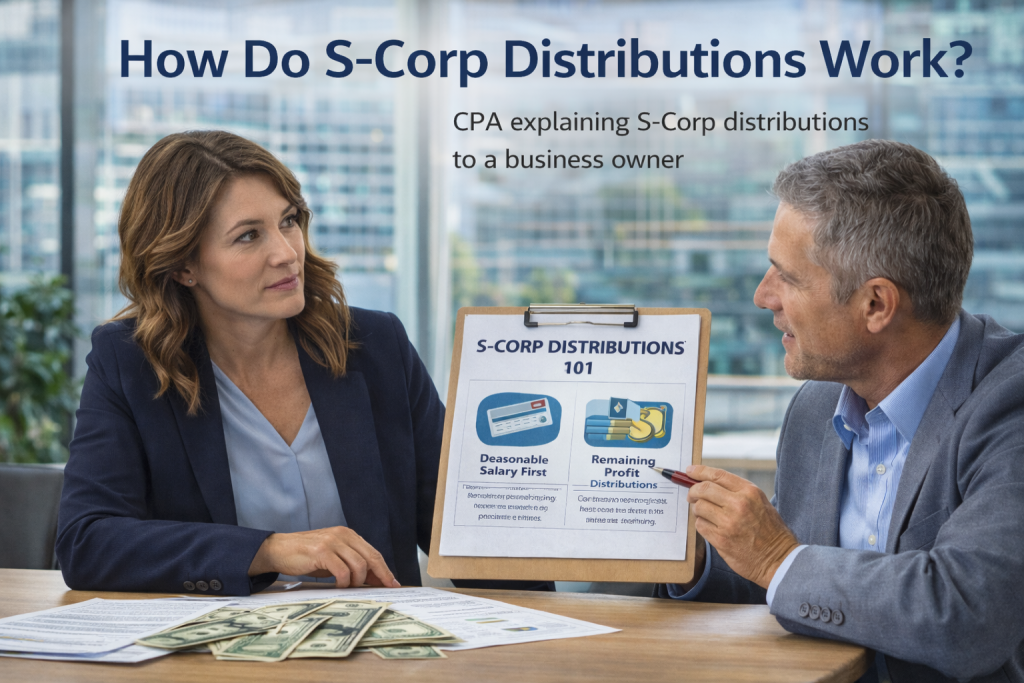
In simple terms, S-Corp distributions allow business owners to withdraw remaining profit after paying reasonable salary, but the tax result depends on shareholder basis and proper payroll treatment.
What Is an S-Corporation Distribution?
An S-Corp distribution is money or property paid out by the corporation to a shareholder as an owner rather than as an employee. That is different from wages. Wages are compensation for services and must go through payroll. Distributions are ownership withdrawals tied to shareholder status. The distinction matters because wages and distributions are taxed and reported differently.
Salary Comes First for Active Owners
This is the rule many owners miss.
If an S-Corp shareholder performs services for the business and receives cash, property, or the right to receive it, the corporation must determine and report an appropriate reasonable salary for that shareholder before treating payments as non-wage distributions. The IRS states this directly: shareholder-employees must receive reasonable compensation for services provided to the corporation before non-wage distributions are made.
So, for an active owner, the structure is generally:
- pay reasonable W-2 wages for work performed
- then take distributions if the business has additional profit
That is the planning opportunity. The point of an S-Corp is not to eliminate payroll. The point is to separate reasonable compensation for labor from shareholder distributions on remaining profit.
How S-Corporation Distributions Are Commonly Taxed
In the most common small-business S-Corp situation, the corporation does not have accumulated earnings and profits from prior C-Corporation years.
In those cases, distributions are usually treated as nondividend distributions under IRS rules.
That is why people often say S-Corp distributions are “tax-free.” That statement is incomplete. A better statement is:
S-Corp distributions may not be taxed again when received, but only to the extent the shareholder has enough basis and the distribution falls under the nondividend distribution rules.
Why Shareholder Basis Matters
Basis is one of the most important parts of understanding S-Corp distributions.
The IRS explains that only nondividend distributions reduce stock basis. Box 16D of Schedule K-1 reports nondividend distributions, and if the shareholder receives distributions beyond available basis, that excess may become taxable gain. The IRS also notes that the shareholder’s stock basis is determined at the end of the taxable year, not at the exact moment the distribution is made.
That means you cannot safely answer “Is this distribution taxable?” by looking only at the bank withdrawal itself. You have to look at the full-year tax picture, including:
- beginning stock basis
- current-year income
- separately stated items
- losses and deductions
- prior distributions
- debt basis, when relevant
That is one reason S-Corp distribution planning should not be handled casually.
Are S-Corp Distributions Always Tax-Free?
No.
They are often not taxed again when the shareholder has enough basis and the corporation fits the common nondividend distribution rules. But distributions can become taxable when:
- the shareholder does not have enough stock basis
- the corporation has accumulated earnings and profits from prior C-Corp years, which can change the ordering and sourcing rules
- the payment is really compensation that should have been treated as wages
- the transaction is not actually a straightforward shareholder distribution
The IRS explains that when an S-Corp has accumulated earnings and profits, the corporation must properly compute accounts such as AAA and accumulated earnings and profits to determine whether distributions are treated as dividend or nondividend distributions.
What If the S-Corp Has Prior C-Corp Earnings?
This does not apply to every S-Corp, but it matters in some cases.
If the corporation previously operated as a C-Corporation and still has accumulated earnings and profits, distribution treatment becomes more technical. In that situation, the IRS rules under section 1368 require analysis of accounts such as the Accumulated Adjustments Account (AAA) and accumulated earnings and profits to determine the character of the distribution. Some amounts may be treated as dividends instead of nondividend distributions.
For many small businesses that elected S-Corp status without prior C-Corp history, this issue may not apply. But when it does apply, the distribution analysis becomes much more technical than most owners expect.
How Do Owners Actually Take Distributions?
Operationally, owners usually take distributions by transferring cash from the business to themselves and recording the payment properly in the books as a shareholder distribution rather than as wages or random owner draw activity.
But the bookkeeping entry alone does not decide the tax treatment. The real tax result depends on whether:
- wages were handled correctly
- the corporation had earnings and basis to support the distribution
- the shareholder had enough stock basis
- the distribution was sourced correctly under the S-Corp rules
That is why distributions should be coordinated with payroll, bookkeeping, and tax planning rather than handled as informal withdrawals.
Can S-Corp Owners Take Monthly Distributions?
Yes, many S-Corp owners take distributions periodically rather than only once a year. There is no general IRS rule requiring distributions to happen on only one date. But regular distributions do not remove the need for proper payroll, basis tracking, and clean accounting treatment.
In practice, the better question is not “Can I take distributions monthly?” The better question is “Am I taking them in a way that is consistent with reasonable compensation, available basis, and proper reporting?”
Are Distributions Deductible to the S-Corp?
No. Distributions are generally not a business expense deduction like wages. They are distributions of value to shareholders, not compensation or an ordinary operating expense. The corporation reports them through its S-Corp reporting structure rather than deducting them the way it deducts payroll compensation. That is why distributions and salary should never be treated as interchangeable from an accounting or tax perspective.
When Do S-Corp Distributions Become Taxable?
S-Corp distributions are often not taxed again when the shareholder has enough stock basis and the corporation follows the standard nondividend distribution rules. However, distributions can become taxable when the shareholder receives more than their available stock basis, because the excess is generally treated as capital gain.
Distributions may also become taxable if the corporation has accumulated earnings and profits from prior C-Corporation years, which can cause part of the distribution to be treated as a dividend instead of a nondividend distribution. In addition, if the IRS determines that payments labeled as distributions were actually compensation for services, those amounts may be reclassified as wages and become subject to payroll taxes.
Common Mistakes Business Owners Make
1. Treating distributions like sole proprietor draws
S-Corps require more formal handling than a Schedule C business. Owners cannot simply move money in and out and assume the label does not matter.
2. Taking distributions before setting reasonable salary
This is one of the biggest IRS risk areas. Active owners generally need payroll first.
3. Assuming all distributions are tax-free
Basis matters. Some distributions can become taxable.
4. Ignoring prior C-Corp history
If there are accumulated earnings and profits, distribution rules can change substantially.
5. Failing to track basis
A distribution may look harmless in the bank account but still create a tax problem if basis is not tracked correctly.
Example Scenario
Suppose an S-Corp owner actively works in the business and the company is profitable. The owner first takes a reasonable W-2 salary through payroll. Later, the business distributes additional cash to the owner as a shareholder. If the corporation does not have prior C-Corp earnings and the shareholder has enough stock basis, that later distribution may not be taxed again when received, even though the underlying business income already flowed through to the shareholder’s return. If basis is insufficient, part of that distribution could become taxable gain instead.
Why This Is a Tax Planning Issue, Not Just a Bookkeeping Issue
Owners often think distributions are just an accounting classification. They are not.
A proper S-Corp distribution analysis may involve:
- reasonable compensation
- payroll setup
- basis tracking
- shareholder loans
- prior-year losses
- accumulated earnings and profits
- timing of withdrawals
- year-end tax projections
That is why distributions are often simple in concept but easy to mishandle in practice.
South Jordan, Utah S-Corp Tax Planning Perspective
For business owners in South Jordan, Utah, and beyond, S-Corp distributions are often where tax planning either starts working well or starts creating risk. At Madsen and Company, we help business owners evaluate whether distributions are being handled correctly alongside payroll, reasonable salary, bookkeeping, and shareholder basis.
Because Madsen and Company operates as a virtual-first CPA firm, many clients work with us remotely throughout Utah and across the country. This allows business owners to review S-Corp compensation planning, distributions, and tax strategy without needing to schedule in-person meetings.
For many owners, the better question is not just “How do S-Corp distributions work?” It is “How do I take money out of my business the right way without creating payroll or tax problems later?”
Final Answer
So, how do S-Corp distributions work?
An S-Corp distribution is generally a payment from the corporation to a shareholder in the shareholder’s role as an owner. For active owners, reasonable salary generally comes first. After that, distributions may be taken if the business has value to distribute. In many common S-Corp situations, distributions are not taxed again to the extent of the shareholder’s stock basis, but basis limits, prior C-Corp earnings, and wage reclassification issues can all change the result.
That is why distributions can be powerful when handled correctly and expensive when handled carelessly.
FAQ SECTION
In many common cases, S-Corp distributions are treated as nondividend distributions and are generally not taxed again to the extent of the shareholder’s stock basis. Amounts above basis are generally taxed as gain, and special rules apply if the corporation has accumulated earnings and profits.
No. Distributions are not wages. Active shareholder-employees generally must receive reasonable compensation before non-wage distributions are made.
Yes, distributions can be taken periodically, but the timing does not override the need for proper payroll, basis tracking, and correct reporting.
Yes. The IRS states that nondividend distributions reduce stock basis.
Yes. The corporation reports nondividend distributions on Schedule K-1, generally in Box 16D. Dividend distributions are reported differently, such as on Form 1099-DIV when applicable.