• Skip to main content
  • Skip to primary sidebar

  • Home
  • About
  • Contact

Archives for February 2026

How Much Should a Small Business Owner Pay Themselves? (W-2 vs Distributions)

February 25, 2026 by Steve Madsen

W-2 salary versus owner distributions for S Corporation small business owners
Understanding the balance between W-2 salary and distributions helps business owners stay compliant while minimizing payroll taxes.

Quick Answer
Most small business owners should pay themselves based on their entity type. S Corporation owners must take a reasonable W-2 salary for the work they perform and then take additional profits as distributions to reduce payroll taxes while staying compliant with Internal Revenue Service rules.

How much should a small business owner pay themselves?

Small business owners should pay themselves differently depending on their business structure, especially if they operate as an S Corporation. The correct mix of W-2 salary and owner distributions must be “reasonable” under IRS rules and aligned with the work performed. Paying yourself incorrectly can trigger payroll tax penalties or missed tax-saving opportunities.

What does “paying yourself” actually mean?

Paying yourself means taking money out of your business in a way that complies with both tax law and your entity type.

How income is taken depends on structure:

  • Sole proprietors and single-member LLCs:
    You do not take a paycheck. Instead, you take owner draws, and all profit is subject to income tax and self-employment tax.
  • Partnerships:
    Owners typically take distributions and possibly guaranteed payments, both subject to self-employment tax.
  • S Corporations:
    Owners must split income between:
    • W-2 salary (subject to payroll taxes)
    • Distributions (not subject to payroll taxes)

Therefore, the real planning question applies mainly to S Corporation owners.

Why does the IRS care how much a small business owner pays themselves?

The IRS requires S Corporation owners to pay themselves a “reasonable salary” for the work they perform.

According to guidance from the Internal Revenue Service, S Corporation owners who perform services for their company must receive reasonable W-2 compensation.

The goal is to prevent owners from avoiding payroll taxes by taking only distributions. The IRS evaluates:

  • Your role in the company (management vs passive owner)
  • Your industry and job function
  • Hours worked and responsibilities
  • Company revenue and profitability
  • Comparable wages for similar work

Because of this, a $20,000 salary with $180,000 in distributions is rarely defensible for an active owner.

When asking how much should a small business owner pay themselves, the goal is to match compensation to actual job duties while remaining tax efficient.

How Much Should an S Corporation Owner Pay Themselves in Salary vs Distributions?

A reasonable salary is what the business would pay someone else to do your job.

Common benchmarks include:

  • 40%–60% of total business profit for many service businesses
  • Industry salary surveys (BLS or private data)
  • Comparable W-2 wages for similar roles

Examples:

  • Consultant earning $150,000 profit → reasonable salary might be $70,000–$90,000
  • Construction company owner earning $250,000 profit → salary might be $100,000–$140,000

However, no single formula fits all cases. Reasonable compensation must be justified annually.

For Utah S Corporation owners—especially those in construction, trades, and professional service businesses—reasonable compensation is one of the most commonly misapplied tax rules we see. Payroll norms in Utah often differ from national averages, and applying generic online formulas without local context can increase audit risk. This is why reasonable salary decisions should be reviewed annually as part of proactive tax planning, not guessed at after the year ends.

Why not take everything as W-2 salary?

Taking all income as salary increases payroll taxes unnecessarily.

W-2 wages are subject to:

  • Social Security tax (12.4% up to the wage cap)
  • Medicare tax (2.9% plus surtax at higher income levels)
  • Federal and state unemployment taxes

Distributions avoid payroll tax. Therefore:

  • More salary = higher payroll tax
  • More distribution = higher audit risk if salary is too low

The strategy is to find the defensible middle ground.

What is the most tax-efficient way for a small business owner to pay themselves?

The tax-efficient strategy is to pay a defensible salary and take the rest as distributions.

Benefits include:

  • Lower total payroll tax burden
  • Cleaner audit trail
  • Better retirement planning accuracy
  • Reduced penalty risk

In addition, timing matters:

  • Salary must be paid regularly through payroll
  • Distributions should follow documented profit
  • Planning should occur before year-end, not after filing

This is where tax planning differs from tax preparation.

When should this be reviewed?

Owner compensation should be reviewed annually or when income changes materially.

Triggers for review include:

  • Revenue growth
  • New responsibilities
  • Hiring staff
  • Adding business partners
  • Switching to S Corporation status

Failing to update salary as profit grows is one of the most common audit red flags.


Bottom Line

Small business owners must align how they pay themselves with their entity type and IRS rules.
S Corporation owners must pay a reasonable W-2 salary before taking distributions.
The goal is not to minimize salary at all costs, but to balance tax efficiency with legal compliance.

How much a small business owner should pay themselves depends on entity type, job role, and IRS reasonable compensation rules.

FAQs

Can I take only distributions and no salary in an S Corp?

No. If you perform services for the company, the IRS requires that you receive W-2 wages.

What happens if my salary is too low?

The IRS can reclassify distributions as wages, assess back payroll taxes, and impose penalties and interest

Is there a fixed percentage I must use?

No. The IRS does not publish a formula. Reasonable pay depends on your role, industry, and company profits.

Can my salary change year to year?

Yes. Salary should change as your business income and responsibilities change.

Does this apply to LLC owners?

Only LLCs taxed as S Corporations use this structure. Single-member LLCs taxed as sole proprietors do not.

What documents support a reasonable salary if I’m audited?

Common support includes payroll records, job descriptions, time spent working in the business, industry wage data, prior-year compensation history, and written tax planning notes explaining how the salary was determined.

Do reasonable salary rules apply if my S Corporation has a loss?

Yes. If you perform services for your S Corporation, reasonable compensation rules still apply even if the business is not profitable. The amount may be lower, but paying zero salary while performing substantial work can still raise audit concerns.

How Madsen and Company Can Help

At Madsen and Company, we help business owners structure compensation that is both tax-efficient and audit-defensible. Our tax planning process includes:

  • Reasonable compensation analysis
  • Payroll and distribution strategy
  • Entity structure review
  • Multi-year tax projections

As a Utah-based CPA firm working with S Corporation owners throughout South Jordan and surrounding areas, we see this issue trigger audits more often than almost any other tax mistake.

What to Do Next if You’re an S Corporation Owner

Schedule a Small Business Tax Planning Consultation

We’ll review your business structure, income, and current pay strategy to determine whether your compensation is optimized for both compliance and tax savings.

Get Started with Business Tax Preparation

If you are ready to file accurately and on time, our CPA-led tax preparation ensures your compensation and distributions are reported correctly.
Filed Under: Small Business Taxes, Tax Planning Tagged With: business tax planning, reasonable salary, S corporation tax planning, S-Corp Taxes

Sole Proprietor vs LLC vs S Corporation: What Really Matters at Tax Time

February 21, 2026 by Steve Madsen

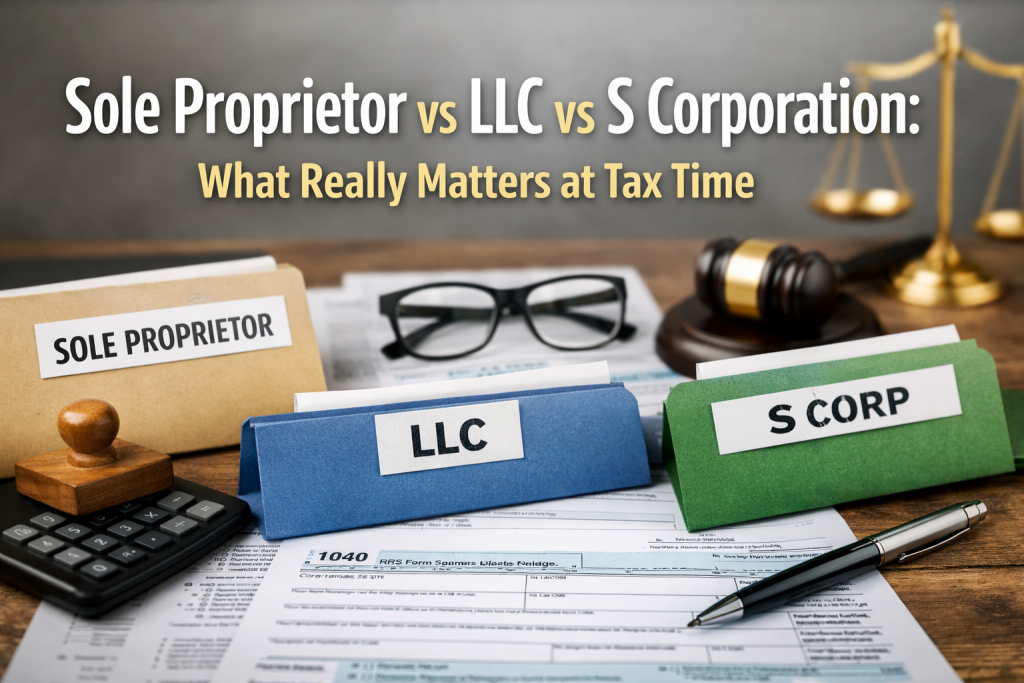
Folders labeled Sole Proprietor, LLC, and S Corporation on a desk with tax forms, representing business entity choices at tax time.
Comparing sole proprietorships, LLCs, and S corporations to understand what matters most at tax time.

Quick answer: A sole proprietorship is simple but often pays the most in self-employment tax. An LLC only saves taxes if it elects S corporation status. An S corporation can reduce employment taxes when profits support payroll and the decision is made before year-end.

Sole proprietor vs LLC vs S corp taxes can produce very different results at tax time, even when two businesses earn the same profit. The structure you choose affects how income is reported, how much self-employment tax you pay, and how much control you have over planning opportunities. The best option depends on profit level, payroll strategy, and timing, not just simplicity or legal protection.

For many Utah-based service businesses and professional firms, the difference between a sole proprietorship, LLC, and S corporation becomes most visible at tax time. State payroll requirements, unemployment reporting, and timing of entity elections can materially affect the outcome, which is why structure decisions should be reviewed before year-end—not after the return is filed.


What is the tax difference in sole proprietor vs LLC vs S corp taxes?

The tax difference comes down to how income is reported and how payroll taxes apply.

• A sole proprietor reports business income on Schedule C and pays self-employment tax on the full net profit.
• A single-member LLC is taxed the same way as a sole proprietor unless it elects S corporation status.
• An S corporation splits income between salary (subject to payroll tax) and distributions (not subject to self-employment tax).

Because of this split, S corporations often reduce overall tax when profits are high enough to justify payroll and compliance costs.


Which structure usually pays the most in sole proprietor vs LLC vs S-corp taxes?

Sole proprietors and non-S-corp LLCs usually pay the most in employment tax.

• All net profit is subject to Social Security and Medicare tax.
• There is no way to separate salary from profit.
• Estimated taxes must cover both income tax and self-employment tax.

This structure works well for very small or part-time businesses but becomes expensive as profits grow.


When does an S corporation reduce sole proprietor vs LLC vs S corp taxes?

An S corporation becomes useful when profits are high enough to support a reasonable salary.

• Business profit generally needs to exceed the cost of payroll and compliance.
• Owners must pay themselves a market-based wage.
• The remaining profit can be distributed without self-employment tax.

For many service-based businesses, this threshold often appears when profits reach the mid five figures or higher, though each case is different.

This is typically the point where a brief tax planning review can prevent unnecessary self-employment tax. Once payroll and reasonable compensation are modeled correctly, the decision becomes much clearer.

View Tax Planning Services

View Business Tax Preparation Services


Does an LLC lower sole proprietor vs LLC vs S corp taxes by itself?

An LLC does not save taxes unless a separate tax election is made.

• By default, a single-member LLC is taxed exactly like a sole proprietorship.
• A multi-member LLC is taxed like a partnership.
• Tax savings only appear if the LLC elects S corporation status.

The LLC provides legal structure, but the IRS focuses on how income is taxed, not the label on the entity.


What does the IRS care about when comparing sole proprietor vs LLC vs S corp taxes?

The IRS cares about income classification, payroll accuracy, and compliance.

• Reasonable compensation for S corporation owners.
• Correct reporting of business income.
• Timely payroll filings and estimated tax payments.
• Proper expense classification and documentation.

Entity type alone does not protect against penalties if reporting is wrong.


What matters more than the name in sole proprietor vs LLC vs S corp taxes?

Profit level, payroll strategy, and planning timing matter more than the legal structure.

• A low-profit S corporation may cost more than it saves.
• A high-profit sole proprietorship usually overpays employment tax.
• Changing entity type after year-end rarely fixes missed opportunities.

This comparison is most useful if:

  • Your business generates consistent profit
  • You expect income to increase
  • You are willing to run payroll correctly if needed

If your business is small, seasonal, or part-time, simpler structures often make more sense.

The right structure must be paired with year-round tax planning to produce meaningful results.


Bottom Line

Entity choice is a tax planning decision—not a tax filing decision. Once the year ends, most opportunities to reduce employment taxes are already gone.

• A sole proprietorship is simple but often the most expensive tax structure as profits grow.
• An LLC does not reduce taxes unless paired with a tax election.
• An S corporation can lower employment taxes when salary and profit are properly balanced.
• Structure decisions should be based on income level, not convenience.
• Tax planning works best when entity choices are made before the year closes.


How Madsen and Company Can Help

Madsen and Company helps business owners evaluate whether their current structure matches their income and long-term goals. We analyze profit levels, payroll strategy, and compliance risk to determine whether staying put or restructuring makes sense. Our focus is proactive planning so your tax return reflects intentional decisions, not last-minute fixes.


Frequently Asked Questions

Is an LLC better than a sole proprietorship for taxes?

No. An LLC is taxed the same as a sole proprietorship unless an S corporation election is made.

Do I have to run payroll if I have an S corporation?

Yes. Owners must pay themselves a reasonable salary through payroll before taking distributions.

What is reasonable compensation?

It is the market wage for the work you perform, based on role, industry, and experience.

Does changing my entity fix past tax problems?

No. Entity changes only affect future tax years. Prior mistakes still require correction.


Call to Action

Choosing between a sole proprietorship, LLC, and S corporation is not about labels—it’s about timing, payroll strategy, and profit. The earlier these decisions are modeled, the more control you have over the outcome.
Schedule a Tax Planning Consultation to review whether your current structure is aligned with your income and goals before the year closes.

Ideal for business owners and S corporation owners.

Filed Under: Small Business Taxes, Tax Planning Tagged With: CPA advisory services, entity selection, LLC taxes, S corporation tax planning, Small Business Tax Strategy, sole proprietor taxes

S-Corp Tax Planning: Why Waiting Until April Costs You

February 18, 2026 by Steve Madsen

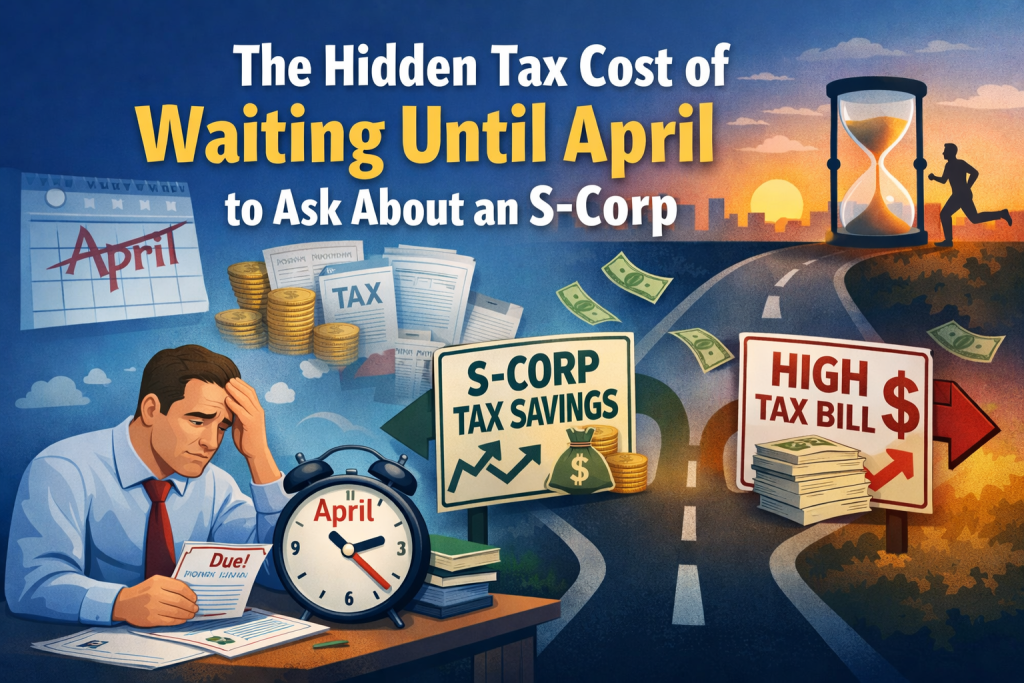
Business owner reviewing tax documents in April while choosing between S-Corp tax savings and a high tax bill
Waiting until tax season to evaluate S-Corp status can mean missing out on significant payroll tax savings.

Quick answer: S-Corp tax savings depend on timing, not just entity choice. Waiting until April usually eliminates the payroll strategies that make S-Corp taxation effective.

Waiting until April to ask whether you should be taxed as an S-Corporation often costs business owners thousands in avoidable self-employment taxes. By the time tax season arrives, most of the planning opportunities tied to S-Corp status have already expired. Proactive timing — not last-minute filing — determines whether an S-Corp actually saves you money.

For many service-based businesses, including Utah professional firms, S-Corp timing directly affects payroll compliance and tax outcomes.


Why does waiting until April eliminate most S-Corp tax savings?

Waiting until April eliminates most S-Corp tax savings because S-Corp elections must generally be made by March 15 to apply for that tax year.

Once the year has closed, income and payroll decisions are already set. As a result:

  • The business owner is stuck paying full self-employment tax on all profits.
  • No reasonable salary was established or paid through payroll.
  • Payroll tax strategies cannot be applied retroactively.
  • Retirement contributions tied to wages may be limited.

Therefore, waiting until April turns S-Corp planning into a missed opportunity rather than a tax strategy.

Already past the deadline? We can still help you file accurately and plan ahead for next year.


What tax benefits are lost when an S-Corp is chosen too late?

The main tax benefit lost is the ability to split income between salary and distributions.

When timing is missed:

  • All business profit is taxed as self-employment income.
  • Social Security and Medicare taxes apply to the full amount.
  • Health insurance and fringe benefits may be structured incorrectly.
  • Quarterly estimates may already be wrong.

In contrast, proper timing allows:

  • A reasonable salary to be taxed through payroll.
  • Remaining profit to avoid self-employment tax.
  • Payroll withholding to support retirement contributions.

Thus, timing determines whether an S-Corp produces real savings or simply adds paperwork.


Who actually benefits from S-Corp taxation?

Not every business benefits from S-Corp taxation, but many profitable service businesses do.

S-Corp taxation usually helps when:

  • Net profit is consistently above $40,000–$50,000.
  • The owner materially participates in operations.
  • Income is stable and predictable.
  • Payroll can be run consistently.

However, S-Corp status is usually a poor fit when:

  • Profits fluctuate wildly.
  • The business is still in startup mode.
  • Owners cannot support payroll compliance.

Therefore, S-Corp status works best as part of a larger tax strategy rather than a reaction to tax season.


Why should S-Corp planning happen before the year starts?

S-Corp planning must happen before the year starts because payroll structure drives tax savings.

When planning happens early:

  • Salary can be set correctly from January.
  • Payroll taxes can be optimized across the year.
  • Estimated payments align with actual tax strategy.
  • Retirement contributions can be maximized.

When planning happens late:

  • Salary cannot be fixed retroactively.
  • Distributions are already misclassified.
  • Compliance risk increases.
  • Savings are permanently lost.

As a result, S-Corp strategy works best as a proactive decision — not an emergency response.


How does this affect small business owners specifically?

Small business owners are most affected because they control both income and compensation.

This means:

  • Their timing decisions directly affect tax liability.
  • Their structure determines payroll exposure.
  • Their planning window closes once the year ends.

Without early guidance:

  • Owners often overpay self-employment tax.
  • Business cash flow suffers unnecessarily.
  • Long-term planning becomes reactive instead of strategic.

Consequently, S-Corp decisions should be evaluated during the year — not after it.


Bottom Line

Waiting until April to ask about S-Corp taxation usually eliminates the tax benefits it is meant to provide.
S-Corp status is most effective when salary, payroll, and profit distributions are structured in advance.
Proactive tax planning — not tax preparation — determines whether an S-Corp reduces tax or simply increases complexity.

View Our Business Tax Preparation Services


How Madsen and Company Can Help

Madsen and Company helps business owners evaluate S-Corp taxation before deadlines pass — not after the savings are gone.

We help Utah-based and nationwide service businesses plan S-Corp taxation before deadlines pass — not after savings are gone.

Our tax planning process includes:

  • Analyzing whether S-Corp taxation actually lowers your total tax
  • Structuring reasonable salary and payroll correctly
  • Coordinating income timing and retirement contributions
  • Integrating tax planning with tax preparation for full compliance

If you want your tax return to reflect strategy instead of surprises, proactive planning is the first step.


Frequently Asked Questions

Can I still elect S-Corp status after March 15?

Yes, but it usually applies to the following tax year unless special relief applies. Late elections often eliminate current-year tax savings.

Does forming an LLC automatically make me an S-Corp?

No. An LLC must file a separate election with the IRS to be taxed as an S-Corporation

How much tax can an S-Corp save?

Savings depend on profit level and salary structure. Many owners save several thousand dollars per year when structured correctly.

Is an S-Corp right for every business?

No. Low-profit or startup businesses often gain little benefit and may increase compliance costs.

Should I ask about S-Corp status during tax season?

Tax season is often too late. S-Corp strategy should be reviewed before or during the tax year to be effective.

Schedule a Tax Planning Consultation

Find out whether S-Corp tax planning could lower your self-employment tax before another year of savings is lost.

Filed Under: Small Business Taxes, Tax Planning Tagged With: business tax planning, proactive tax planning, S corporation tax planning, S-Corporation, small business CPA, South Jordan Tax Planning

Tax Planning vs Tax Preparation: Why March Is Too Late

February 14, 2026 by Steve Madsen

Calendar marked ‘March – Too Late’ next to tax forms and calculator illustrating why a CPA cannot fix a bad 2025 tax year after year-end.
Most tax decisions are locked in after December 31. By March, tax filing is no longer a strategy session — it is a reporting exercise.

Tax planning vs tax preparation is the difference between shaping your tax outcome and simply reporting it.
Most tax decisions are locked in after December 31, making March tax filing a reporting process—not a strategy session.

If you want a deeper explanation of the difference between tax preparation and tax planning, start with our guide on business tax preparation vs tax planning.


Why can’t tax strategy be fixed after December 31?

This is the core distinction between tax planning vs tax preparation — planning changes outcomes before year-end, while preparation only reports what already happened.

Because most tax-saving strategies must be implemented before the year closes.

Once the calendar year ends, the IRS treats your financial activity as final. At that point, your CPA can only report the results accurately, not restructure them.

Key examples of what becomes fixed after year-end include:

  • Income timing: You cannot shift income to a different year once it has been earned and received.
  • Entity structure: You cannot retroactively change your entity type under IRS S-Corporation tax rules once the tax year has closed.
  • Retirement plan design: You cannot create new employer plans after year-end and apply them backward.
  • Depreciation strategy: You cannot change how assets were purchased or placed in service.
  • Payroll strategy: You cannot correct a missing reasonable salary after the year closes.

As a result, March tax work becomes historical reporting, not strategic planning.


What decisions are already locked in by tax season?

Your major tax drivers are determined by how your business operated during the year.

By the time tax documents arrive, the following decisions are already embedded in your return:

  • How your business was structured (sole prop, LLC, S-Corp, partnership)
  • How much you paid yourself versus distributions
  • When you recognized revenue
  • What expenses you documented and categorized
  • Whether assets were purchased strategically or reactively
  • Whether estimated payments matched actual liability

Each of these choices affects tax liability. However, none of them can be meaningfully changed during tax preparation.

For many business owners, choosing the right entity type—such as an S corporation—must be done early to take advantage of S-Corporation tax planning strategies.


Tax Planning vs Tax Preparation: What Your CPA Can Do in March?

Your CPA can optimize reporting but not redesign outcomes.

Tax preparation still adds value, even late in the cycle. However, the value comes from accuracy and compliance, not from strategy creation.

At this stage, your CPA can:

  • Ensure deductions are properly classified
  • Apply existing tax elections correctly
  • Catch missing documents or data errors
  • Verify depreciation and carryforwards
  • File extensions when needed
  • Prevent penalties and filing mistakes

These actions protect you from overpaying due to errors, but they cannot reduce tax caused by poor planning.

At this stage, your CPA can still ensure deductions are properly classified and returns are filed accurately through professional business tax preparation services.


Why does waiting create higher tax bills?

Because tax planning only works when there is still time to make different choices.

When business owners wait until filing season, they often discover:

  • They should have switched entity types earlier
  • They should have paid themselves differently
  • They should have timed income and expenses more intentionally
  • They should have created retirement plans sooner
  • They should have purchased equipment differently
  • They should have adjusted quarterly estimates

Unfortunately, realization does not create retroactive authority. The IRS measures behavior, not intention.


When does real tax planning actually happen?

Effective tax planning happens during the year, not after it ends.

Proactive tax planning focuses on future periods instead of past transactions.

This process typically includes:

  • Mid-year tax projections
  • Entity structure evaluations
  • Compensation strategy reviews
  • Asset purchase timing
  • Retirement contribution planning
  • Cash flow and estimated tax modeling
  • Multi-year tax forecasting

Each of these actions changes the numbers before they become permanent.

This principle applies equally to business owners and real estate investors who rely on real estate tax planning to manage depreciation and income timing.

Effective tax planning services focus on income timing, entity structure, and long-term strategy before deadlines pass.

I explain this timing difference in more detail in this short video on tax planning vs tax preparation, including why waiting until filing season limits what a CPA can actually change.


Bottom Line

  • Tax preparation reports history.
  • Tax planning shapes outcomes.
  • Once a tax year ends, most meaningful tax strategies expire with it.

Waiting until March limits your CPA to compliance instead of strategy.


How Madsen and Company Can Help

Madsen and Company provides both tax preparation and proactive tax planning for business owners, S-Corporation owners, and real estate investors.

We help clients:

  • Identify tax risks before year-end
  • Implement entity and compensation strategies
  • Project future tax liability
  • Coordinate business and personal tax planning
  • Use tax preparation as execution, not discovery

If you only need tax filing, we provide accurate, compliant returns.
If you want lower taxes going forward, we offer year-round tax planning and advisory services.

Schedule a tax planning consultation to see what can still be changed for the current year — and what should be done before this one closes.


Frequently Asked Questions

Can my CPA reduce my taxes after the year is over?

No, your CPA cannot implement most tax-saving strategies after the year closes.
They can apply existing rules correctly, but they cannot retroactively change income, structure, or timing decisions.

Is tax preparation the same as tax planning?

No, tax preparation reports results, while tax planning changes future results.
Preparation looks backward. Planning looks forward.

What is the best time to start tax planning?

The best time is before the year ends and preferably during the year.
Quarterly or mid-year reviews allow strategy adjustments while time remains.

Does this apply to small businesses only?

No, this applies to individuals, investors, and business owners.
Anyone with variable income, assets, or business activity benefits from proactive planning.

What if I already filed my return?

You can still plan for the next tax year even after filing.
Filing closes one chapter. Planning controls the next one.

Ready to stop guessing and start planning?
Tax preparation shows you what already happened. Tax planning helps you change what happens next.

Madsen and Company works with business owners to identify tax-saving opportunities before the year closes — not after the damage is done.

👉 Schedule a Tax Planning Consultation
👉 Start Tax Preparation

Filed Under: Small Business Taxes, Tax Planning Tagged With: S corporation tax planning, Small Business Tax Strategy, South Jordan CPA, tax planning vs tax preparation, year end tax planning

Why Your Tax Return Is Not a Financial Strategy

February 10, 2026 by Steve Madsen

Business tax planning concept showing a tax return on a desk with a calculator, clock, and blocks labeled “Plan” and “File,” illustrating that tax strategy comes before filing.
Tax preparation reports the past — tax planning shapes the future.

Most business owners treat their tax return like a report card. If the number looks “good,” they assume they made smart financial decisions.

But the real issue is tax preparation vs tax planning — and most people confuse the two. Your tax return doesn’t create strategy. It only reports what already happened.

By the time you prepare a return, every important tax decision for that year is already locked in.

That’s the difference between tax preparation and tax planning — and why confusing the two often costs more than necessary.

Prefer a quick explanation? This short video explains why tax preparation and tax planning are not the same thing — and why the difference affects how much you ultimately pay.


Tax Preparation Reports the Past

Tax preparation is compliance.
It answers one question:

“What do I owe based on what already happened?”

A tax return:

  • Records income and expenses
  • Applies existing tax law
  • Files required IRS forms
  • Looks backward at last year’s activity

It’s essential — but it’s not strategic.

At that stage:

  • Deductions can’t be created
  • Entity choices can’t be changed
  • Timing decisions are already over

Tax Planning Shapes the Future

Tax planning is forward-looking.

It answers a very different question:

“What decisions should I make now to legally reduce future taxes?”

Planning focuses on:

  • How to structure your compensation
  • Which entity structure fits your business
  • When to buy equipment
  • How to time income and expenses
  • How retirement contributions affect your taxes
  • Whether investments change your tax picture

As a result, this work happens before the year ends — not after forms are due.


Why Refunds and Low Bills Can Be Misleading

For example, a refund doesn’t mean your strategy worked.
It usually means you overpaid.

Likewise, a low tax bill doesn’t mean you optimized your structure.
It may mean you underreported income, misclassified expenses, or missed planning opportunities.

What really matters is:

  • How much tax you paid relative to what you could have paid
  • Whether your business structure matches your growth
  • Whether your cash flow supports your tax strategy
  • Whether your decisions were intentional — or accidental

The Cost of Treating Tax Filing as Strategy

When tax preparation becomes your only tax service, business owners often:

  • Choose the wrong entity type
  • Miss timing opportunities
  • Skip retirement strategies
  • Overpay self-employment tax
  • Trigger avoidable penalties
  • Discover problems after you close the year

Because of this, you can’t fix any of these once you file the return.


How Smart Business Owners Use Their Tax Return

Smart business owners use a tax return as a diagnostic tool, not as a strategy document.

It shows:

  • Where your business made money
  • Where your business triggered taxes
  • Where inefficiencies exist
  • What planning opportunities may exist next year

When you use last year’s return correctly, it helps guide next year’s decisions.


The Real Difference: Reaction vs. Control

This is the core difference in tax preparation vs tax planning: one records results, while the other shapes them.

Tax preparation reacts to results.
Tax planning controls outcomes.

One looks backward.
The other looks forward.

CPA Insight:

Most business owners don’t overpay taxes because they lack deductions — they overpay because key structural and timing decisions were never reviewed before year-end.

Both are necessary — but they are not the same service, and they do not produce the same value.


How Madsen and Company Approaches Tax Work

At Madsen and Company, tax preparation is the implementation step — not the strategy step.

We use:

  • Proactive tax planning
  • Ongoing advisory
  • Entity structure reviews
  • Cash-flow-aware tax strategy
  • Year-round decision support

So your tax return reflects deliberate choices, not surprises.

Frequently Asked Questions

What is the difference between tax preparation and tax planning?

Tax preparation focuses on accurately filing your tax return based on what already happened during the year. Tax planning focuses on making financial and business decisions ahead of time to legally reduce future tax liability. One looks backward; the other looks forward.

When should tax planning take place?

Tax planning is most effective before the end of the tax year, while there is still time to adjust income, expenses, compensation, and retirement contributions. Waiting until tax filing season limits the strategies that can be used.

Is tax planning only for large businesses?

No. Tax planning is valuable for small business owners, S-Corporation owners, and real estate investors at many income levels. Even modest changes in structure or timing can produce meaningful tax savings.

Can my CPA do both tax preparation and tax planning?

Some CPAs only provide tax preparation services. Others provide proactive tax planning and advisory services in addition to filing returns. It is important to ask whether your CPA offers year-round planning or only seasonal filing.

Why do I still owe taxes even when my return was prepared correctly?

A correctly prepared tax return reports what happened but does not change the tax outcome. Owing taxes usually means that income, structure, or timing decisions during the year created a higher tax liability than expected.

Does getting a refund mean my tax strategy worked?

Not necessarily. A refund usually means too much tax was withheld or paid during the year. A good tax strategy focuses on minimizing total tax owed legally, not creating large refunds.

What types of decisions are part of tax planning?

Tax planning includes decisions about business structure, compensation, retirement contributions, equipment purchases, timing of income and expenses, and how investments affect overall tax exposure.

How does tax planning help control future tax bills?

By making informed decisions before deadlines pass, tax planning helps align income, deductions, and structure in a way that reduces taxes legally and predictably rather than relying on last-minute adjustments.

Is tax planning still useful if my income changes year to year?

Yes. In fact, tax planning becomes more important when income fluctuates because strategies can be adjusted annually based on cash flow, growth, and investment activity.

How often should tax planning be done?

Tax planning should be reviewed at least annually and ideally throughout the year when major financial or business changes occur, such as starting a business, buying property, or changing entity structure.

Do I need tax planning if my books are handled by a bookkeeper?

Bookkeeping records transactions but does not determine tax strategy. Tax planning focuses on how those numbers are structured and reported for tax purposes.

What is the first step to getting proactive tax planning?

The first step is reviewing your most recent tax return and financial activity to identify planning opportunities and areas where decisions could be improved going forward.


Final Thought

If your only tax service is preparing a return, your tax outcome is mostly accidental.

In the debate of tax preparation vs tax planning, real tax strategy starts before the year begins — and works while the year is still in progress.

Your tax return should confirm your plan.
Not become your plan.


Ready to move beyond reactive tax filing?

If you’re a business owner who wants more control over your tax outcome — not just a number on a form — proactive tax planning can make the difference.

👉 Schedule a Tax Planning Consultation

Filed Under: Small Business Taxes, Tax Planning Tagged With: CPA advisory services, proactive tax planning, small business taxes, tax planning, tax planning vs tax preparation, tax preparation

Proactive Tax Planning for Small Business Owners: A Complete Guide

February 7, 2026 by Steve Madsen

Written by Steve Madsen, CPA — licensed since 1993.

Proactive tax planning tools on a desk, including a tax strategy document, calculator, calendar, and money for small business owners.
Visual representation of proactive tax planning strategies for small business owners, including timing, structure, and financial decision-making.

Proactive tax planning helps small business owners reduce taxes before filing season by making intentional financial and structural decisions throughout the year.

This proactive approach is the foundation of our business tax planning and advisory services, where strategy is built before deadlines pass — not after.

For Utah-based small business owners, proactive tax planning often affects both federal and state tax outcomes, making timing and structure especially important.

Unlike tax preparation, which reports what already happened, tax planning shapes what happens next.
For most business owners, waiting until tax season is the main reason they miss legal tax-saving opportunities.

CPA Insight:
The biggest tax savings for small business owners are created by decisions made before year-end — not by adjustments made when a return is already being prepared.
Proactive tax planning is most effective when it influences decisions before money moves — not when it reacts to results after the year ends.

What Is Proactive Tax Planning for Small Business Owners?

Proactive tax planning means using the tax code strategically before year-end to influence your future tax outcome. In other words, it’s about decisions you make during the year, not after it’s over.

Key elements include:

  • Evaluating your business structure to match your income level
  • Timing income and expenses intentionally
  • Coordinating retirement contributions with tax goals
  • Using depreciation and credits legally and efficiently
  • Modeling outcomes before making financial moves

As a result, tax planning turns taxes into a managed variable instead of a surprise bill.

Why Is Tax Season the Worst Time to Start Tax Planning?

Tax season is too late because most tax-saving opportunities depend on actions taken earlier in the year. Once December 31 passes, many options are no longer available.

Common limitations during tax season:

  • Entity structure changes are no longer retroactive
  • Income timing decisions are already locked in
  • Missed retirement planning opportunities cannot be recreated
  • Equipment purchases may no longer qualify for optimal treatment

Therefore, tax preparation can only report results—it can’t improve them.

For many Utah-based small business owners, waiting until tax season can also affect state-level cash flow planning and estimated tax requirements.

CPA Insight:

Tax planning only works before the calendar does

From a CPA’s perspective, the biggest tax savings come from decisions made during the year, not from forms filed after it ends.


Most business owners misunderstand this because tax preparation feels like the moment taxes are “handled,” even though it only documents what already happened.


The real-world consequence is that clients often discover missed deductions, missed elections, or missed structure changes when it’s already too late to fix them.


Instead, business owners should treat tax planning as an ongoing strategy tied to income, cash flow, and major decisions—not a last-minute event at filing time.

Who Benefits Most from Tax Planning for Small Business Owners?

Business owners with variable or growing income benefit most from proactive tax planning. Planning is especially valuable for:

  • S corporation owners managing salary and distributions
  • Self-employed professionals with rising profits
  • Real estate investors using depreciation strategies
  • Short-term rental owners with complex deductions
  • High-income households with multiple income sources

In each case, planning helps align financial decisions with tax efficiency.

What Are the Core Small Business Tax Planning Strategies?

Core tax planning strategies focus on structure, timing, and classification of income and expenses. Common strategies include:

  • Choosing the right entity type (sole proprietor, LLC, S corporation)
  • Optimizing retirement contributions for tax deferral or tax-free growth
  • Managing depreciation through Section 179 or bonus rules
  • Coordinating income recognition with expected tax brackets
  • Applying business credits when available and appropriate
  • Using legally permitted special rules such as accountable plans or home office methods

However, strategies must be tailored to each business to remain compliant.

When Should Business Owners Do Proactive Tax Planning?

Tax planning should occur before year-end and whenever major financial changes happen. The best timing typically includes:

  • A mid-year review to adjust course
  • A late-year strategy session before December
  • Planning after significant income changes
  • Planning before large purchases or investments
  • Planning when adding partners or changing payroll

As a result, planning becomes part of ongoing business management rather than a one-time event.

How Is Small Business Tax Planning Different from Business Tax Preparation?

Tax planning is forward-looking, while tax preparation is backward-looking. The distinction matters:

Tax Planning:

  • Focuses on strategy and forecasting
  • Influences future tax outcomes
  • Advisory in nature

Tax Preparation:

  • Focuses on reporting and compliance
  • Records past activity
  • Procedural in nature

Together, they work best when integrated rather than separated.

What Mistakes Do Business Owners Make Most Often?

The most common mistake is assuming tax preparation equals tax strategy. Other frequent mistakes include:

  • Waiting until March or April to ask tax questions
  • Choosing a business structure based on internet advice
  • Ignoring quarterly estimates and cash flow impact
  • Overemphasizing deductions without understanding risk
  • Treating bookkeeping as tax planning

Consequently, these mistakes usually result in higher taxes over time.

Bottom Line: Why Proactive Tax Planning Matters for Small Business Owners

Proactive tax planning allows business owners to influence their tax outcome before deadlines pass. Tax preparation alone cannot replace strategy because it only reports what already occurred. The earlier planning begins, the more options remain available.

How Madsen and Company Helps with Small Business Tax Planning

Madsen and Company provides proactive tax planning and tax preparation for business owners, S corporation owners, and real estate investors.

Our approach includes:

  • Year-round advisory instead of once-a-year filing
  • Scenario modeling before decisions are made
  • Strategy-driven tax preparation
  • Virtual-first service for nationwide clients

If you want tax preparation that reflects intentional strategy—not last-minute outcomes—professional planning is essential.

Ready to take control of your tax strategy? Schedule a tax planning consultation or begin your tax preparation process to ensure your return reflects deliberate financial choices rather than missed opportunities.

Frequently Asked Questions

What is proactive tax planning?

Proactive tax planning is the process of making financial and business decisions in advance to legally reduce future tax liability.

When should I start tax planning?

Tax planning should start as soon as income becomes predictable and should be revisited before year-end or major financial changes.

Is tax planning only for high-income earners?

Tax planning benefits any business owner with variable income, but it becomes increasingly valuable as income rises.

Can a CPA do both tax planning and tax preparation?

Yes. A CPA can provide tax planning to shape outcomes and tax preparation to ensure accurate filing.

How much can tax planning save?

Savings vary by situation, but effective planning often prevents avoidable overpayment by aligning business structure and timing with tax rules.

Does proactive tax planning replace tax preparation?

No. Tax planning and tax preparation work together. Planning shapes decisions during the year, while preparation ensures those decisions are reported accurately and compliantly.

Related articles

Specific tax planning strategies for small businesses

Why timing matters in tax planning

Planning ahead of March filing deadlines

Why tax planning must happen before filing

Planning major deductions before year-end

Next Steps
If you want your tax return to reflect intentional planning instead of last-minute outcomes, the process needs to start before deadlines pass. Madsen and Company provides both proactive tax planning and tax preparation for business owners, S corporation owners, and real estate investors. To move forward, schedule a tax planning consultation or begin your tax preparation process so your filings align with deliberate financial decisions rather than missed opportunities.

👉 Schedule a Proactive Tax Planning Review

👉 Start Tax Preparation

Filed Under: Small Business Taxes, Tax Planning Tagged With: proactive tax planning, S corporation tax planning, Small Business Tax Strategy, South Jordan Tax Planning, tax planning vs tax preparation, year-round tax planning

  • Page 1
  • Page 2
  • Go to Next Page »

Primary Sidebar

Search

Archives

  • March 2026
  • February 2026
  • January 2026
  • December 2025
  • November 2025
  • July 2025
  • May 2025
  • April 2025
  • March 2025
  • January 2025
  • August 2024
  • July 2024
  • June 2024
  • February 2024
  • January 2024
  • November 2023
  • August 2023
  • March 2023
  • February 2023

Categories

  • Business Best Practices
  • Business Tax
  • Individual Tax
  • Real Estate
  • Retirement
  • S-Corporation Tax
  • Small Business
  • Small Business Taxes
  • Tax Deadlines & Compliance
  • Tax Planning
  • Uncategorized

Copyright © 2026 · https://www.madsencpa.com/blog