Written by Steve Madsen, CPA (licensed since 1993)
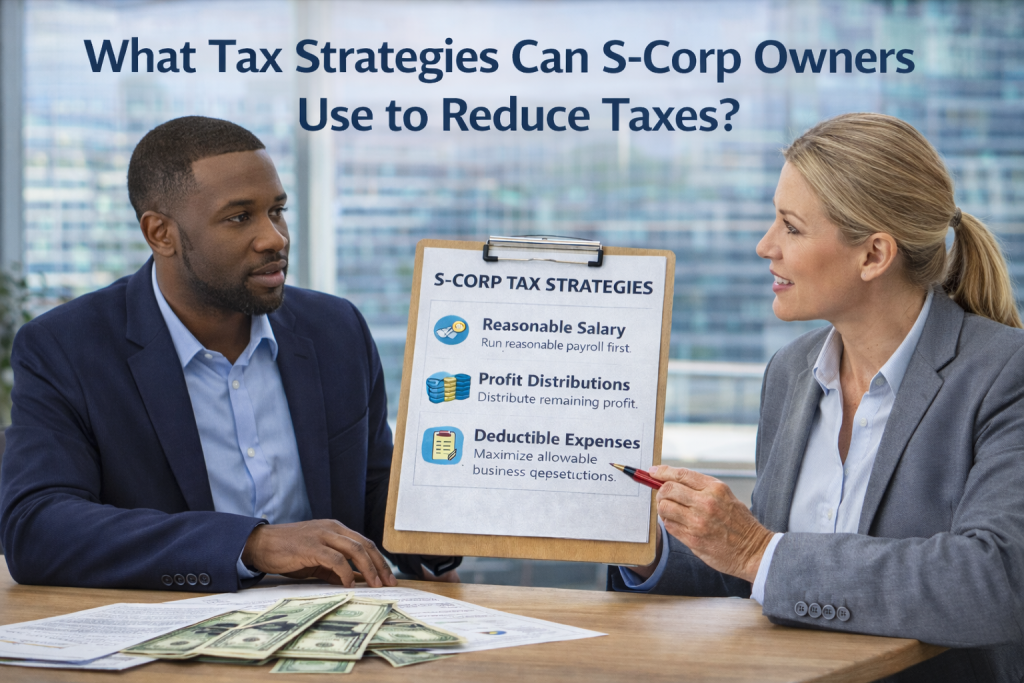
Many business owners elect S-Corporation tax treatment because they hear it can save taxes, but simply becoming an S-Corp does not automatically produce the best tax result. The biggest savings usually come from how the S-Corp operates throughout the year, not just from electing S-Corp status with the IRS.
That is why many owners ask: What tax strategies can S-Corp owners use to reduce taxes?
The answer is not one trick or deduction. Good S-Corp tax planning usually combines salary planning, shareholder distributions, retirement contributions, accountable expense reimbursement, depreciation decisions, health insurance treatment, and timing strategies. The right mix depends on profit, payroll, bookkeeping, entity structure, and the owner’s broader financial goals.
Quick Answer
S-Corp owners can reduce taxes by using proactive strategies such as setting a proper reasonable salary, taking distributions correctly, maximizing retirement contributions, using an accountable plan for business reimbursements, reviewing Section 179 and bonus depreciation carefully, timing income and expenses strategically, and coordinating owner health insurance and fringe benefit rules properly. The best results usually come from year-round planning rather than waiting until tax return season.
These S-Corp tax strategies work best when business owners plan throughout the year rather than waiting until tax filing season.
Why S-Corp Tax Planning Matters
An S-Corp can create tax-saving opportunities, but it also creates rules that must be followed correctly.
Setting salary too low increases payroll risk.
Paying too much salary may cause the business to pay unnecessary payroll taxes.
Careless distribution handling can create basis and reporting problems.
Without a plan for deductions, the business may miss better long-term tax outcomes.
That is why S-Corp tax planning is not just about claiming more deductions. It is about structuring the business in a way that legally improves the overall tax result.
1. Set a Reasonable Salary Without Overpaying Payroll Tax
For many S-Corp owners, the most important tax planning decision each year is how much to pay themselves in W-2 wages.
An active owner generally needs to take reasonable compensation for the work they perform. But that does not mean the owner should automatically pay themselves every dollar of business profit as wages.
Careful planning matters here. A well-structured S-Corp often separates:
- reasonable salary for labor, and
- shareholder distributions on remaining profit
That balance can help reduce self-employment-type payroll exposure compared with operating as a sole proprietor, while still staying within IRS rules.
The mistake many owners make is focusing only on minimizing salary. The real goal is not the lowest salary. The goal is a defensible salary that still preserves legitimate tax efficiency.
2. Use Shareholder Distributions Correctly
Once reasonable salary is addressed, shareholder distributions may become part of the tax strategy.
Distributions are not the same as wages. They should not replace payroll for an active owner. But when handled correctly, distributions can be an efficient way for an S-Corp owner to receive remaining profit from the business.
This area should still be monitored carefully because:
- distributions do not fix an unreasonably low salary
- basis matters
- bookkeeping needs to be clean
- shareholder withdrawals should be tracked properly
Many S-Corp tax problems happen because owners take money out of the business casually without coordinating payroll, distributions, and bookkeeping.
3. Maximize Retirement Contributions
Retirement planning is one of the strongest tax strategies available to many S-Corp owners.
Depending on the facts, an owner may be able to use options such as:
- Solo 401(k)
- SEP IRA
- other employer-sponsored retirement strategies where appropriate
The key point is that S-Corp owners often need to understand that certain retirement contribution limits are based on W-2 wages, not just business profit. That means salary planning and retirement planning should be coordinated together.
This is one reason S-Corp tax strategy should not be handled in isolated pieces. A salary number that looks good for payroll tax purposes may unintentionally reduce retirement planning opportunities if not reviewed carefully.
4. Use an Accountable Plan for Owner Expenses
Many S-Corp owners pay business expenses personally at some point during the year. If those expenses are not handled correctly, tax benefits may be lost or the bookkeeping may become messy.
An accountable plan can allow the corporation to reimburse the owner for certain legitimate business expenses properly, rather than leaving those items buried in personal accounts or treated incorrectly.
This strategy can be especially useful for expenses such as:
- home office costs, when applicable
- mileage or vehicle use under proper methods
- business travel
- cell phone or internet costs with business use components
- supplies and smaller recurring business expenses paid personally
Handled correctly, an accountable plan can improve tax treatment and create cleaner books.
5. Review Section 179 and Bonus Depreciation Carefully
Equipment purchases can create major deductions, but the biggest current-year deduction is not always the best overall tax strategy.
S-Corp owners often need to evaluate whether to use:
- Section 179
- bonus depreciation
- regular depreciation
The best answer depends on the business’s profit, future income expectations, state tax treatment, and whether the owner needs cash flow savings now or better deductions spread over time.
Many businesses make poor decisions here by focusing only on the largest immediate write-off. Sometimes that is the right answer. Sometimes it is not.
A planning-first review helps determine whether the deduction should be accelerated or preserved for future years.
6. Time Income and Expenses Intentionally
Tax planning is often about timing, not just total dollars.
Depending on the business and accounting method, an S-Corp owner may benefit from reviewing whether to:
- delay certain income into the following year
- accelerate needed business expenses into the current year
- time major equipment purchases intentionally
- pay bonuses or wages before year-end when appropriate
- complete retirement contributions by the applicable deadlines
Timing decisions become especially important when income fluctuates, tax brackets change, or the owner expects a materially different year ahead.
The key is to make those decisions before year-end rather than after the year is closed.
7. Coordinate Health Insurance Properly
Health insurance is another area where S-Corp owners often make mistakes.
The treatment of shareholder health insurance can be different for more-than-2% S-Corp shareholders than it is for rank-and-file employees. Proper reporting matters. Incorrect handling can prevent the deduction from flowing through the tax return correctly.
This is not a strategy to improvise at tax time. It should be coordinated through payroll and year-end reporting so the deduction is preserved correctly.
8. Review Family Payroll and Spouse Involvement Carefully
In some businesses, involving a spouse or family members in the business may create planning opportunities, but this area needs to be handled carefully.
The question is not whether payroll can be added just to reduce taxes. The real question is whether family members are performing legitimate services and whether compensation is appropriate and documented.
When the facts support it, family payroll planning can affect:
- retirement contribution opportunities
- earned income-based benefits
- overall family tax strategy
But it must be real, supportable, and properly administered.
9. Keep Books Clean Enough for Planning
This may not sound like a tax strategy, but it is one of the most important ones.
Messy bookkeeping destroys tax planning.
If the books are behind, incorrect, or full of mixed personal and business activity, it becomes much harder to:
- project profit accurately
- set salary appropriately
- track distributions
- measure basis
- time deductions properly
- make intelligent year-end decisions
Many owners assume bookkeeping is just compliance work. In reality, good books are what make real tax planning possible.
10. Monitor Basis and Owner Withdrawals
S-Corp owners often focus on profit and ignore basis until tax filing season. That can be a mistake.
Basis affects whether losses may be deductible and whether certain distributions may create tax consequences. Owners who take frequent distributions or who have prior-year losses should pay close attention to basis and how money is moving through the business.
This is one reason random owner withdrawals can create problems. What looks simple from a cash-flow perspective can become complicated on the tax return.
11. Plan Before the S-Corp Election Deadline and Before Year-End
One of the best S-Corp tax strategies is simply planning early enough to still have options.
For businesses considering electing S-Corp status, decisions should be reviewed before the Form 2553 deadline and before payroll habits are set incorrectly.
For businesses already operating as S-Corps, year-end planning should happen while there is still time to:
- adjust salary
- review distributions
- make retirement decisions
- purchase equipment intentionally
- correct bookkeeping
- structure reimbursements properly
The earlier the review happens, the more useful the planning tends to be.
12. Match the Strategy to the Owner’s Bigger Goals
Not every tax-saving move is the right business move.
A business owner may want to lower current-year taxes, but they may also need to think about:
- cash flow
- retirement accumulation
- loan applications
- buying a home
- reducing audit risk
- future expansion
- eventual sale of the business
The best tax plan is the one that fits the owner’s full picture, not just the one that creates the lowest immediate tax bill.
Common Mistakes When Using S-Corp Tax Strategies
Many S-Corp owners lose savings because they focus on isolated tactics instead of coordinated planning. Common mistakes include:
Setting salary too low
This can increase IRS risk and weaken the entire tax position.
Taking distributions without tracking basis
That can create avoidable tax problems and messy year-end corrections.
Making equipment purchases only for the deduction
A bad business purchase does not become a good decision just because it creates a write-off.
Ignoring payroll timing
Late payroll setup can create compliance problems and missed opportunities.
Waiting until tax return season
By then, many planning opportunities are already gone.
Example of How S-Corp Tax Planning Works in Real Life
A profitable S-Corp owner might reduce taxes not through one dramatic move, but through several coordinated decisions:
- setting a supportable reasonable salary
- taking additional profit as shareholder distributions
- maximizing retirement contributions tied to wages
- reimbursing owner-paid business expenses properly
- choosing the right depreciation method for equipment
- making year-end timing decisions before December closes
Individually, each move may seem modest. Together, they can significantly improve the overall tax outcome.
South Jordan, Utah S-Corp Tax Planning Perspective
For business owners in South Jordan, Utah and beyond, the most effective S-Corp tax strategies usually come from ongoing planning rather than one-time tax filing decisions. At Madsen and Company, we help business owners review whether their salary, distributions, retirement planning, deductions, and entity structure are working together the way they should.
For many owners, the right question is not simply “What can I deduct?” The better question is “How do I structure my S-Corp so I keep more of what I earn without creating unnecessary complexity or risk?”
Final Answer
So, what tax strategies can S-Corp owners use to reduce taxes?
The strongest strategies usually include setting a proper reasonable salary, using distributions correctly, maximizing retirement contributions, reimbursing owner expenses through an accountable plan, reviewing depreciation choices carefully, coordinating health insurance properly, timing income and expenses intentionally, and keeping books clean enough to make smart decisions during the year.
The biggest tax savings usually do not come from one magic deduction. They come from proactive planning across multiple areas of the business before year-end. That is why the most successful S-Corp owners usually benefit from planning-first tax advice rather than waiting until the return is being prepared.
FAQ SECTION
There is no single best strategy for every owner. In many cases, the most important starting point is setting a reasonable salary correctly and then coordinating distributions, retirement contributions, deductions, and timing decisions around that structure.
One of the main S-Corp planning opportunities allows active owners to take a reasonable salary for services and then receive additional profit as shareholder distributions. The structure must still be handled correctly and supported by reasonable compensation.
They often can, but the reporting must be handled correctly, especially for more-than-2% shareholder-employees.
Yes. Retirement contributions are often one of the strongest tax planning tools for S-Corp owners, but they should be coordinated with W-2 wages and overall profit planning.
The best time is before major year-end decisions are locked in. Planning earlier in the year usually creates more options than waiting until tax return season.