• Skip to main content
  • Skip to primary sidebar

  • Home
  • About
  • Contact

Business Tax

S-Corp SALT Workaround in 2025: What Utah S-Corp Owners Need to Know

November 26, 2025 by Steve Madsen

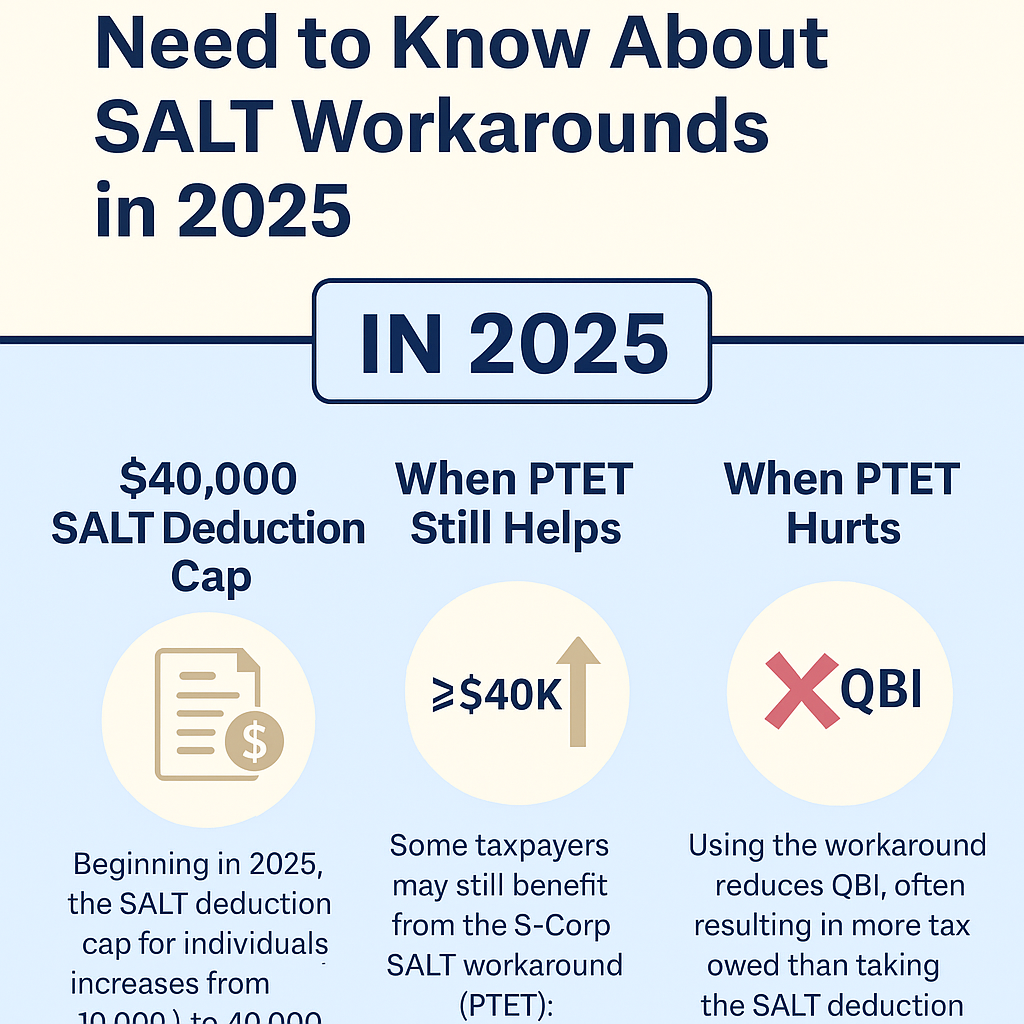
Updated for the 2025 increase of the SALT deduction cap from $10,000 to $40,000.
📌 Quick Summary

Starting in 2025, the federal SALT (State and Local Tax) deduction cap increases from $10,000 to $40,000. This is a major shift for S-Corp owners who used Utah’s PTET workaround to bypass the previous limit.

With a much higher personal deduction threshold, the PTET workaround becomes less necessary—but still strategically useful in certain cases.

This guide explains when Utah business owners should (and shouldn’t) continue using PTET in 2025.


1. What Is the SALT Workaround for S-Corporations?

During the years when federal SALT deductions were capped at $10,000, states (including Utah) created a workaround called:

Pass-Through Entity Tax (PTET)

This allows an S-Corp to pay the owner’s state income tax at the business level and deduct it as a business expense—avoiding the individual SALT cap.

Example under 2024 rules:

  • Utah tax: $15,000
  • Individual SALT limit: $10,000
  • PTET bypasses the cap
  • Entire $15K becomes a business deduction → reduces federal taxable income

This was an extremely valuable strategy for many small business owners.


2. What Changes in 2025?

Beginning January 1, 2025:

The SALT deduction cap increases from $10,000 to $40,000.

This means:

  • Most Utah S-Corp owners can now deduct a much larger portion of their state taxes personally
  • The PTET workaround becomes optional, not essential

Does PTET go away?

No — Utah still allows PTET.
But the math changes in 2025.

Now the question is:
Does the PTET deduction save more than the QBI deduction it reduces?

For many owners, the answer is no.


3. When PTET Still Makes Sense in 2025

Even with a $40,000 SALT deduction available personally, there are situations where PTET still produces better outcomes.

✔ 1. When your state tax exceeds $40,000

High-income earners may still benefit.

Example:

  • State tax owed: $62,000
  • Personal deduction cap: $40,000
  • Remaining $22,000 is nondeductible personally
  • But PTET allows the entire $62,000 to be deducted at the business level

This is still a major PTET advantage.


✔ 2. When you claim the standard deduction

If you do NOT itemize, personal SALT deductions are worthless.

In this case, PTET creates a new business deduction that would otherwise be lost.


✔ 3. When you want to reduce K-1 income

PTET lowers federal K-1 income, which can:

  • Reduce federal tax
  • Reduce 3.8% Net Investment Income Tax
  • Reduce phaseouts tied to AGI
  • Improve certain credit qualifications

This remains a planning tool, even in 2025.


4. When NOT to Use PTET in 2025

There are now more situations where PTET hurts more than it helps.

❌ 1. When PTET reduces your QBI deduction

Because:

  • PTET reduces K-1 income
  • Lower K-1 = lower QBI deduction (20%)

If lowering QBI costs more than the PTET deduction saves → PTET is a bad deal.

This will apply to many small and mid-sized Utah S-Corp owners.


❌ 2. When your Utah taxes fall under the new $40,000 SALT cap

If:

  • Your Utah tax < $40,000
  • You itemize deductions

Then you can deduct 100% of your state tax personally without reducing QBI.

PTET offers no advantage, and may reduce QBI unnecessarily.


❌ 3. When you already itemize (mortgage, charity, state tax)

If you are already itemizing, a larger SALT cap makes personal deduction more efficient than PTET.


5. Examples: PTET vs Personal SALT Deduction in 2025

📘 Example 1: PTET Helps

  • Utah tax: $55,000
  • Personal SALT cap: $40,000
  • $15,000 would be nondeductible personally
  • PTET allows full $55K deduction at entity level

PTET is the better option.


📕 Example 2: PTET Hurts

  • Utah tax: $18,000
  • Well under the $40K cap
  • Owner itemizes
  • K-1 income: $150,000
  • PTET would reduce K-1 → reduces QBI deduction by ~$3,600

Paying SALT personally is superior.


6. Strategic Recommendation for Utah S-Corp Owners in 2025

Recommended for MOST business owners in 2025:

✔ Pay your state tax personally
✔ Itemize and use the increased $40,000 SALT cap
✔ Preserve the full QBI deduction

Use PTET only when:

  • Your state tax exceeds $40K
  • You take the standard deduction
  • You must lower K-1/AGI for tax purposes
  • You’re subject to NIIT or phaseouts

7. Madsen & Company’s Advisory Approach

Because of the new SALT cap, PTET is no longer an automatic strategy.

We now run:

  • Side-by-side QBI comparisons
  • PTET vs personal SALT deduction analyses
  • Itemized vs standard deduction projections
  • Full 2025 tax strategy optimization

This ensures you choose the path that minimizes your total tax, not just one line item.


8. Final Takeaway

In 2024, PTET was usually the best choice.

In 2025, the increased SALT deduction changes everything.

For most Utah S-Corp owners, PTET will NOT be the best option in 2025.

But for high-income or high-tax situations, it can still be a powerful tool.

If you want a custom PTET vs SALT analysis for 2025, Madsen & Company can run the numbers and show the exact tax difference.

Filed Under: Business Tax Tagged With: tax

Business Tax Reduction 101: Smart Strategies to Keep More of What You Earn

July 1, 2025 by admin

For every business owner, managing taxes is one of the most important parts of running a successful operation. Overpaying taxes can eat into profits, while smart planning can significantly improve your bottom line. The good news? With the right strategies, you can reduce your business tax liability legally and effectively.

This guide breaks down the basics of business tax reduction—what it is, why it matters, and how to do it.

Why Business Tax Reduction Matters
Paying taxes is a non-negotiable part of doing business, but how much you pay is often within your control. By leveraging deductions, credits, and smart planning, you can:

  • Improve cash flow
  • Boost profitability
  • Reinvest more into your business
  • Avoid costly penalties and audits

The key is understanding your options and taking a proactive approach throughout the year—not just during tax season.

Top Strategies for Reducing Business Taxes

1. Maximize Business Deductions
The IRS allows you to deduct “ordinary and necessary” expenses related to running your business. Some common deductions include:

  • Office rent or home office expenses
  • Business travel and meals (50% deductible)
  • Equipment and software
  • Marketing and advertising
  • Professional services (legal, accounting, consultants)
  • Employee wages and benefits

Keep detailed records and receipts to support your deductions in case of an audit.

2. Leverage Section 179 and Bonus Depreciation
If you purchase equipment or vehicles for your business, you can often deduct the full cost in the year of purchase through Section 179 or bonus depreciation. These incentives can provide huge tax savings, especially for capital-intensive businesses.

3. Hire Strategically
Hiring employees or independent contractors may qualify you for tax credits and deductions. The Work Opportunity Tax Credit (WOTC), for example, rewards businesses that hire veterans, ex-felons, or long-term unemployed workers.

Also, offering tax-advantaged benefits like retirement plans, health insurance, or commuter benefits can reduce your payroll tax burden.

4. Contribute to a Retirement Plan
Setting up a retirement plan—like a SEP IRA, SIMPLE IRA, or Solo 401(k)—not only helps you and your employees save for the future, but also reduces your taxable income. Employer contributions are typically tax-deductible.

5. Choose the Right Business Structure
The way your business is structured (sole proprietorship, LLC, S-corp, C-corp, partnership) can have a major impact on your tax bill. For example:

  • S-corporations allow profits (and losses) to pass through to the owner’s personal tax return, avoiding double taxation.
  • LLCs offer flexibility—you can elect how you want to be taxed.
  • C-corporations may benefit from a flat corporate tax rate, but may also be subject to double taxation unless handled carefully.

Work with a tax professional to determine the best structure for your business.

6. Defer Income and Accelerate Expenses
If your business operates on a cash basis, you can defer income (delay invoices or payments) to the next tax year and accelerate expenses (prepay for goods or services) in the current year to reduce your taxable income.

7. Take Advantage of Tax Credits
Credits directly reduce your tax liability dollar for dollar. Some examples include:

  • R&D Tax Credit: For businesses investing in innovation, technology, or product development.
  • Energy Efficiency Credits: For eco-friendly building upgrades or equipment.
  • Small Business Health Care Tax Credit: If you offer health insurance and meet eligibility criteria.

Tax credits often require documentation and qualifications, so consult a tax advisor before applying.

Common Mistakes to Avoid

  • Failing to keep accurate and updated financial records
  • Mixing personal and business expenses
  • Ignoring quarterly estimated tax payments
  • Waiting until year-end to plan taxes
  • Overlooking tax credits and deductions you’re eligible for

Final Thoughts
Reducing your business taxes doesn’t mean cutting corners—it means planning smartly and using the tax code to your advantage. Whether you’re a solo entrepreneur or run a growing enterprise, these strategies can help you legally reduce your tax burden and improve your financial health.

Partner with a qualified accountant or tax advisor to tailor a tax reduction plan that fits your specific business model. With the right support, you can keep more of what you earn—and reinvest it into the success of your business.

Filed Under: Business Tax

Business Tax Planning for Tax Cuts and Jobs Act (TCJA) Sunset

March 10, 2025 by admin

The Tax Cuts and Jobs Act (TCJA) of 2017 introduced substantial tax reductions and incentives for businesses, many of which are set to expire by the end of 2025. As this sunset approaches, businesses must engage in strategic tax planning to mitigate potential financial impacts. This article outlines key considerations and strategies for businesses to prepare for the post-TCJA landscape.

Key Provisions Set to Expire

Several significant tax provisions benefiting businesses are scheduled to lapse, including:

  • Corporate Tax Rate Stability â€“ The TCJA permanently lowered the corporate tax rate to 21%. However, potential legislative changes could lead to rate increases, making it essential for businesses to anticipate higher tax burdens.
  • Qualified Business Income Deduction (QBI) â€“ Pass-through businesses (LLCs, S corporations, sole proprietorships) currently enjoy a 20% deduction on qualified business income. This deduction is set to expire, potentially increasing taxable income for these entities.
  • Bonus Depreciation â€“ The TCJA allowed businesses to deduct 100% of the cost of eligible property in the year of acquisition. This provision is set to phase out gradually, reducing to 80% in 2023, 60% in 2024, and fully expiring in 2027.
  • Interest Expense Deduction Limitations â€“ The TCJA limited the deduction of business interest expenses to 30% of adjusted taxable income. With the expiration, businesses may face tighter restrictions, impacting debt-financed operations.
  • Research & Development (R&D) Expensing â€“ The immediate expensing of R&D costs may revert to a five-year amortization schedule, affecting businesses that rely on innovation and technological advancements.

Strategic Tax Planning Approaches

To navigate these impending changes, businesses should consider the following strategies:

  1. Accelerate Deductions and Capital Investments â€“ Taking advantage of the remaining bonus depreciation and Section 179 expensing rules before they phase out can optimize deductions.
  2. Evaluate Business Structure â€“ With the potential expiration of the QBI deduction, pass-through businesses may reassess their entity type and consider whether a C corporation structure is more tax-efficient.
  3. Optimize Interest Expense Planning â€“ Businesses relying on debt financing should explore restructuring loans or increasing equity financing to minimize potential tax liabilities.
  4. Maximize R&D Credits â€“ Companies engaged in research activities should ensure they are fully leveraging available tax credits before the amortization requirement takes effect.
  5. Plan for Potential Rate Increases â€“ If corporate tax rates rise post-TCJA, businesses may benefit from accelerating income recognition under the current lower rates.

Conclusion

The sunset of the TCJA presents both challenges and opportunities for businesses. Proactive tax planning can help mitigate adverse impacts and maximize available benefits. Consulting with tax professionals and financial advisors will be essential in navigating the evolving tax landscape and ensuring continued profitability.

By taking strategic action now, businesses can position themselves for a smoother transition and financial stability in the post-TCJA era.

Filed Under: Business Tax

Double Taxation: How Small Businesses Can Avoid It in the U.S.

February 23, 2024 by admin

young woman work with tax form 2022. Deduction planning concept. April time for tax, deadline

Double taxation is a significant concern for small business owners in the United States. It occurs when the same income is taxed twice: once at the corporate level and again at the individual level when profits are distributed as dividends. This situation can create a financial burden for small businesses, affecting their ability to reinvest profits and grow. Understanding how double taxation works and exploring strategies to avoid it is crucial for small business owners aiming to maximize their financial efficiency.

Double taxation typically affects businesses structured as C corporations. In this setup, the corporation itself is taxed on its earnings. When these after-tax profits are distributed to shareholders as dividends, the recipients must pay personal income tax on the dividends, leading to the same money being taxed twice.

Strategies to Avoid Double Taxation

1. Choosing the Right Business Structure

One of the most effective ways to avoid double taxation is to choose a business structure that bypasses the issue entirely. Here are some alternatives:

  • S Corporation: By electing S corporation status, a business can avoid federal corporate income taxes. Instead, income is passed through to shareholders and taxed at their individual rates, thus eliminating one layer of taxation.
  • Limited Liability Company (LLC): An LLC can choose to be taxed as a sole proprietorship, partnership, S corporation, or C corporation. Most small LLCs opt for pass-through taxation (as a sole proprietorship or partnership), where business income is reported on the owners’ personal tax returns.
  • Partnership: Similar to LLCs, partnerships enjoy pass-through taxation, allowing profits to be taxed only at the individual partner level.

2. Retaining Earnings

C corporations can retain earnings rather than distributing them as dividends. While this means the corporation pays tax on the earnings, the shareholders avoid paying personal tax on dividends, thus mitigating double taxation. However, this strategy requires careful planning, as the IRS may impose an accumulated earnings tax on corporations that retain earnings beyond reasonable business needs.

3. Paying Salaries to Owners

Another strategy for avoiding double taxation is to pay salaries to owner-employees. Salaries are deductible as a business expense, reducing the corporate taxable income. This way, the income is only taxed once as personal income for the recipients. It’s crucial to ensure that the salaries are reasonable and commensurate with the work performed to avoid IRS scrutiny.

4. Using Fringe Benefits

C corporations can provide tax-deductible fringe benefits to owner-employees, such as health insurance, retirement plans, and education assistance. These benefits are not considered taxable income for the employees but are deductible for the corporation, thus reducing taxable income and avoiding double taxation.

5. Borrowing Instead of Distributing Dividends

Shareholders can receive loans from the corporation instead of dividends. This approach can defer personal income tax liability. However, the loan must be structured as a bona fide loan with a reasonable expectation of repayment to avoid reclassification as a dividend by the IRS.

6. Reinvesting Profits

Reinvesting profits in the business for expansion, research and development, or other growth initiatives can reduce taxable income at the corporate level. By lowering the corporate tax burden, the business can mitigate the effects of double taxation.

Double taxation can pose a significant challenge for small businesses, but by understanding the tax implications of different business structures and implementing strategic financial practices, owners can minimize their tax burden. Whether through electing S corporation status, leveraging the flexibility of LLCs, retaining earnings, paying reasonable salaries, or using fringe benefits and loans, small businesses have several tools at their disposal to navigate and avoid the pitfalls of double taxation. Consulting with a tax professional can further ensure that small business owners make informed decisions tailored to their specific financial situations and long-term goals.

Filed Under: Business Tax

A Comprehensive Guide to Small Business Taxes

November 16, 2023 by admin

Online tax filing concept, businessman filling tax form documents online vector illustration

Running a small business comes with a multitude of responsibilities, and one crucial aspect is managing taxes. Small business owners often find themselves grappling with the complexities of the tax system, from understanding different tax obligations to maximizing deductions. In this article, we’ll delve into the world of small business taxes, offering insights and tips to help entrepreneurs navigate the tax landscape more effectively.

Different Types of Small Business Taxes

Small businesses are subject to various types of taxes, each with its own rules and regulations. Some common types of taxes that small business owners need to be aware of include:

  1. Income Tax: Business income is generally subject to federal, state, and sometimes local income taxes. Sole proprietors report their business income on their personal tax return, while other business structures have separate tax filings.
  2. Self-Employment Tax: If you’re self-employed or a sole proprietor, you’re responsible for paying both the employee and employer portions of Social Security and Medicare taxes, known as self-employment tax.
  3. Employment Taxes: If you have employees, you’ll need to withhold federal and, in some cases, state income taxes, Social Security, and Medicare taxes from their wages. You’re also responsible for paying the employer portion of these taxes.
  4. Sales Tax: Many states impose sales tax on the sale of goods and some services. Small businesses that sell taxable items need to collect and remit sales tax to the appropriate state authorities.
  5. Property Tax: If your business owns real estate or tangible property, you may be subject to property taxes levied by local governments.
  6. Excise Tax: Certain goods and services are subject to excise taxes, such as gasoline, alcohol, and tobacco products.

Tax Deductions and Credits for Small Businesses

Understanding tax deductions and credits is vital for minimizing your tax liability. Some common deductions and credits for small businesses include:

  1. Business Expenses: You can deduct ordinary and necessary business expenses, such as rent, utilities, office supplies, and employee salaries.
  2. Home Office Deduction: If you operate a business from your home, you may be eligible for a home office deduction.
  3. Startup Costs: New businesses can deduct a portion of startup expenses in their first year of operation.
  4. Health Insurance Deduction: Small business owners who provide health insurance for themselves and their employees may qualify for a deduction.
  5. Section 179 Deduction: This allows you to deduct the cost of certain property (like equipment) in the year it’s purchased, rather than depreciating it over time.
  6. Research and Development Credit: Businesses engaged in qualified research activities may be eligible for a tax credit.

Seeking Professional Assistance

Given the complexity of small business taxes, seeking professional assistance can be a wise investment. Enlisting the help of a certified public accountant (CPA) or tax advisor can help ensure that you’re compliant with tax laws, taking advantage of all eligible deductions, and making informed financial decisions.

Staying Organized and Prepared

Maintaining accurate and organized records is crucial for managing small business taxes effectively. Keep track of all income, expenses, receipts, and relevant documentation throughout the year. This will make tax preparation and filing smoother and more accurate.

Small business taxes are an integral part of entrepreneurship that demands attention and careful planning. By understanding the different types of taxes, leveraging deductions and credits, seeking professional advice, and maintaining organized records, small business owners can navigate the complex world of taxes with confidence. Remember, staying informed and proactive about tax obligations can help your business thrive financially while remaining compliant with tax laws.

Filed Under: Business Tax

  • « Go to Previous Page
  • Page 1
  • Page 2

Primary Sidebar

Search

Archives

  • February 2026
  • January 2026
  • December 2025
  • November 2025
  • July 2025
  • May 2025
  • April 2025
  • March 2025
  • January 2025
  • August 2024
  • July 2024
  • June 2024
  • February 2024
  • January 2024
  • November 2023
  • August 2023
  • March 2023
  • February 2023

Categories

  • Business Best Practices
  • Business Tax
  • Individual Tax
  • Real Estate
  • Retirement
  • S-Corporation Tax
  • Small Business
  • Small Business Taxes
  • Tax Deadlines & Compliance
  • Tax Planning
  • Uncategorized

Copyright © 2026 · https://www.madsencpa.com/blog