• Skip to main content
  • Skip to primary sidebar

  • Home
  • About
  • Contact

Archives for November 2025

S-Corp SALT Workaround in 2025: What Utah S-Corp Owners Need to Know

November 26, 2025 by Steve Madsen

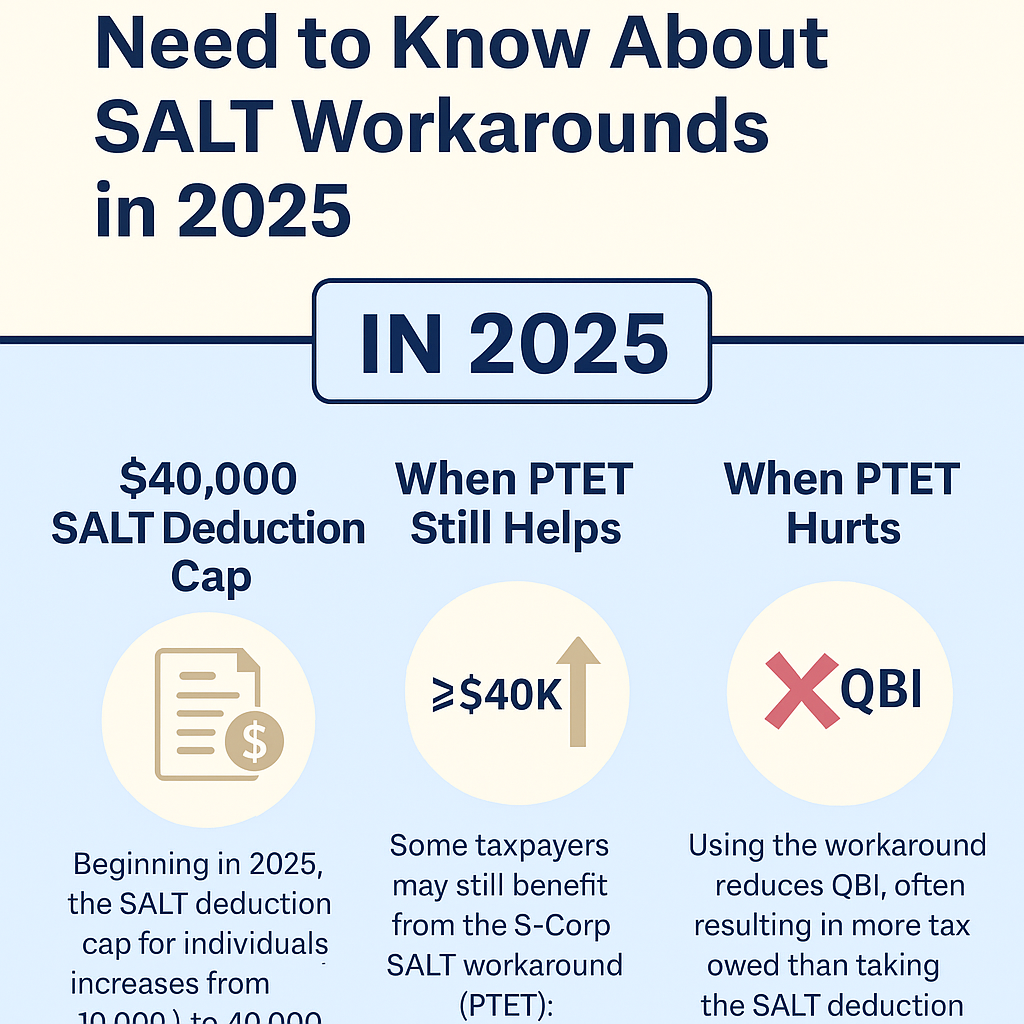
Updated for the 2025 increase of the SALT deduction cap from $10,000 to $40,000.
📌 Quick Summary

Starting in 2025, the federal SALT (State and Local Tax) deduction cap increases from $10,000 to $40,000. This is a major shift for S-Corp owners who used Utah’s PTET workaround to bypass the previous limit.

With a much higher personal deduction threshold, the PTET workaround becomes less necessary—but still strategically useful in certain cases.

This guide explains when Utah business owners should (and shouldn’t) continue using PTET in 2025.


1. What Is the SALT Workaround for S-Corporations?

During the years when federal SALT deductions were capped at $10,000, states (including Utah) created a workaround called:

Pass-Through Entity Tax (PTET)

This allows an S-Corp to pay the owner’s state income tax at the business level and deduct it as a business expense—avoiding the individual SALT cap.

Example under 2024 rules:

  • Utah tax: $15,000
  • Individual SALT limit: $10,000
  • PTET bypasses the cap
  • Entire $15K becomes a business deduction → reduces federal taxable income

This was an extremely valuable strategy for many small business owners.


2. What Changes in 2025?

Beginning January 1, 2025:

The SALT deduction cap increases from $10,000 to $40,000.

This means:

  • Most Utah S-Corp owners can now deduct a much larger portion of their state taxes personally
  • The PTET workaround becomes optional, not essential

Does PTET go away?

No — Utah still allows PTET.
But the math changes in 2025.

Now the question is:
Does the PTET deduction save more than the QBI deduction it reduces?

For many owners, the answer is no.


3. When PTET Still Makes Sense in 2025

Even with a $40,000 SALT deduction available personally, there are situations where PTET still produces better outcomes.

✔ 1. When your state tax exceeds $40,000

High-income earners may still benefit.

Example:

  • State tax owed: $62,000
  • Personal deduction cap: $40,000
  • Remaining $22,000 is nondeductible personally
  • But PTET allows the entire $62,000 to be deducted at the business level

This is still a major PTET advantage.


✔ 2. When you claim the standard deduction

If you do NOT itemize, personal SALT deductions are worthless.

In this case, PTET creates a new business deduction that would otherwise be lost.


✔ 3. When you want to reduce K-1 income

PTET lowers federal K-1 income, which can:

  • Reduce federal tax
  • Reduce 3.8% Net Investment Income Tax
  • Reduce phaseouts tied to AGI
  • Improve certain credit qualifications

This remains a planning tool, even in 2025.


4. When NOT to Use PTET in 2025

There are now more situations where PTET hurts more than it helps.

❌ 1. When PTET reduces your QBI deduction

Because:

  • PTET reduces K-1 income
  • Lower K-1 = lower QBI deduction (20%)

If lowering QBI costs more than the PTET deduction saves → PTET is a bad deal.

This will apply to many small and mid-sized Utah S-Corp owners.


❌ 2. When your Utah taxes fall under the new $40,000 SALT cap

If:

  • Your Utah tax < $40,000
  • You itemize deductions

Then you can deduct 100% of your state tax personally without reducing QBI.

PTET offers no advantage, and may reduce QBI unnecessarily.


❌ 3. When you already itemize (mortgage, charity, state tax)

If you are already itemizing, a larger SALT cap makes personal deduction more efficient than PTET.


5. Examples: PTET vs Personal SALT Deduction in 2025

📘 Example 1: PTET Helps

  • Utah tax: $55,000
  • Personal SALT cap: $40,000
  • $15,000 would be nondeductible personally
  • PTET allows full $55K deduction at entity level

PTET is the better option.


📕 Example 2: PTET Hurts

  • Utah tax: $18,000
  • Well under the $40K cap
  • Owner itemizes
  • K-1 income: $150,000
  • PTET would reduce K-1 → reduces QBI deduction by ~$3,600

Paying SALT personally is superior.


6. Strategic Recommendation for Utah S-Corp Owners in 2025

Recommended for MOST business owners in 2025:

✔ Pay your state tax personally
✔ Itemize and use the increased $40,000 SALT cap
✔ Preserve the full QBI deduction

Use PTET only when:

  • Your state tax exceeds $40K
  • You take the standard deduction
  • You must lower K-1/AGI for tax purposes
  • You’re subject to NIIT or phaseouts

7. Madsen & Company’s Advisory Approach

Because of the new SALT cap, PTET is no longer an automatic strategy.

We now run:

  • Side-by-side QBI comparisons
  • PTET vs personal SALT deduction analyses
  • Itemized vs standard deduction projections
  • Full 2025 tax strategy optimization

This ensures you choose the path that minimizes your total tax, not just one line item.


8. Final Takeaway

In 2024, PTET was usually the best choice.

In 2025, the increased SALT deduction changes everything.

For most Utah S-Corp owners, PTET will NOT be the best option in 2025.

But for high-income or high-tax situations, it can still be a powerful tool.

If you want a custom PTET vs SALT analysis for 2025, Madsen & Company can run the numbers and show the exact tax difference.

Filed Under: Business Tax Tagged With: s corp, tax

Mastering Business Budget Forecasting: A Key to Smarter Financial Planning

November 4, 2025 by admin

Budget forecasting is a vital tool in the arsenal of any successful business. It enables leaders to make informed decisions, anticipate financial outcomes, allocate resources wisely, and steer the company toward long-term sustainability. Whether you’re a startup planning your first fiscal year or an established enterprise aiming for growth, mastering budget forecasting can be the difference between thriving and merely surviving.

What Is Business Budget Forecasting?
Budget forecasting is the process of estimating your business’s future financial performance based on historical data, current trends, and projected growth. Unlike a static budget, which outlines planned expenses and revenues for a specific period, a forecast is a dynamic model that evolves with changing conditions.

Forecasts can be short-term (monthly or quarterly) or long-term (annual or multi-year), and they help businesses:

  • Anticipate revenue
  • Manage expenses
  • Adjust strategies in response to market shifts
  • Secure funding or loans
  • Evaluate the feasibility of new initiatives

Key Components of a Budget Forecast
To create an effective forecast, you need a clear picture of both your income and expenses. Here are the core elements:

1. Revenue Projections
Estimate how much income your business will generate from sales or services. Use:

  • Historical sales data
  • Market trends
  • Sales pipeline analysis
  • Seasonality and economic indicators

2. Cost of Goods Sold (COGS)
Estimate the direct costs associated with producing your goods or delivering services. This helps determine gross margin.

3. Operating Expenses
Include fixed and variable costs such as:

  • Rent and utilities
  • Salaries and benefits
  • Marketing and advertising
  • Software and subscriptions
  • Professional services

4. Capital Expenditures
Plan for one-time or infrequent purchases like equipment, vehicles, or property upgrades.

5. Cash Flow and Working Capital
Factor in when money actually moves in and out, not just when it’s earned or incurred. A budget forecast should align closely with your cash flow forecast.

Steps to Create a Budget Forecast
1. Review Past Financial Performance
Start with a detailed analysis of your historical financials. Identify revenue patterns, seasonal fluctuations, and fixed vs. variable costs.

2. Set Clear Objectives
Are you aiming to grow, cut costs, expand into new markets, or maintain stability? Your goals will shape your assumptions and priorities.

3. Make Assumptions
Forecasting relies on assumptions about pricing, customer growth, market demand, inflation, and costs. Be realistic—and document these assumptions clearly.

4. Build the Forecast
Use spreadsheet software or financial forecasting tools to project revenue and expenses over your chosen time frame. Consider creating multiple scenarios:

  • Best-case scenario: Optimistic growth, strong sales
  • Worst-case scenario: Market contraction, higher costs
  • Most likely scenario: A balanced, data-driven estimate

5. Monitor and Update Regularly
Business conditions change. A good forecast isn’t static—it should be reviewed monthly or quarterly and adjusted based on performance and new data.

Tools and Software for Forecasting
Manual spreadsheets work for small businesses, but as complexity grows, consider tools like:

  • QuickBooks, Xero – For basic budgeting and tracking
  • Float, Fathom, LivePlan – For forecasting and cash flow planning
  • Excel with custom templates – For more control and customization

Common Forecasting Mistakes to Avoid

  • Overestimating revenue: Be conservative and base estimates on solid data.
  • Underestimating expenses: Don’t forget hidden or irregular costs.
  • Ignoring market trends: Economic shifts, regulations, and competitor moves matter.
  • Failing to update: Outdated forecasts are useless. Regular reviews are essential.
  • Relying on one scenario: Always plan for contingencies.

The Strategic Value of Budget Forecasting
Beyond financial control, budget forecasting fosters strategic thinking. It encourages:

  • Data-driven decision-making
  • Agility in uncertain times
  • Improved investor confidence
  • Accountability across departments

It’s not just about numbers—it’s about being proactive, resilient, and competitive.

Final Thoughts
Budget forecasting is not a one-time task; it’s an ongoing discipline that should be baked into your business operations. By forecasting carefully, you can avoid surprises, seize opportunities, and lead with confidence.

Remember: A business without a forecast is like a ship without a compass. Chart your course, check it often, and be ready to adjust with the tides.

Filed Under: Business Best Practices

Primary Sidebar

Search

Archives

  • December 2025
  • November 2025
  • October 2025
  • September 2025
  • August 2025
  • July 2025
  • June 2025
  • May 2025
  • April 2025
  • March 2025
  • February 2025
  • January 2025
  • December 2024
  • November 2024
  • October 2024
  • September 2024
  • August 2024
  • July 2024
  • June 2024
  • May 2024
  • April 2024
  • March 2024
  • February 2024
  • January 2024
  • December 2023
  • November 2023
  • October 2023
  • September 2023
  • August 2023
  • July 2023
  • June 2023
  • May 2023
  • April 2023
  • March 2023
  • February 2023
  • January 2023
  • December 2022
  • November 2022
  • October 2022
  • September 2022

Categories

  • Business Best Practices
  • Business Tax
  • Estate and Trusts
  • Individual Tax
  • Investments
  • QuickBooks
  • Real Estate
  • Retirement

Copyright © 2025 · https://www.madsencpa.com/blog